


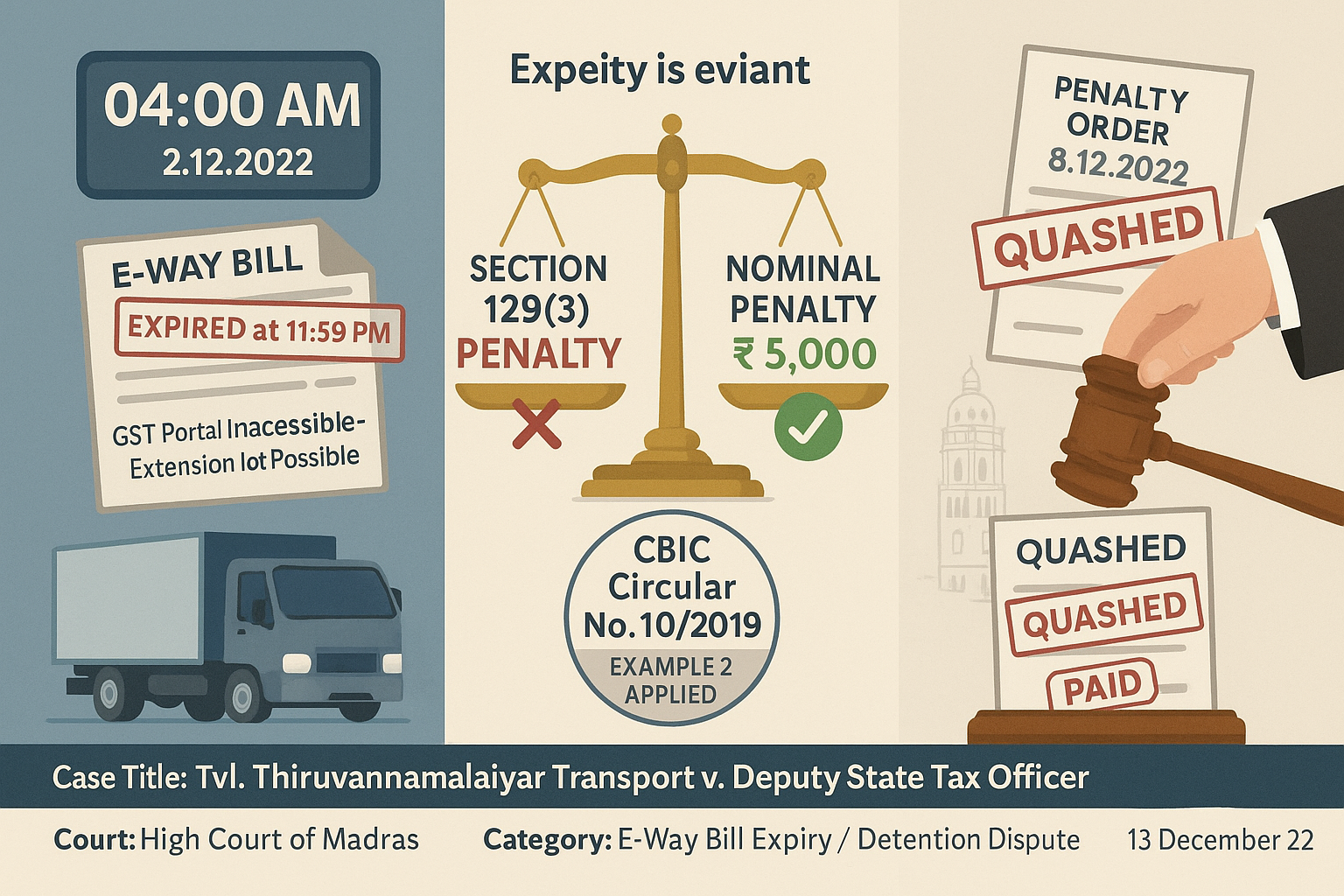
Case Title: Tvl. Thiruvannamalaiyar Transport v. Deputy State Tax Officer
Court: High Court of Madras
Petition Number: W.P. No. 32960 of 2022 with W.M.P. No. 32361 of 2022
Category of Dispute: Detention and Penalty – E-Way Bill Expiry
Date of Judgment: 13 December 2022
Relevant Sections: Section 129(3), 125 of CGST Act, Rule 138(10) of CGST Rules
Takeaway: Expiry Isn’t Evasion – Madras HC Limits Penalty for E-Way Lapse
Facts of the Case [¶4–7, ¶9]:
- The petitioner, a transporter, carried steel angles from Gummidipoondi to Ranipet in truck TN28-AQ-9203.
- The vehicle was intercepted at Walaja toll at 4:00 AM on 2.12.2022.
- The e-way bill had expired at 11:59 PM on 1.12.2022.
- The petitioner contended that as per Rule 138(10) of CGST Rules, there were still 4 hours left to extend the e-way bill but could not do so due to portal blockage post-detention.
- Penalty of ₹6,76,764 was imposed under Section 129(3).
Question(s) in Consideration [¶7]:
(a) Whether the truck breakdown and repair justified the delay?
(b) Whether the inability to extend the e-way bill due to GST portal blockage, though within permissible time, is a valid defence?
Observations of the Court:
- The order of 8.12.2022 (penalty imposition) was made while the case was under active consideration by the court [¶9].
- As per Circular No. 10/2019 dated 31.05.2019, if tax documents are available and no tax evasion is evident, only a nominal penalty up to ₹5,000 should be imposed [¶12–13].
- Example 2 in the circular directly applied – a case where goods were in transit but e-way bill had expired, yet there was no intent of evasion [¶13].
- The court emphasized that mere expiry of the e-way bill does not automatically indicate tax evasion, and hence, higher penalties are unwarranted [¶10–13].
Judgment of the Court [¶14–15]:
- Set aside both impugned orders dated 2.12.2022 and 8.12.2022.
- Directed the petitioner to pay ₹5,000 penalty as per Circular No. 10/2019.
- Ordered release of the detained truck and consignment immediately upon payment.
- Held that this ruling is specific to the facts of the case and shall not serve as precedent.
Between Fine Lines:
- The Court recognized procedural lapses without any mala fide intent or revenue loss.
- It held that e-way bill expiry alone, in absence of evasion, doesn’t justify severe penalty.
- Department circulars must guide penalty quantum, especially when basic documents are present.
- Transporters may seek relief even if owners do not challenge orders.
- Each case must be evaluated on its own factual background.
Summary of Referred Cases:
| Case Name | Citation | Summary | Verdict |
| Padma Sundara Rao v. State of TN | (2002) 3 SCC 533 | Courts must consider factual context before applying precedent; minor factual variations can alter outcome | Cited for judicial restraint in precedents |
| TCI Freight v. AC (ST), TN | W.P. Nos. 18753 of 2022 & batch | Held that owner should be petitioner where documents are absent or deficient | Distinguished on facts – not applicable here |

