
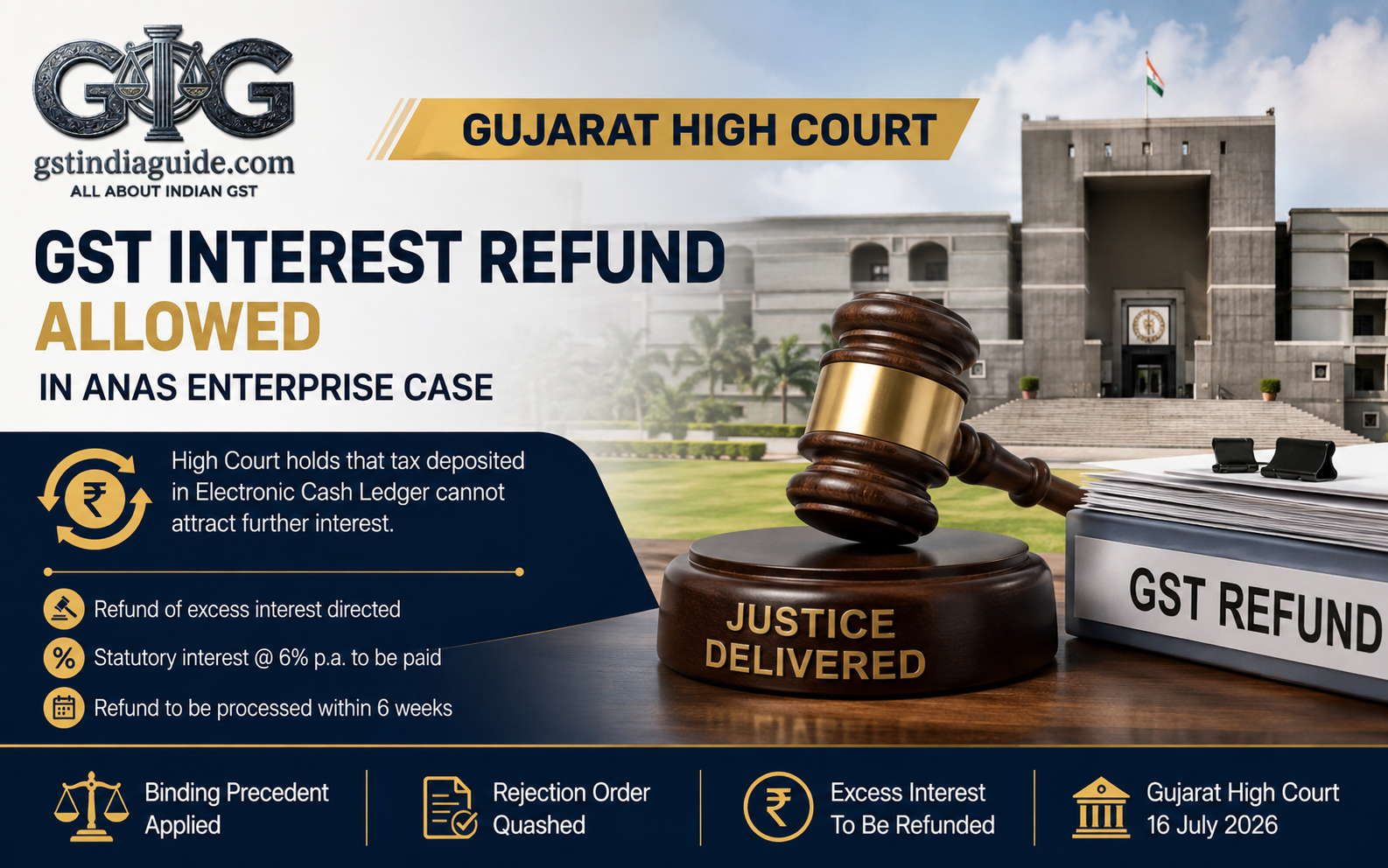
The Gujarat High Court, in Anas Enterprise v. Union of India & Anr., has set aside the rejection of a refund claim relating to excess interest paid under the Central Goods and Services Tax Act, 2017. The Court held that the tax authorities could not disregard the binding principle laid down in Arya Cotton Industries v. Union of India merely by asserting that the proviso subsequently inserted in Rule 88B of the Central Goods and Services Tax Rules, 2017 operated prospectively.
The judgment was delivered by a Division Bench comprising Justice A.S. Supehia and Justice Vaibhavi D. Nanavati on 16 July 2026 in R/Special Civil Application No. 11064 of 2025.
Background of the Dispute
The petitioner was engaged in the manufacture and sale of chewing tobacco. It had filed certain GST returns belatedly for the months of July to September 2017, June 2020 and March to June 2021. However, except for April 2021, the tax payable under those returns had already been deposited in the Electronic Cash Ledger before the respective due dates for filing the returns.
Following an audit objection, the petitioner paid interest through FORM GST DRC-03 on 1 June 2023. The department subsequently issued an advisory and a recovery notice demanding interest on the basis that the returns had been filed after the prescribed due dates.
The petitioner relied upon the Gujarat High Court’s earlier decision in Arya Cotton Industries, under which interest could be levied only up to the date on which the tax amount was deposited in the Electronic Cash Ledger. It accordingly filed an online refund application seeking repayment of the excess interest.
The refund application was nevertheless rejected through an order dated 17 June 2025 in FORM GST RFD-06. The authority reasoned that the proviso inserted in Rule 88B with effect from 10 July 2024 was prospective and could not govern the earlier tax periods.
Deposit in Electronic Cash Ledger Constitutes Payment for Interest Purposes
The High Court reiterated the principle laid down in Arya Cotton Industries that the amount deposited in the Electronic Cash Ledger is in the nature of tax lying to the credit of the taxpayer for discharge of the corresponding liability.
Once sufficient funds have been deposited in the Electronic Cash Ledger, the subsequent debit made while filing FORM GSTR-3B merely adjusts that amount against the tax liability disclosed in the return. Interest, being compensatory in nature, cannot continue to run after the Government has received the tax amount through the authorised banking system.
The Court observed that charging interest for the period between the deposit of tax in the Electronic Cash Ledger and the subsequent filing of the return would effectively convert a compensatory levy into a penalty.
Proviso to Rule 88B and the Arya Cotton Principle
The Court noted that the proviso to Rule 88B was inserted through Notification No. 12/2024 dated 10 July 2024 following the decision in Arya Cotton Industries and the recommendations made in the 53rd meeting of the GST Council.
Under the proviso, where an amount is credited to the Electronic Cash Ledger on or before the due date of filing the return and continues to remain in the ledger until it is debited while filing a delayed return, that amount is excluded while calculating interest.
The High Court held that the department had incorrectly treated the prospective operation of the proviso as a ground for refusing to apply the judicial principle already declared in Arya Cotton Industries. The petitioner’s case was admittedly covered by that judgment independently of the subsequent amendment to Rule 88B.
Rejection of Refund Termed Arbitrary
The Court described the department’s approach as a “classic case of selective denial”. While the authorities did not dispute that the ratio of Arya Cotton Industries applied to the petitioner’s claim, they still rejected the refund application by relying upon their understanding that the proviso to Rule 88B was prospective.
The Court held that the refund application ought to have been examined in accordance with the binding judgment. The rejection order was found to be arbitrary and to suffer from complete non-application of mind.
High Court’s Directions
The Gujarat High Court quashed the refund rejection order dated 17 June 2025 as well as the recovery notice dated 17 January 2025.
The respondents were directed to grant the refund of the excess interest paid by the petitioner in accordance with its refund application, together with statutory interest at 6% per annum.
The refund was required to be processed within six weeks. In the event of delay beyond that period, the amount would carry further interest at 12% per annum for each week of delay. The Court also imposed costs of ₹5,000 on the respondent, to be deposited with the Registry within one week from receipt of the judgment.
Significance of the Judgment
The judgment reinforces that interest under Section 50 of the CGST Act is compensatory and cannot be demanded for a period during which the relevant tax amount was already available with the Government in the taxpayer’s Electronic Cash Ledger.
It also makes clear that a tax authority cannot avoid applying a binding judicial precedent by relying on the prospective date of a later rule amendment that incorporates the same legal principle. Refund claims involving interest paid for the period after deposit in the Electronic Cash Ledger must therefore be examined in light of the actual date on which the Government received the tax amount.