
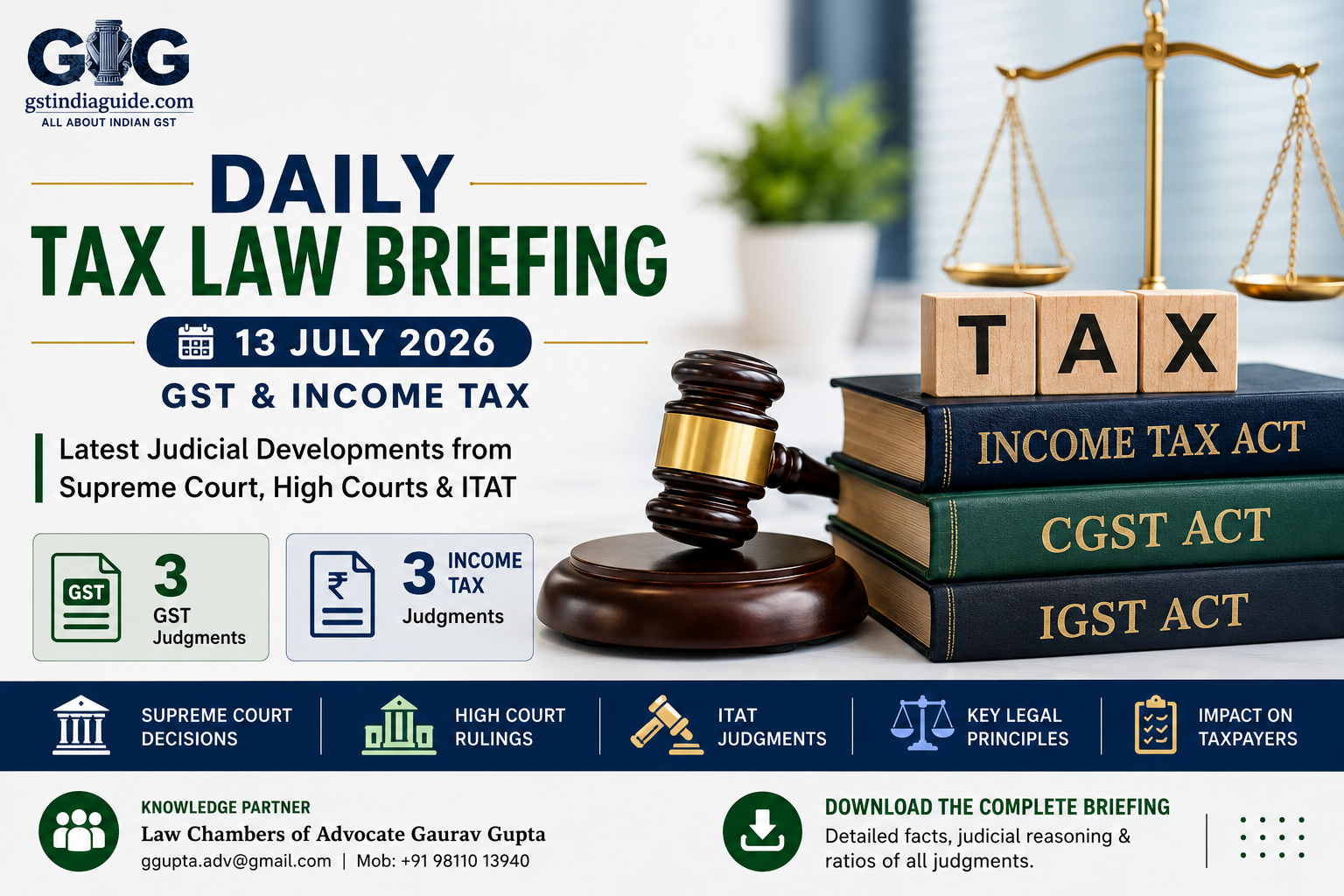
Daily Tax Law Briefing – GST & Income Tax | 13 July 2026
The Daily Tax Law Briefing – 13 July 2026 brings together the latest judicial developments under the Goods and Services Tax (GST) and the Income-tax Act that are relevant for tax professionals, advocates, chartered accountants, businesses and corporate tax teams. This edition highlights important decisions of the Supreme Court of India, Delhi High Court, Madras High Court, Calcutta High Court and the Income Tax Appellate Tribunal, covering significant issues relating to GST enforcement, writ jurisdiction, reassessment proceedings, limitation, GST refunds and appellate remedies.
On the GST front, this briefing analyses three significant rulings. The Supreme Court has reaffirmed the constitutional validity of Section 69 of the CGST Act relating to arrest powers by following its earlier three-Judge Bench decision in Radhika Agarwal. The Delhi High Court has reiterated that where an effective statutory appellate remedy exists under Section 107 of the CGST Act, writ jurisdiction under Article 226 will ordinarily not be exercised for disputes involving questions of fact, alleged procedural violations or merits of adjudication. The Madras High Court has also clarified that challenges to show cause notices issued under Section 74 should ordinarily be raised before the adjudicating authority, particularly where disputed factual issues are involved, and that limitation and jurisdictional objections can appropriately be examined during adjudication.
The Income Tax section covers three noteworthy decisions dealing with reassessment proceedings, rectification orders and GST refund taxation. The Calcutta High Court has reaffirmed that reassessment proceedings initiated against a deceased person are void in law. The Delhi Bench of the ITAT has held that a rectification order under Section 154 cannot survive once the original assessment has been quashed, while also restricting reopening directions beyond statutory authority. The Bangalore Bench of the ITAT has clarified that where an assessee follows the exclusive method of accounting, a GST refund merely representing recovery of an asset already reflected as receivable does not constitute taxable income unless the corresponding GST had earlier been claimed as expenditure.
This edition serves as a practical resource for professionals seeking concise updates on evolving judicial principles relating to GST litigation, writ jurisdiction, appellate procedure, reassessment proceedings, rectification, GST refunds and income-tax assessments. The summaries provide quick insights into the legal ratios while enabling readers to identify decisions that may have practical implications for ongoing litigation and tax advisory work.