
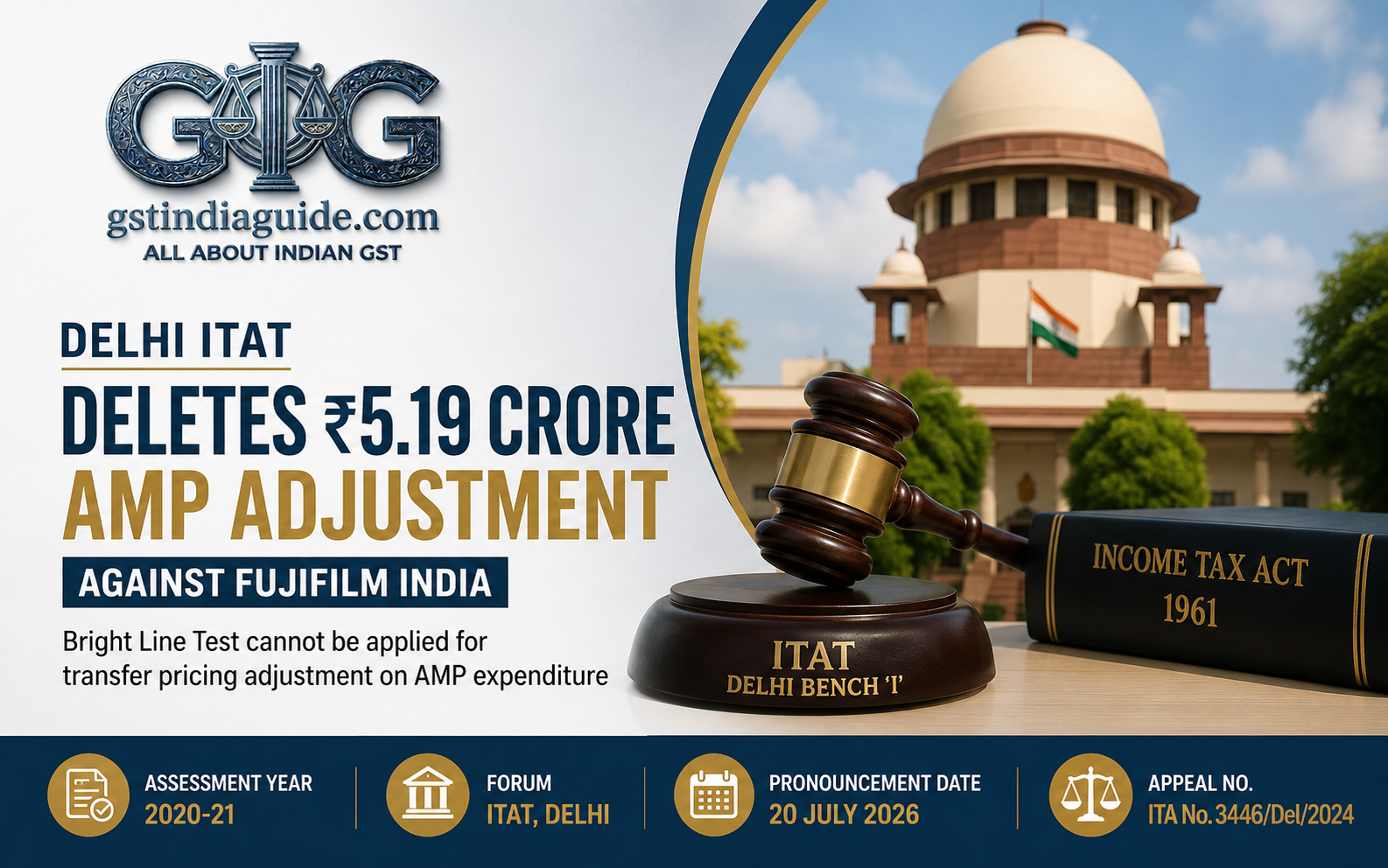
The Income Tax Appellate Tribunal, Delhi Bench, has deleted a transfer pricing adjustment of ₹5.19 crore made against Fujifilm India Private Limited in relation to advertising, marketing and promotion expenditure. The adjustment had been sustained by applying the Bright Line Test to determine the alleged non-routine portion of the company’s AMP expenditure.
Fujifilm India is engaged in trading various products, including medical imaging equipment, photo-imaging products, digital cameras, graphic arts products, data-storage solutions and industrial products. The company purchased goods from its associated enterprises for resale in India.
For Assessment Year 2020–21, the assessee filed its return declaring an income of ₹51,29,52,500 and reported its international transactions in Form 3CEB. Since transactions had been undertaken with associated enterprises, the Assessing Officer referred the matter to the Transfer Pricing Officer for determination of the arm’s length price.
Transfer Pricing Adjustment on AMP Expenditure
The Transfer Pricing Officer observed that Fujifilm India had incurred expenditure on advertising, marketing and promotion of the “Fuji” brand, which was owned by its foreign parent enterprise. According to the TPO, the AMP expenditure resulted in brand-building benefits for the foreign associated enterprise and should, therefore, have been compensated.
The TPO treated the AMP expenditure as an international transaction and applied the Bright Line Test by comparing the assessee’s AMP-to-sales ratio with that of comparable companies. The expenditure incurred beyond the alleged bright line was treated as having been incurred for the benefit of the foreign brand owner.
Initially, a protective adjustment of ₹12.00 crore was proposed by applying the Bright Line Test. A substantive adjustment was also proposed under the intensity method. Following directions issued by the Dispute Resolution Panel, the adjustment based on the Bright Line Test was ultimately reduced to ₹5.19 crore, while the adjustment under the intensity method was reduced to nil.
The Assessing Officer thereafter passed the final assessment order under Sections 144, 144C(13) and 144B of the Income-tax Act, incorporating the ₹5.19 crore adjustment.
Assessee Challenges the Bright Line Test
Before the Tribunal, Fujifilm India argued that the Bright Line Test had already been rejected by the Delhi High Court in Sony Ericsson Mobile Communications India Private Limited. Therefore, the transfer pricing adjustment made solely by applying that test was contrary to the binding judgment of the jurisdictional High Court.
The assessee also relied upon the Delhi High Court’s decision in DCIT v. Casio India Company, where an AMP adjustment based upon the Bright Line Test had been deleted by following the ruling in Sony Ericsson.
The Revenue submitted that AMP expenditure constituted an international transaction and stated that its special leave petition against the Delhi High Court’s judgment in Sony Ericsson was pending before the Supreme Court. However, the Revenue could not produce any stay of the High Court’s judgment or any contrary decision of a superior court.
Tribunal Rejects AMP Adjustment Based on Bright Line Test
The Tribunal observed that the entire adjustment of ₹5.19 crore had been computed by applying the Bright Line Test to the assessee’s AMP expenditure. The alleged excess AMP expenditure, compared with that incurred by comparable companies, had been treated as expenditure incurred for building the “Fuji” brand owned by the assessee’s foreign parent.
The Tribunal noted that the Delhi High Court had rejected the Bright Line Test as a method for determining transfer pricing adjustments in respect of AMP expenditure. Although the Revenue’s special leave petition against that judgment was pending before the Supreme Court, no stay had been granted against the operation of the Delhi High Court’s ruling.
In the absence of any contrary judgment or stay order, the Tribunal held that it was bound to follow the decision of the jurisdictional High Court.
Accordingly, the Tribunal deleted the transfer pricing addition of ₹5.19 crore made by applying the Bright Line Test. It nevertheless directed that both parties would remain bound by the eventual outcome of the Revenue’s pending special leave petition before the Supreme Court.
Other Grounds of Appeal
Since the AMP adjustment was deleted by following the Delhi High Court’s judgment, the Tribunal kept the assessee’s other connected grounds open.
The assessee did not press its ground challenging the existence of an international transaction in relation to AMP expenditure. That ground was therefore dismissed as not pressed. The ground concerning initiation of penalty proceedings under Section 271AA was also dismissed as premature.
The appeal was consequently partly allowed.
Legal Principle Emerging from the Decision
The ruling reiterates that a transfer pricing adjustment for AMP expenditure cannot be sustained merely by applying the Bright Line Test when the jurisdictional High Court has already rejected that methodology.
The pendency of a special leave petition before the Supreme Court does not, by itself, suspend the binding effect of a High Court judgment. Unless the operation of the judgment is stayed or a contrary decision is rendered by a superior court, subordinate authorities and tribunals within the jurisdiction must follow the applicable High Court precedent.
This decision is relevant for multinational enterprises facing transfer pricing adjustments on AMP expenditure, particularly where such adjustments are computed by separating alleged routine and non-routine expenditure through the Bright Line Test.