


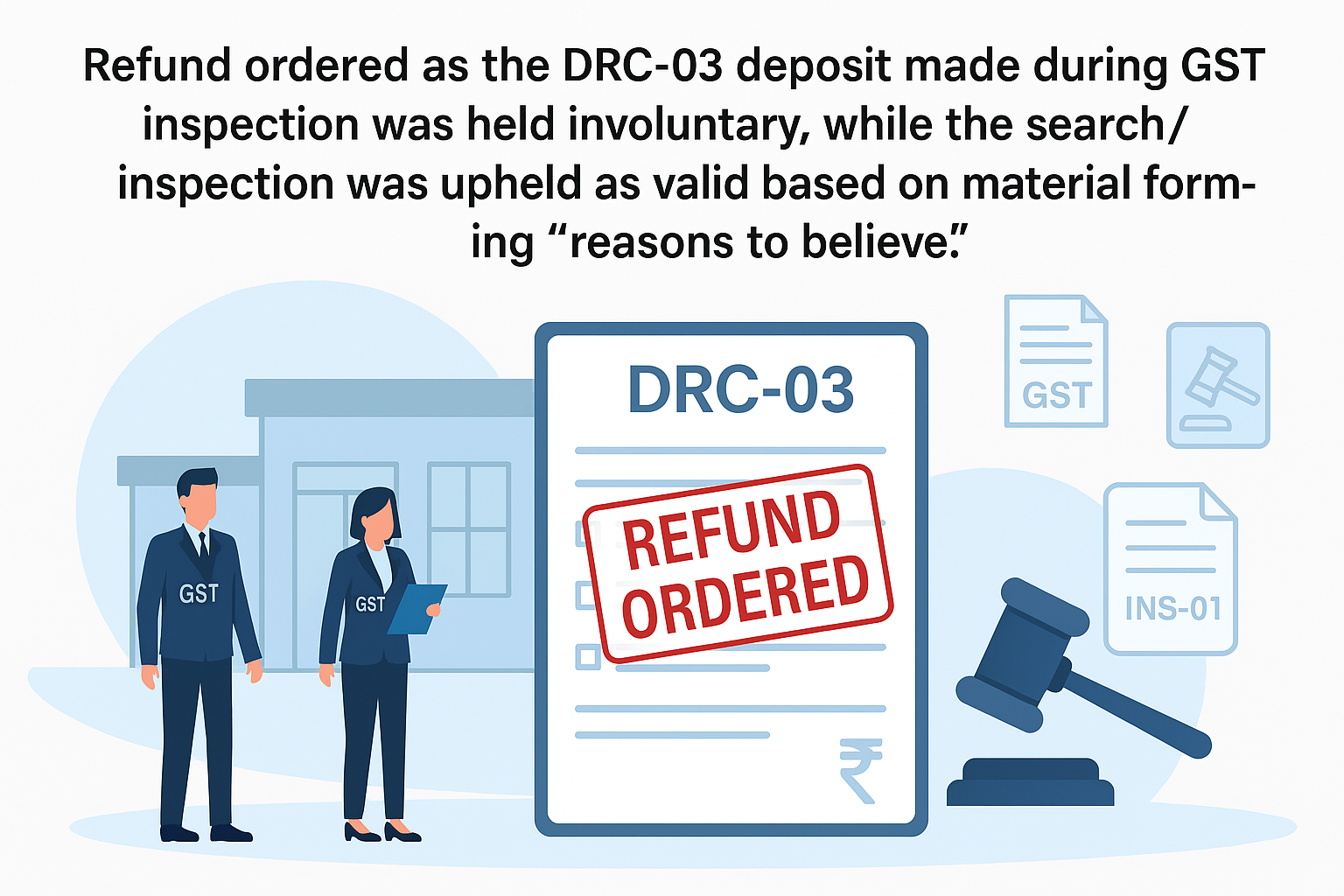
Santosh Kumar Gupta Prop. Mahan Polymers v. Union of India & Ors., Delhi High Court, W.P.(C) 16365/2022, Judgment dated 05.12.2023
Category: Search under Section 67, Refund of coerced DRC-03 payment
Sections Involved: Sections 67, 6(2)(b), 70, 73/74, 83 of CGST Act; Rule 86A of CGST Rules
Facts of the Case (Paras 1–9, 17–20)
The petitioner, a sole proprietor of M/s Mahan Polymers dealing in PVC resins, was registered under the CGST Act and allocated GSTIN 07AAPPG5295A1ZP . On 12.11.2022, officers from the Anti-Evasion Branch, CGST, visited the petitioner’s business premises pursuant to authorisation in FORM GST INS-01 dated 11.11.2022, claiming to act under Section 67(1). The petitioner alleged that officers compelled him to deposit ₹10,00,000 (₹5 lakh CGST + ₹5 lakh DGST) by forcibly generating DRC-03 on the officers’ laptop at around 9 PM, and that his statement was recorded without copy or punchnama being supplied .
The petitioner contended that he was threatened based on alleged inadmissible ITC from M/s Hari Om Chemicals and that the search was illegal because DGST authorities had already conducted a prior search on 18.10.2022, thereby attracting the bar under Section 6(2)(b). A retraction letter dated 14.11.2022 was issued immediately after the visit, asserting coercion and requesting refund of the forced deposit.
The respondents stated that the premises were found closed and the petitioner voluntarily joined inspection and agreed to furnish documents later. They asserted that no statement was recorded, no search was conducted, and the amount paid was voluntary. They further recorded that the petitioner had availed ₹47,38,189/- ITC from a supplier (Hari Om Chemicals) found to be non-existent, and a total of ₹3.24 crores ITC from 19 cancelled suppliers, forming part of a larger investigation into fake-invoice entities .
Questions / Issues for Determination
-
Whether the inspection/search conducted under Section 67(1) was illegal for want of “reasons to believe”, or barred by Section 6(2)(b) due to parallel DGST proceedings.
-
Whether the deposit of ₹10,00,000/- through DRC-03 during the inspection was voluntary or coerced, and whether the Court should order refund.
-
Whether the petitioner was entitled to copies of INS-01, statement, and punchnama.
Observations of the Court (Paras 10–16, 17–25)
On Reasons to Believe (Section 67)
The Court emphasised that the phrase “reasons to believe” requires existence of tangible material, not mere suspicion, relying on Calcutta Discount Co. (1961) and Lakhmani Mewal Das (1976) . The information that the petitioner availed ITC from a supplier found non-existent had a live nexus with forming belief of wrongful ITC availment (para 15).
The sufficiency of reasons is not justiciable so long as there is rational material (para 13).
On Section 6(2)(b) – Cross-Empowerment
The Court held that Section 6(2)(b) does not bar central authorities from conducting inspection in continuation of their own investigation merely because DGST authorities had previously conducted a search (para 22). Thus, central officers’ actions did not violate the bar on parallel proceedings.
On Search / Statement
Respondents asserted no statement was recorded and no goods were seized. Since the petitioner did not dispute absence of seizure, no direction for supplying punchnama or statement was required (paras 17–18, 23).
On Coercive DRC-03 Payment
The Court relied on Vallabh Textiles (2022) and Lovelesh Singhal (2023) and held that payments made during inspection hours, followed by immediate retraction, and submitted through officers’ laptops indicate absence of free consent (paras 24–25). The petitioner sent a retraction within two days and filed the writ within ten days, showing absence of voluntariness (para 25).
Thus, the deposit was held involuntary and required to be refunded.
Judgment / Ratio Decidendi (Paras 16, 22, 26–27)
The Court upheld the validity of the inspection under Section 67, holding that there existed adequate material (non-existent supplier and suspected bogus ITC chain) establishing “reasons to believe”. It rejected the challenge to search on the ground of Section 6(2)(b).
However, it held that the DRC-03 deposit of ₹10,00,000/- was not voluntary and was made during inspection hours under implied coercion. Given the quick retraction and use of officers’ devices for payment, the Court directed refund of ₹10,00,000/- to the petitioner.
The order clarified that the refund does not restrict authorities from exercising powers under Sections 83 or Rule 86A in future based on satisfaction of statutory conditions (para 26).
Case Law Referred – Summary Table
| Case | Brief Issue | Verdict / Principle |
|---|---|---|
| Calcutta Discount Co. Ltd. v. ITO (1961) | Interpretation of “reason to believe” | Requires rational material; belief must be bona fide, not a pretence. |
| Lakhmani Mewal Das (1976) | “Reason to believe” nexus test | There must be a live link between material and the belief. |
| Vallabh Textiles v. SIO (2022) | Coercive payments during search | DRC-03 deposits made during raids are not voluntary; must be refunded. |
| Lovelesh Singhal v. DGST (2023) | Coercion during investigation | Payments made while officers are present are treated as involuntary. |
Between Fine Lines – Practical Takeaways for Industry
This judgment reinforces that Section 67 inspections will not be struck down where authorities possess even preliminary material linking a taxpayer to non-existent suppliers. However, any monetary deposit extracted during inspection hours—especially through officers’ devices and immediately retracted—is treated as coerced, and taxpayers are entitled to full refund. Businesses must immediately issue written retractions of DRC-03 payments made under pressure to preserve their rights, while maintaining documentary trail for subsequent adjudication under Sections 73/74.
Disclaimer – “The above summary is for academic purpose only; not formal legal opinion. Seek professional opinion before application. Author or publisher or website shall not be responsible for any usage in any form.”

