

1. Taxability & Valuation Clarifications
-
The Council decided that standalone restaurants cannot declare themselves as “specified premises.” Accordingly, they cannot opt to pay GST at 18% with input tax credit (ITC). They will continue under the standard composition for restaurants.
-
Amendments to GST Valuation Rules have been recommended to align with the revised framework for lottery taxation.
Significance:
This removes ambiguity in restaurant taxation and prevents misuse of the 18%+ITC option. The valuation rule changes ensure consistency in treatment of lottery supplies, avoiding litigation on valuation bases.
2. Treatment of Sin Goods – RSP-based Taxation
-
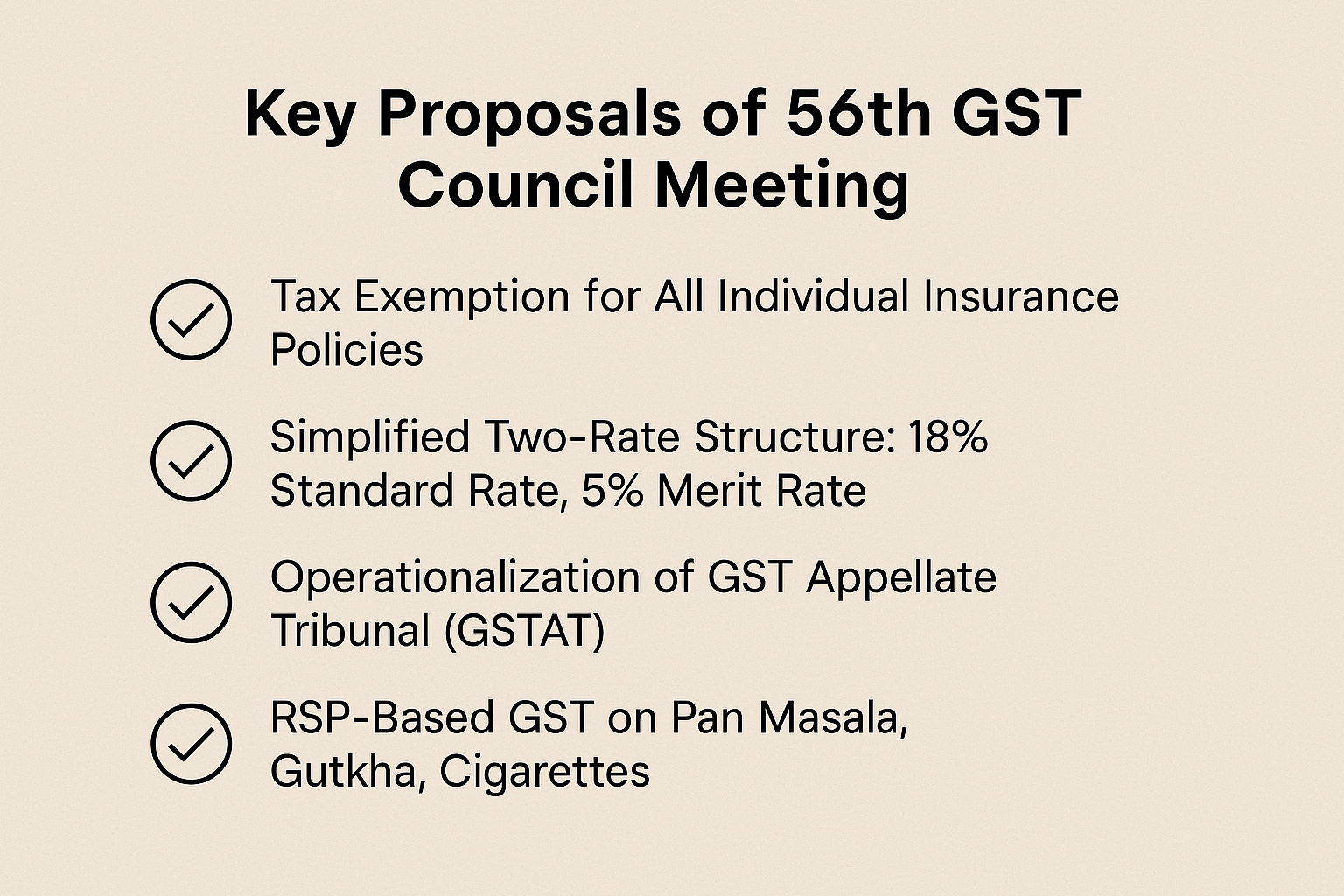
For pan masala, gutkha, cigarettes, bidis, and other tobacco products, GST will now be levied on the Retail Sale Price (RSP) instead of transaction value.
Significance:
This shift closes loopholes where undervaluation was adopted at the manufacturer or wholesale stage, ensuring that actual retail value forms the tax base. It enhances revenue protection and prevents leakage in high-risk commodities.
3. Exemptions for Constitutional Authorities
-
Ad hoc IGST and Compensation Cess exemption has been granted on the import of a new armoured sedan car by the President’s Secretariat for the President of India.
Significance:
A measure of constitutional propriety, reflecting the GST Council’s authority to provide case-specific exemptions in the national interest.
4. Refund Reforms – Inverted Duty Structure
-
Pending legislative amendments to the CGST Act, the Council authorised the CBIC to administratively operationalise 90% provisional refunds in cases of inverted duty structure.
-
This will be processed through risk-based data analysis, similar to the mechanism already adopted for zero-rated supplies.
Significance:
This is a pragmatic move to relieve working capital blockages faced by industries such as textiles and fertilisers, where refund delays often lead to liquidity crises.
5. Operationalisation of GSTAT
-
The Goods and Services Tax Appellate Tribunal (GSTAT) will be made functional for accepting appeals by end of September 2025, with hearings commencing by December 2025.
-
A limitation cut-off of 30th June 2026 has been provided for filing backlog appeals.
-
The Principal Bench will also function as the National Appellate Authority for Advance Ruling (NAAAR).
Significance:
This institutional reform addresses a long-standing lacuna in GST dispute resolution. Taxpayers have been compelled to approach High Courts due to the absence of a tribunal. With GSTAT operational, there will be consistency in rulings, reduced burden on constitutional courts, and greater certainty for businesses.
6. Process Reforms for Trade Facilitation
The Council approved a set of procedural reforms (listed in Annexure-V of the press release), to be notified later. While details remain awaited, these will address:
-
Simplification of compliance processes.
-
Streamlining filing and assessment mechanisms.
-
Enhancing the risk-based scrutiny framework.
Significance:
These changes are expected to reduce compliance costs, mitigate harassment, and improve ease of doing business under GST.
Key Announcements in Rate changes
1. Exemptions on Insurance
-
GST exemption on all individual life insurance policies (term, ULIP, endowment).
-
GST exemption on all individual health insurance policies, including family floater and senior citizen policies.
-
Reinsurance of these policies also exempt.
Impact: Increased affordability and wider insurance coverage across India.
2. Simplified GST Rate Structure
-
Standard Rate: 18%
-
Merit Rate: 5%
-
De-merit Rate: 40% (for select goods like tobacco & luxury items)
Impact: Greater transparency, fewer disputes, and simpler compliance.
3. Daily Use Goods
GST reduced to 5% on household essentials including hair oil, soap, shampoos, toothpaste, toothbrushes, bicycles, tableware, and kitchenware.
Impact: Direct relief to households and common man.
4. Food Products
-
NIL GST: UHT milk, paneer, chapati, roti, paratha, parotta.
-
5% GST: Packaged namkeens, noodles, chocolates, sauces, coffee, ghee, butter, cornflakes.
Impact: Wider affordability, supporting rural and urban consumers.
5. Agriculture & Labour-Intensive Sectors
-
Tractors, harvesting machinery, horticultural/forestry machinery – 12% → 5%.
-
Handicrafts, marble, granite blocks, leather goods – 12% → 5%.
Impact: Support to farmers, artisans, and small-scale industries.
6. Cement and Automobiles
-
Cement – 28% → 18%.
-
Small cars, motorcycles ≤350cc, buses, trucks, ambulances – 28% → 18%.
-
Uniform 18% on all auto parts.
Impact: Reduced cost of construction and auto ownership, encouraging demand.
7. Healthcare Relief
-
33 lifesaving drugs – 12% → NIL.
-
3 cancer/rare disease drugs – 5% → NIL.
-
All other medicines – 12% → 5%.
-
Medical devices, diagnostic kits – 12%/18% → 5%.
Impact: Affordable treatment and better healthcare access.
8. Correction of Inverted Duty Structures
-
Manmade textiles: fibre 18% → 5%; yarn 12% → 5%.
-
Fertilisers: sulphuric acid, nitric acid, ammonia 18% → 5%.
Impact: Working capital relief and reduced refund disputes.
9. Renewable Energy, Hospitality & Wellness
-
Renewable energy devices – 12% → 5%.
-
Hotel accommodation ≤₹7,500/day – 12% → 5%.
-
Beauty & wellness services (gyms, salons, yoga centres) – 18% → 5%.
Impact: Encourages green energy, tourism, and wellness industries.
10. Other Notable Changes
-
GST on tobacco, pan masala, gutkha, cigarettes to be levied on Retail Sale Price (RSP) instead of transaction value.
-
Clarification: Standalone restaurants cannot declare as “specified premises” to avail 18% with ITC.
-
Exemption for import of new armoured car for the President of India.
11. Implementation Timeline
-
Services – New rates effective 22nd September 2025.
-
Goods (except tobacco) – Effective 22nd September 2025.
-
Tobacco products – Existing rates continue till compensation cess obligations are discharged.
The above compilation is made for educational purpose only. Please refer to the original press release before relying on any information. Click here for original press release content.

 introduced major tariff and non tariff reforms: GSTAT setup, RSP-based tax on tobacco, refund reforms & compliance simplification.)