
ion, Urban Ladder Home Decor Solutions (P.) Ltd., Telstra Singapore Pte. Ltd., Asia Satellite Telecommunications Co. Ltd. and New Skies Satellite BV.
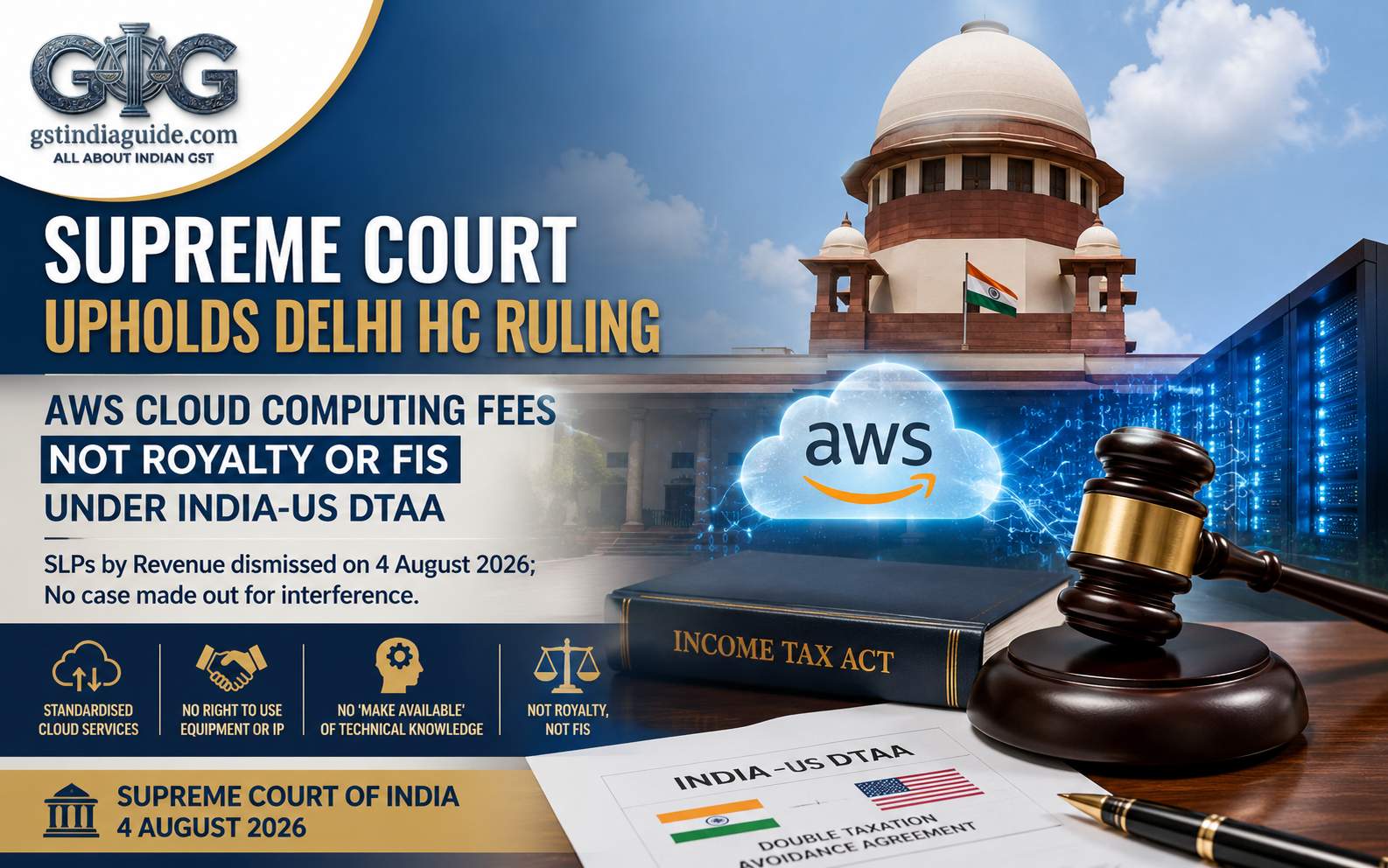
The Court concluded that AWS customers merely access standard automated cloud computing services and neither obtain commercially exploitable intellectual property rights nor a right to use AWS equipment in the sense contemplated by the DTAA.
Supreme Court Dismisses Revenue’s SLP
The Revenue challenged the Delhi High Court judgment before the Supreme Court through Special Leave Petition (Civil) No. 17045/2026 along with the connected matter.
On 4 August 2026, the Supreme Court, comprising Justice J.B. Pardiwala and Justice K. Vinod Chandran, heard the parties and held that no case was made out for interference with the judgments and orders of the Delhi High Court. The Special Leave Petitions were accordingly dismissed.
Key Legal Takeaway
The decision reinforces the distinction between using a technology-enabled service and acquiring a right to use the underlying equipment, copyright or intellectual property. Standardised cloud computing services, where customers merely access computing capacity, storage and related facilities without obtaining control over the infrastructure or commercially exploitable rights in the provider’s intellectual property, do not become royalty merely because sophisticated hardware and software are involved.
Further, technical support accompanying such services does not constitute FIS under the India-US DTAA unless the service provider makes available technical knowledge, experience, skill, know-how or processes that enable the customer to independently apply the technology.
The Supreme Court’s dismissal of the Revenue’s SLP leaves the Delhi High Court’s ruling in favour of Amazon Web Services undisturbed.