Case Summary: Sahil Jain v. DGGI — Delhi High Court — W.P.(C) 14140/2023 — Order dated 31.10.2023
Category: Coercive recovery / Summons / Voluntary deposit
Relevant Provisions: Sections 73, 74 & 79 of the CGST Act, 2017
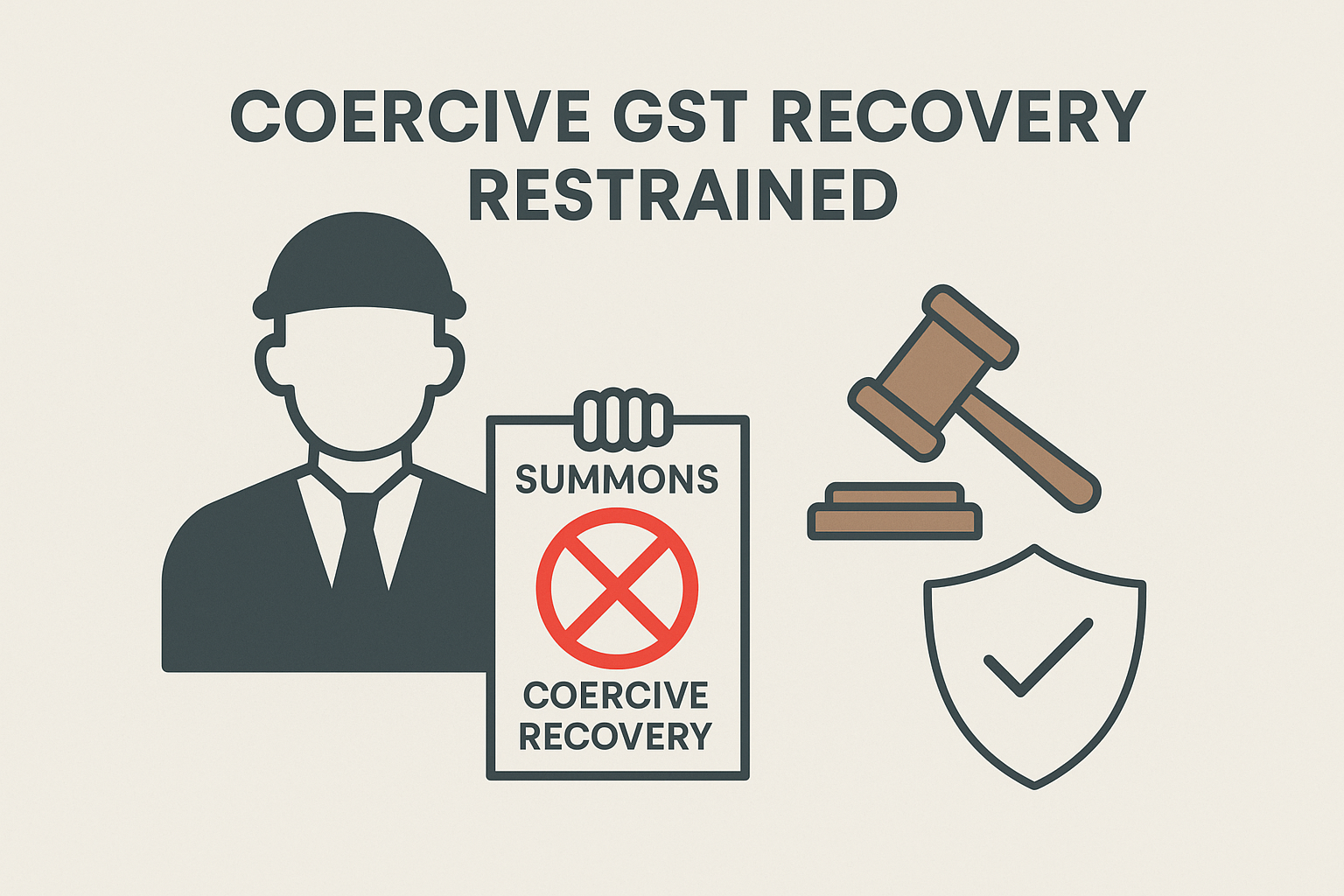
Coercive GST recovery restrained as Court holds that no tax can be compelled without due process under Sections 73/74/79 of the CGST Act
Facts (Paras 1–3)
The petitioner challenged the summons dated 18.10.2023 issued by the Directorate General of GST Intelligence, alleging that the said summons were being used as a tool for coercive recovery. It was asserted that he and the co-director of M/s Avik Televentures Pvt. Ltd. were repeatedly threatened with arrest and compelled to deposit ₹1 crore even though no show cause notice had been issued and no tax liability had been determined. The petitioner prayed for quashing of summons, protection from coercive action, compliance with natural justice, and permission for presence of counsel during investigation. The Court noted that although allegations of coercive recovery were made, there was no prayer for refund of the allegedly forced deposit, and further, the amount was not deposited by the petitioner but by another director, hence the Court could not adjudicate that specific issue.
Questions Before the Court
-
Whether the DGGI could issue summons and exert pressure to extract tax without issuance of SCN under Sections 73/74 of the CGST Act.
-
Whether coercive recovery could be initiated without any adjudication or determination under law.
-
Whether the petitioner could be protected from any compulsion to deposit tax during investigation.
-
Whether the presence of a lawyer during summons proceedings could be directed.
Observations (Paras 4–6)
The Court recorded the respondent’s categorical statement that no tax shall be compelled from the petitioner, and that if the petitioner expressly does not wish to voluntarily deposit tax, no officer can demand or accept any tax without following statutory procedure. It was reiterated that determination of tax liability must occur strictly under Sections 74 and 79, and any deviation from statutory process would be impermissible. The Court further held that since voluntariness was expressly denied, acceptance of any payment without adjudication stood prohibited. If the petitioner wished to deposit tax voluntarily, such deposit must only be made with prior permission of the Court so that no allegation of coercion can arise.
Judgment (Paras 5–7)
The High Court disposed of the writ petition with a clear direction restraining DGGI from accepting any tax amount from the petitioner in view of his unequivocal assertion that the deposit is not voluntary. The Court held that no amount of tax can be compelled from the petitioner in the absence of proceedings under Sections 73, 74 or recovery under Section 79, thereby protecting the petitioner from any coercive recovery. It further held that any voluntary deposit, if desired in future, must be done only after obtaining leave of the Court.
Table: Cases Referred (with Summary & Verdict)
| Case Name | Summary | Verdict / Principle Laid Down |
|---|---|---|
| No external cases referred in this judgment | — | — |
Between Fine Lines (Trade/Industry Takeaway)
This order reinforces that no GST officer, including DGGI, can compel payment of tax without issuing a proper show cause notice and determining liability under Sections 73 or 74. Summons cannot be used as a coercive tool, and any deposit must be purely voluntary. Businesses facing investigations may rely on this precedent to resist forced recoveries during inquiry proceedings.
Disclaimer – “The above summary is for academic purpose only; not formal legal opinion. Seek professional opinion before application. Author or publisher or website shall not be responsible for any usage in any form.”