


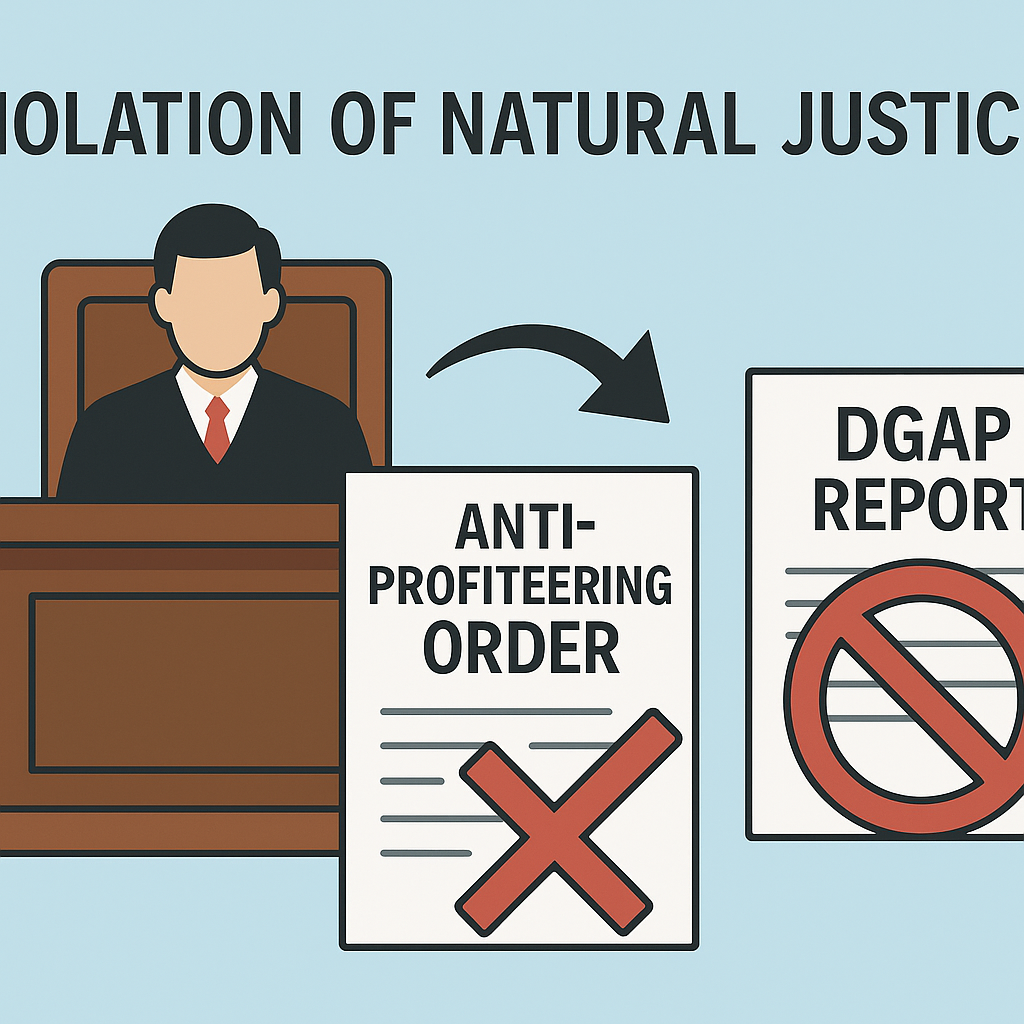
Case Summary – E-Homes Infrastructure Pvt. Ltd. v. Competition Commission of India
W.P.(C) 11932/2023 | Delhi High Court | Anti-Profiteering | Section 171 CGST Act | Judgment dated 12.09.2023**
Facts of the Case (Paras 1–4)
The petitioner, M/s E-Homes Infrastructure Pvt. Ltd., challenged before the Delhi High Court the order dated 17.08.2023 passed by the Competition Commission of India functioning as the National Anti-Profiteering Authority (NAA) under Section 171 of the CGST Act, 2017. The grievance was that the DGAP’s investigation reports, which formed the foundation of the impugned order, were never furnished to the petitioner. This prevented the petitioner from rebutting the findings and violated the audi alteram partem rule.
The petitioner further asserted that the impugned order included a direction relating to a second real-estate project for which no complaint had ever been filed, thereby exceeding jurisdiction. The respondents contended that no prejudice was caused because the order was “favourable” and largely remanded the matter to DGAP.
Questions / Issues (Paras 2, 4–6)
-
Whether the NAA could pass directions based on DGAP reports without supplying those reports to the petitioner, thereby violating the principles of natural justice?
-
Whether the Authority possessed jurisdiction under Rule 133(5)(a) of the CGST Rules to expand the enquiry to a separate project not forming part of the original complaint?
-
Whether a remand order, even if not finally adverse, could still prejudice the assessee if it is founded on material not shared with the assessee?
Court’s Observations (Paras 7–9)
The Court unequivocally held that the DGAP reports were admittedly not furnished to the petitioner. Since the reports contained material adverse findings, the petitioner had no opportunity to offer rebuttal or explanation. This procedural lapse vitiated the entire proceeding.
The Court rejected the respondent’s argument that the order was “in favour” of the petitioner. It clarified that had it actually been favourable, the proceedings would have been closed. Instead, the Authority considered the undisclosed DGAP reports and directed further verification/investigation, meaning the findings were relied upon without the petitioner’s participation.
Consequently, the Court held that principles of natural justice are not contingent upon the final outcome; rather, they apply whenever material adverse to a party is considered behind its back.
Judgment / Verdict (Paras 9–12)
The Delhi High Court set aside the NAA’s order dated 17.08.2023 for being passed in breach of natural justice. The matter was remanded to the Authority for fresh adjudication, with a direction to supply relevant material to the petitioner and pass a speaking, reasoned order after considering all submissions.
All rights and contentions of both parties were expressly kept open.
Table – Case Law Referred
(Only those cases referred within uploaded text; none explicitly cited on record except generic reference to Madras HC order. Hence summarised accordingly.)
| Case Referred | Court | Ratio / Relevance | Verdict Summary |
|---|---|---|---|
| Unnamed Madras High Court decision (referred by respondent in para 4) | Madras High Court | Allegedly upheld jurisdiction of NAA/DGAP under Rule 133(5)(a) to investigate additional projects. | Not analysed by Delhi HC; issue left open as case disposed on natural justice grounds. |
(No other specific precedents were cited in the uploaded judgment.)
Between Fine Lines – Practical Takeaways for Trade & Industry
The judgment confirms that anti-profiteering proceedings must scrupulously observe natural justice. DGAP reports are treated as critical evidence; failure to supply them renders the proceedings void. Even a “remand” or “verification” order can prejudice a business and is treated as adverse if it relies on material not shared with the taxpayer. Developers and suppliers facing anti-profiteering actions must insist on full disclosure of DGAP findings before any decision or remand is made.
Disclaimer – “The above summary is for academic purpose only; not formal legal opinion. Seek professional opinion before application. Author or publisher or website shall not be responsible for any usage in any form.”

