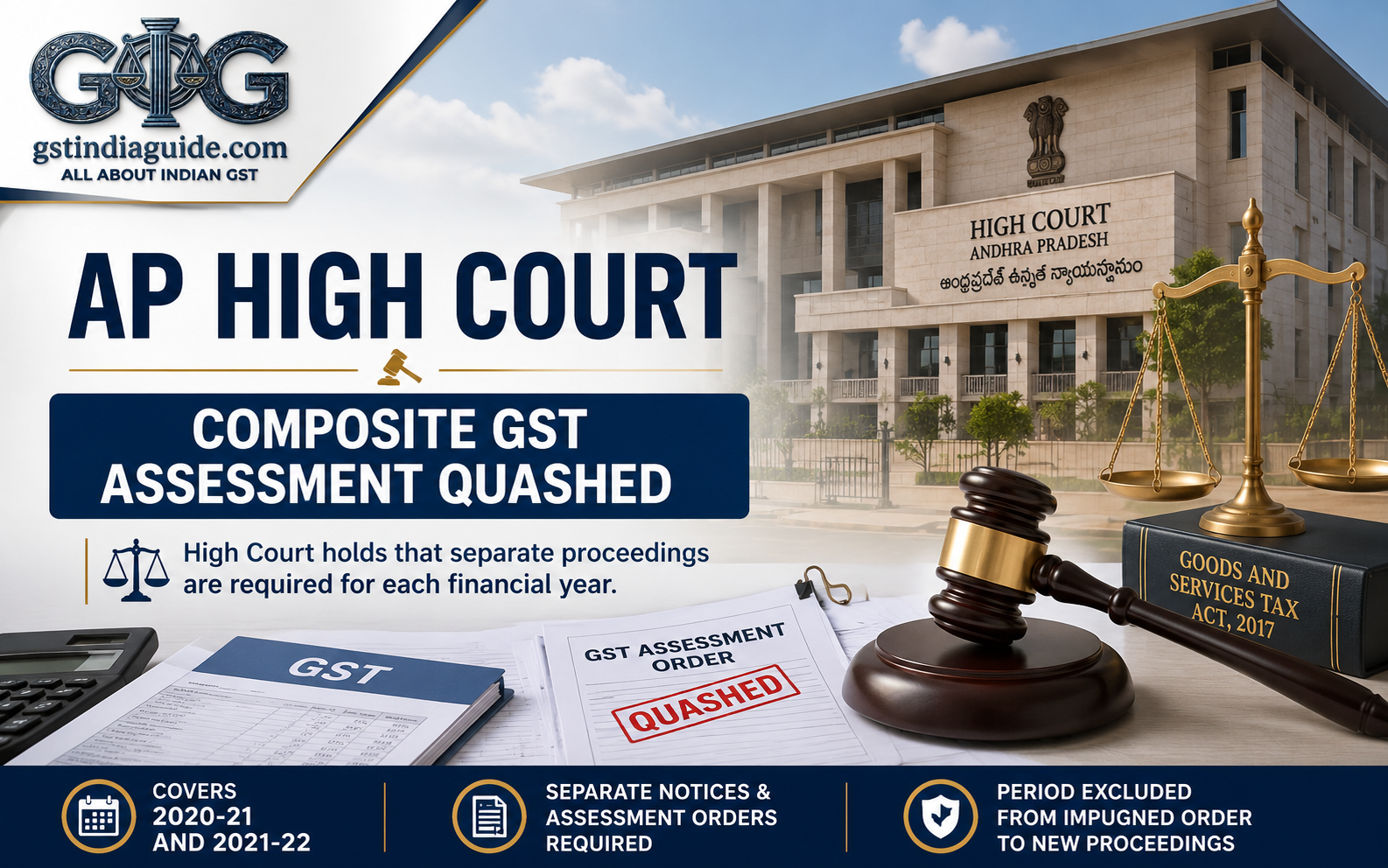
The Andhra Pradesh High Court has set aside a GST adjudication order that covered two separate financial years through a single composite assessment. The Court held that a common assessment order cannot be passed for more than one tax period or financial year where separate assessment proceedings are required under the GST law.
The judgment was delivered on 15 July 2026 by a Division Bench comprising Justice Ninala Jayasurya and Justice T.C.D. Sekhar in M/s C. Eswara Reddy and Co. v. The Joint Director, Directorate General of GST Intelligence and Others, Writ Petition No. 18602 of 2025.
Background of the Case
The petitioner, a partnership firm engaged in providing works contract services, was registered under the Central Goods and Services Tax Act, the Andhra Pradesh Goods and Services Tax Act and the Integrated Goods and Services Tax Act.
The petitioner challenged an Order-in-Original dated 27 March 2025 and the corresponding summary order issued in Form GST DRC-07 dated 29 March 2025. The impugned adjudication covered the financial years 2020-21 and 2021-22 through a single composite order.
Among other grounds, the petitioner contended that the adjudicating authority had failed to properly consider its objections, had not followed the prescribed statutory procedure and had passed an order covering more than one assessment year. It was also alleged that the proceedings resulted in overlapping taxation for the financial year 2020-21.
The respondents opposed the writ petition on the ground that the petitioner had an alternative remedy of appeal before the GST Appellate Tribunal.
Composite GST Proceedings for Multiple Years
The High Court noted that the Order-in-Original and Form GST DRC-07 admittedly covered the composite tax period of 2020-21 and 2021-22.
The Court relied upon its earlier decision in W.P. No. 11028 of 2025 and connected matters, in which it had held that a single show-cause notice or composite assessment order cannot be issued in relation to more than one tax period.
The earlier ruling explained that permitting a consolidated order for several years could adversely affect important statutory rights available to a registered person. These include the right to obtain the benefit of statutory penalty provisions and the right to independently challenge assessment orders relating to each financial year.
Accordingly, the Court reiterated that once the due date for filing the annual return has been reached, separate assessment proceedings must be undertaken for each financial year.
High Court Sets Aside the GST Order
Applying the above legal principle, the Andhra Pradesh High Court set aside the Order-in-Original dated 27 March 2025 and the summary order in Form GST DRC-07 dated 29 March 2025.
The writ petition was accordingly allowed.
However, the Court granted liberty to the adjudicating authority to issue separate notices for the relevant tax periods and proceed with the assessments in accordance with law. The authority was directed to provide a proper opportunity of hearing to the petitioner before completing the proceedings.
Limitation Period Protected
The High Court further directed that the period commencing from the date of the impugned order until the date on which the authorities receive the High Court’s order would be excluded while computing the applicable limitation period.
This direction protects the revenue authorities from a limitation objection when initiating fresh and separate proceedings for the relevant financial years.
Legal Significance of the Judgment
The judgment reinforces the principle that GST adjudication must be undertaken separately for each relevant tax period or financial year. A consolidated show-cause notice or assessment order covering several financial years may interfere with the taxpayer’s procedural and appellate rights.
The ruling is particularly relevant in proceedings under Sections 73 and 74 of the GST enactments. Adjudicating authorities must ensure that demands relating to different financial years are not combined into a single assessment order merely for administrative convenience.
The decision also clarifies that the setting aside of a composite order does not prevent the department from commencing fresh proceedings. Separate notices may be issued for each relevant financial year, subject to compliance with the principles of natural justice and the applicable limitation provisions.
Why This Judgment Matters
The ruling is important for advocates, Chartered Accountants, Company Secretaries, GST practitioners, tax consultants, corporate tax teams and businesses facing consolidated GST demands covering multiple financial years. It highlights a significant jurisdictional and procedural ground for challenging composite adjudication orders while preserving the department’s right to undertake fresh proceedings in accordance with law.