Case Details
Case: Shree Hanumant Steel Traders & Anr. v. Assistant Commissioner
Court: High Court of Chhattisgarh at Bilaspur
Case Nos.: WPT Nos. 11, 15 & 12 of 2026
Neutral Citation: 2026:CGHC:39456
Bench: Hon’ble Shri Justice Rakesh Mohan Pandey
Date of Decision: 09.09.2026
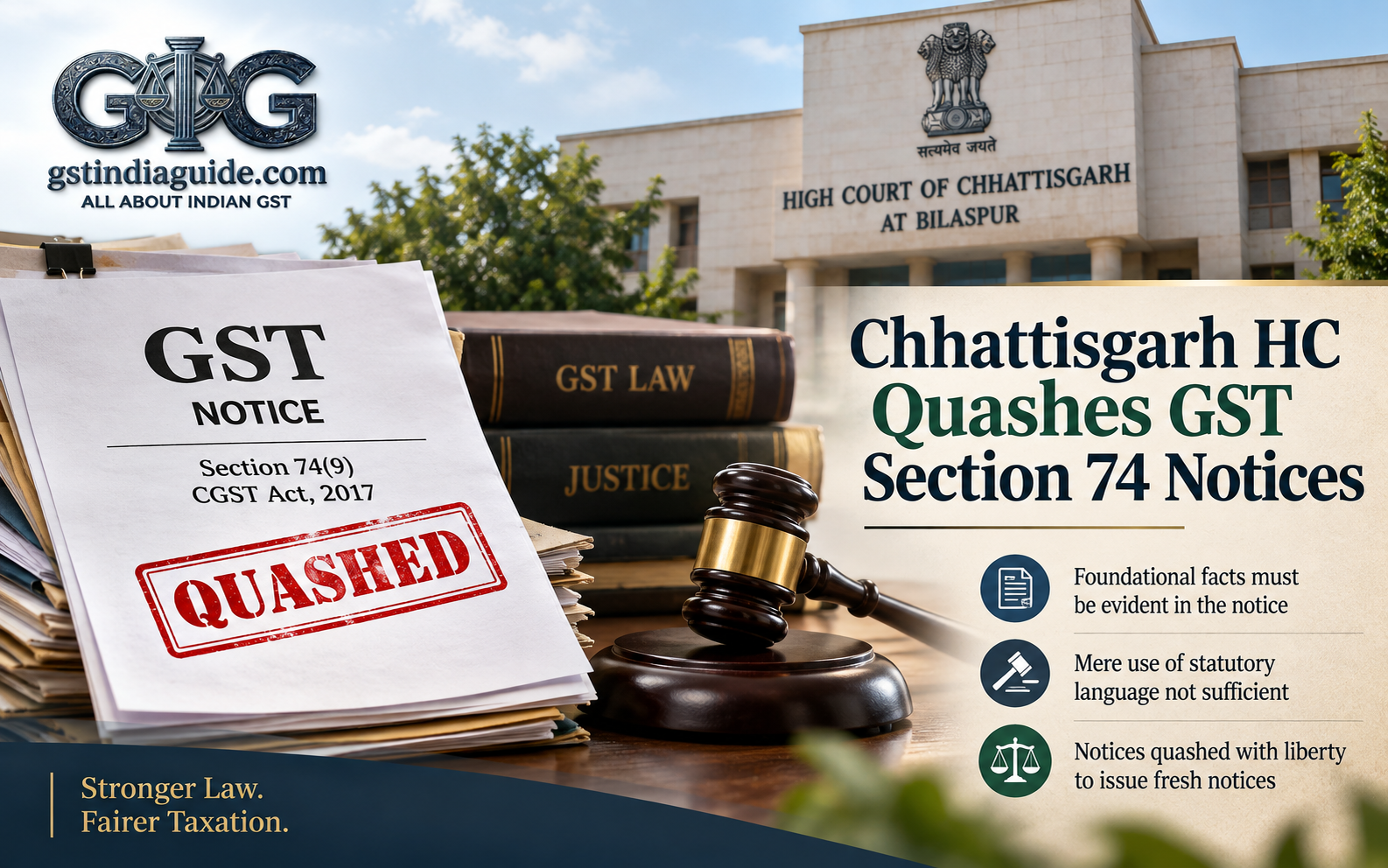
Provision Involved: Section 74(9) of the GST Act, 2017
Impugned Notices: 16.10.2025
Result: Writ petitions allowed; notices quashed with liberty to issue fresh notices strictly in accordance with law.
Background of the Dispute
Shree Hanumant Steel Traders and its proprietor, Shri Kamal Kishor Agrawal, approached the Chhattisgarh High Court through a batch of three writ petitions challenging respective notices dated 16 October 2025 issued by the Assistant Commissioner, Circle-5, Division-1, State Goods and Services Tax, Raipur.
The notices were issued under Section 74(9) of the GST Act, 2017. According to the State’s submissions before the High Court, the authority had alleged that the petitioners had availed input tax credit by issuing fake invoices without actual supply of goods.
The principal controversy before the High Court was whether the impugned notices contained sufficient foundational facts and reasons to support the allegations attracting Section 74.
Petitioners’ Arguments
The petitioners contended that the issue stood covered by the Supreme Court’s decision in Tata Steels Ltd. v. Union of India.
Their principal contention was that when the department seeks to proceed on allegations of fraud, wilful misrepresentation or suppression, the foundational facts from which such an inference is drawn must be apparent from the notice itself.
According to the petitioners, the impugned notices lacked those foundational facts and were therefore liable to be quashed.
Revenue’s Arguments
The State opposed the writ petitions. It submitted that the respective notices described the allegation that the petitioners had availed input tax credit by issuing fake invoices without actual supply of goods.
The Revenue maintained that the authority had appropriately disclosed the foundational facts in the notices.
It also raised the objection of alternative remedy, contending that the petitioners had an efficacious remedy of filing appeals under Section 107 of the GST Act.
High Court’s Findings
After examining the impugned notices, the High Court found that the authority had failed to assign sufficient reasons while issuing them under Section 74(9).
The Court relied upon the legal principle stated by the Supreme Court in Tata Steels Ltd. v. Union of India, referred to in the judgment as [2026] 189 taxmann.com 520 (SC).
The High Court reproduced the Supreme Court’s observation that where an extended limitation period is sought to be invoked on allegations such as fraud, wilful misrepresentation or suppression, the foundational facts leading to that inference must be evident from the notice itself.
The Supreme Court had further explained that merely employing expressions such as “fraud”, “wilful misrepresentation” or “suppression” does not by itself establish application of mind. Such statutory expressions cannot simply be mechanically reproduced in a notice for making a recovery outside the normal limitation prescribed under the statute.
Foundational Facts Must Appear in the Notice
The judgment reinforces an important requirement concerning notices founded upon allegations of fraud, wilful misrepresentation or suppression.
The authority must disclose in the notice the foundational facts that led it to draw such an inference. The requirement is not satisfied merely by reproducing statutory terminology.
On examining the notices before it, the Chhattisgarh High Court concluded that sufficient reasons had not been assigned by the authority.
Final Decision
In view of the above legal position, the High Court quashed the respective notices dated 16.10.2025 issued under Section 74(9) of the GST Act, 2017.
Accordingly, WPT Nos. 11, 15 and 12 of 2026 were allowed.
Importantly, the Court did not prevent the GST authority from initiating proceedings afresh. It expressly granted liberty to the respondent authority to issue fresh notices strictly in accordance with law, if so advised.
Key Takeaway
The decision reiterates that invocation of provisions involving allegations of fraud, wilful misrepresentation or suppression cannot rest merely upon the mechanical reproduction of statutory expressions. The notice itself must disclose the foundational facts from which the authority has drawn such an inference. Where sufficient reasons are absent, the notice may fail to satisfy this requirement.
At the same time, quashing of such a notice does not necessarily prevent fresh proceedings where the Court expressly preserves the authority’s liberty to issue a fresh notice in accordance with law.