
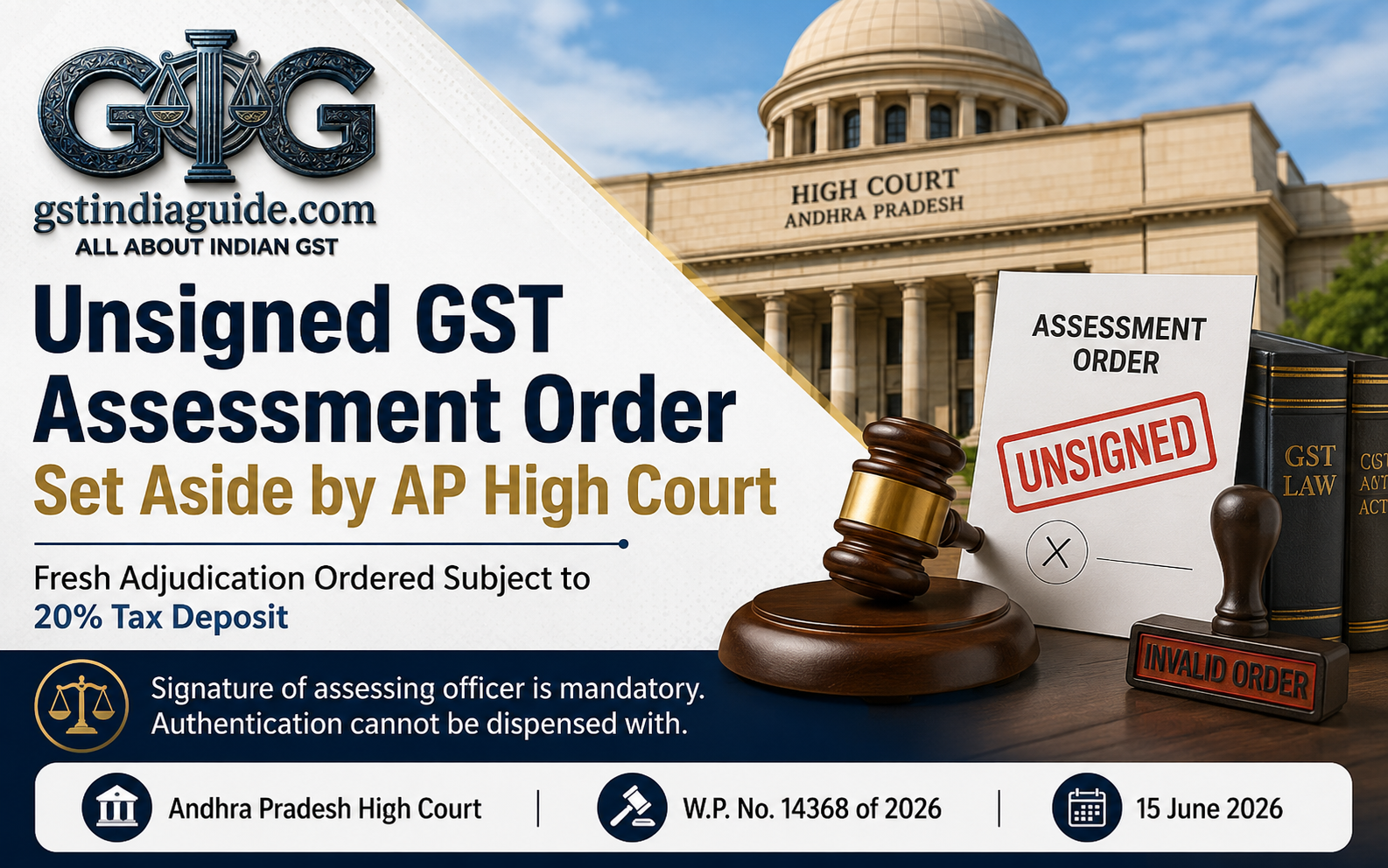
The Andhra Pradesh High Court, in M/s GSN Granites v. The Assistant Commissioner, ST, Ongole II Circle & Others, has set aside a GST assessment order that did not bear the signature of the assessing officer. The Court remanded the matter for fresh adjudication after granting the taxpayer an opportunity of hearing, subject to the deposit of 20% of the disputed tax.
The judgment was delivered by a Division Bench comprising Justice R. Raghunandan Rao and Justice T.C.D. Sekhar on 15 June 2026 in Writ Petition No. 14368 of 2026. The petitioner had challenged the assessment proceedings for the tax period 2022–23, including the summary uploaded in Form GST DRC-07 on 24 May 2025.
Background of the Dispute
The petitioner was subjected to an assessment resulting in a disputed demand of approximately ₹2.31 crore, comprising tax, penalty and interest. One of the principal grounds of challenge was that the summary of the assessment order did not contain the signature of the assessing officer.
The petitioner also contended that an effective opportunity to contest the proceedings had not been provided and that the assessment was contrary to the principles of natural justice. It was further argued that the order uploaded on the GST portal did not contain a Document Identification Number and was neither physically nor digitally signed.
The State opposed the writ petition on the ground of delay. It submitted that the assessment order had been validly served by uploading it on the GST portal in accordance with Section 169(1)(d) of the GST enactment.
Signature on a GST Assessment Order Is Mandatory
The High Court referred to its earlier decisions in A.V. Bhanoji Row v. Assistant Commissioner (ST), M/s SRK Enterprises v. Assistant Commissioner and M/s SRS Traders v. Assistant Commissioner ST, in which it had been held that the signature of the assessing officer on an assessment order cannot be dispensed with.
The Court reiterated that Sections 160 and 169 of the Central Goods and Services Tax Act, 2017, cannot cure the fundamental defect arising from the absence of the assessing officer’s signature.
Accordingly, an unsigned assessment order suffers from an inherent defect and cannot be treated as a valid and enforceable adjudication order.
Delay in Filing the Writ Petition
The Court also considered the objection that the petitioner had approached it after a substantial delay. The petitioner maintained that the order had not been served through conventional means and had merely been uploaded on the GST portal.
The Bench observed that portal-based administration has created practical difficulties for several registered persons. Taxpayers sometimes remain unaware of uploaded orders or depend upon authorised persons who may not communicate such orders in time.
Although ignorance of law or inability to access the portal would ordinarily not justify delay, the Court held that relief may still be considered where the impugned order suffers from a patent irregularity.
Relief Subject to 20% Deposit
To balance the difficulties faced by registered taxpayers with the State’s interest in tax administration, the High Court adopted a conditional approach.
The unsigned assessment order was set aside and the matter was remanded to the assessing officer for fresh adjudication. However, the relief was made subject to the petitioner depositing 20% of the disputed tax within six weeks.
Any amount already paid or recovered after the impugned assessment order was directed to be adjusted against the required 20% deposit.
The assessing officer was directed to provide the petitioner a proper opportunity of hearing and pass fresh orders in accordance with the GST law. The Court also clarified that the period between the filing of the writ petition and the receipt of the High Court’s order by the assessing officer would be excluded while computing limitation.
All legal and factual issues were left open for the petitioner to raise during the fresh assessment proceedings.
Key Legal Principle
The judgment reinforces that authentication of an adjudication order is not a procedural formality. A GST assessment order that does not contain the signature of the competent assessing officer suffers from a fundamental defect and may be declared invalid.
At the same time, where a taxpayer approaches the High Court belatedly, relief may be granted subject to appropriate safeguards, including partial deposit of the disputed tax.
Why This Judgment Matters
The decision is relevant for advocates, Chartered Accountants, GST practitioners, tax consultants, businesses and corporate tax teams dealing with assessment orders communicated electronically through the GST portal.
Taxpayers should examine whether adjudication orders and DRC-07 summaries are properly authenticated and signed by the competent officer. However, the judgment also indicates that taxpayers must monitor the GST portal regularly, as delay in challenging an order may result in the imposition of financial conditions before relief is granted.