


Case Title: M.N. Ghosh & Sons v. Principal Commissioner, CGST & CX & Ors.
Court: High Court of Jharkhand at Ranchi
Petition No.: W.P.(T) No. 3408 of 2024
Category of Dispute: Cancellation of GST Registration / Limitation in Appeal
Judgment Date: Pronounced on 25/04/2025 (CAV on 03/04/2025)
Relevant Sections: Section 29(2)(c), Section 107 CGST Act, 2017; Rule 23 CGST Rules, 2017
Facts of the Case (Ref: Para 2–3, 5)
-
The petitioner, a partnership firm engaged in civil construction, obtained GST registration (GSTIN: 20ABMFM1797K1ZX).
-
For non-filing of returns for six months, notice in Form REG-17/31 was issued, and registration was suspended on 28.01.2022.
-
Registration was cancelled w.e.f. 28.02.2022 under Section 29(2)(c) CGST Act, order passed on 08.07.2022.
-
Due to illness of an active partner and financial crisis, returns could not be filed timely. The return for February 2022 was filed only on 19.09.2023.
-
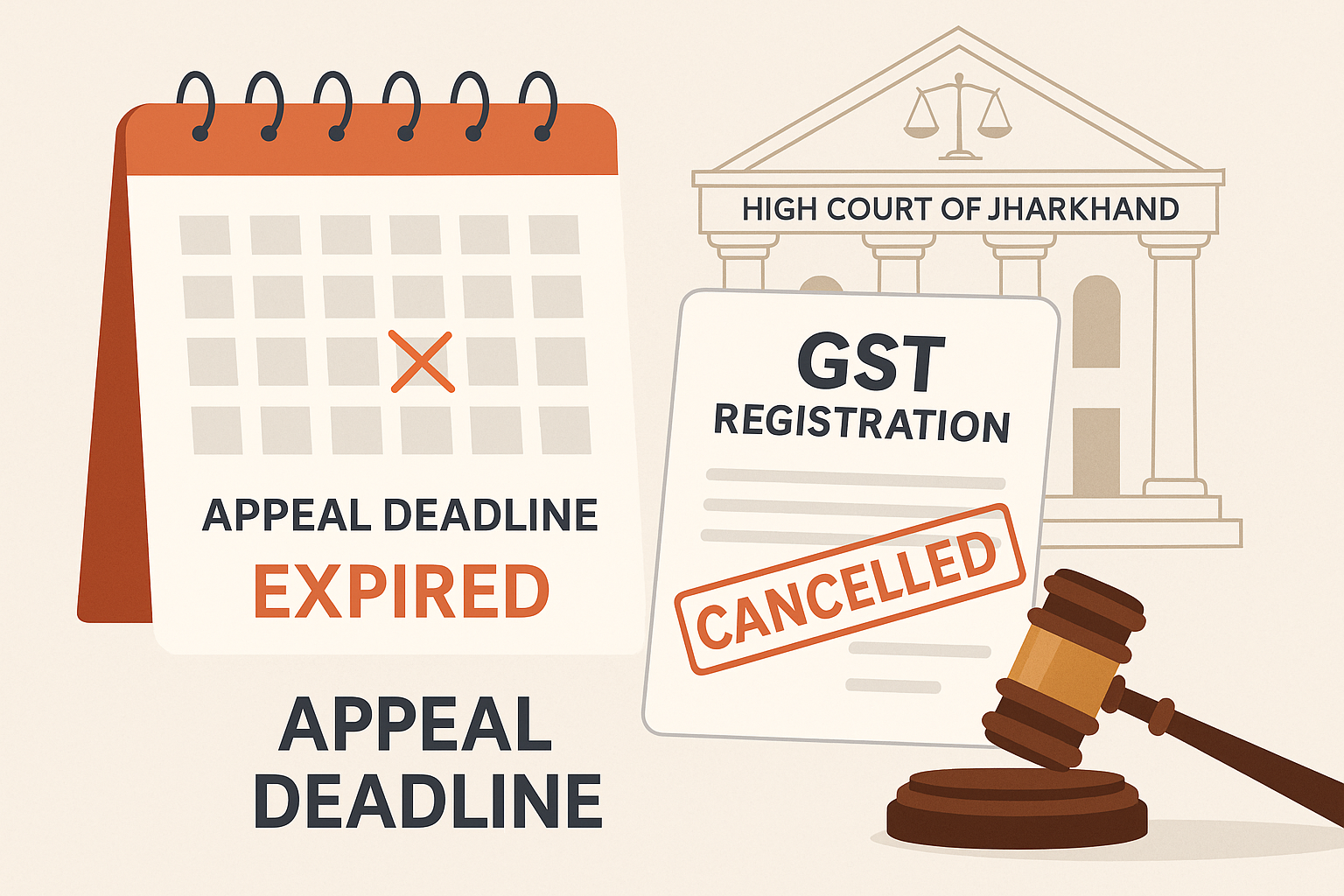
Appeal under Section 107 was filed on 29.09.2023 (more than 1 year and 3 months after limitation). It was dismissed by Joint Commissioner (Appeals) as time-barred.
Questions in Consideration (Ref: Para 1, 5–7)
-
Whether the appellate authority had power to condone the delay in filing appeal beyond the period prescribed under Section 107 of CGST Act?
-
Whether cancellation of GST registration could be interfered with despite delayed filing of appeal?
Observations of the Court (Ref: Para 6–10)
-
Section 107(1) prescribes 3 months’ time to file appeal; sub-section (4) allows condonation of only 1 additional month.
-
Appeal filed after more than one year and three months was clearly barred.
-
Court relied on Singh Enterprises v. Commissioner of Central Excise, Jamshedpur (2008) 3 SCC 70 where Supreme Court held appellate authorities cannot condone delay beyond statutory limits.
-
The petitioner showed lethargy both in filing returns and in preferring appeal.
-
Hence, High Court could not interfere, as writ jurisdiction cannot be used to override statutory limitation.
Judgment of the Court (Ref: Para 11–12)
-
The writ petition was dismissed as devoid of merit.
-
No interference was warranted with the cancellation order or appellate order since the appeal was filed far beyond statutory period.
-
No costs imposed.
Between Fine Lines (Simplified Summary in 5 Points)
-
GST registration was cancelled due to non-filing of returns.
-
Petitioner filed appeal after more than 1 year 3 months, against statutory limit of 3+1 months.
-
Law does not permit condonation beyond this time.
-
Court cited Singh Enterprises to reinforce bar of limitation.
-
Result: Appeal and writ petition both failed; cancellation stands.
Summary of Referred Cases
| Case Name | Citation | Summary | Verdict |
|---|---|---|---|
| Singh Enterprises v. Commissioner of Central Excise, Jamshedpur | (2008) 3 SCC 70 | Appeal filed beyond condonable period; Commissioner (Appeals) and Tribunal cannot extend limitation beyond statute; Section 5 Limitation Act excluded. | Appeal dismissed; statutory bar upheld. |
Disclaimer – “The above summary is for academic purpose only; not formal legal opinion. Seek professional opinion before application. Author or publisher or website shall not be responsible for any usage in any form.”

