


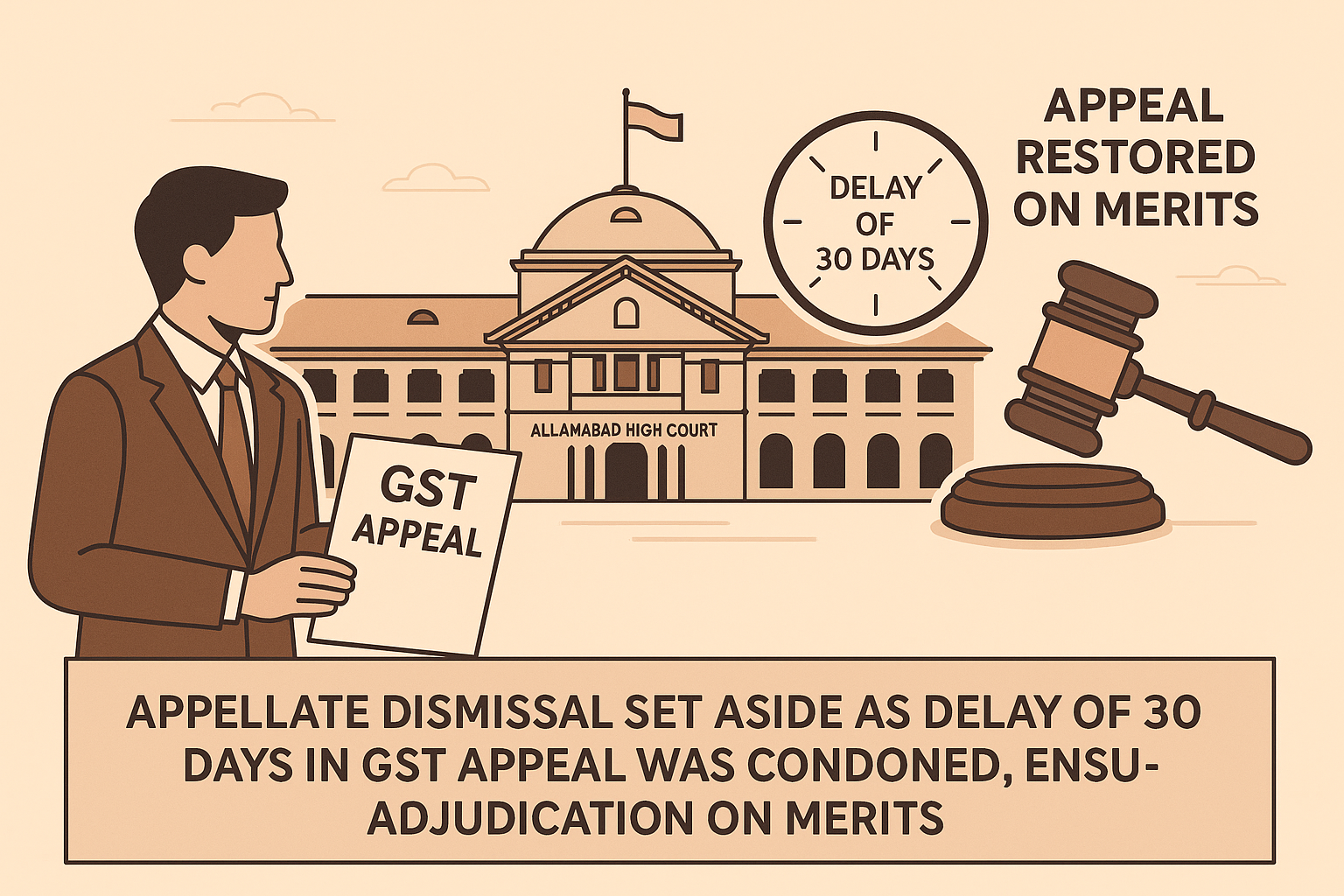
Case: M/S Shri Bankey Bihari Enterprises v. State of U.P. and Others
Court: High Court of Judicature at Allahabad
Petition No.: Writ Tax No. 403 of 2025
Date of Judgment: 20.02.2025
Judge: Hon’ble Ajit Kumar, J.
Category of Dispute: Appeal dismissed on delay – GST demand challenge
Relevant Provisions: Article 226 of the Constitution of India, CGST Act – provisions relating to appeal (Section 107), principles of natural justice
Facts (Para 1–3)
The petitioner, M/S Shri Bankey Bihari Enterprises, filed a writ petition challenging the order dated 20.12.2024 passed by the Appellate Authority dismissing its statutory appeal solely on the ground of delay. The delay was only 30 days and occurred due to lack of notice of the original assessment order. The petitioner argued that the appellate authority ignored judicial precedents where it was held that when procedure prescribed by law is not followed, such orders become unsustainable. The petitioner relied on the judgment in Writ Tax No. 2070 of 2024, where similar issues were discussed.
Questions in Dispute (Para 3–4)
-
Whether dismissal of the appeal on a mere 30-day delay, without considering merits, was valid?
-
Whether principles of natural justice required condonation of short delays where the assessee was deprived of notice of assessment order?
-
Whether the appellate authority was bound to follow judicial guidance laid down in earlier writs including Writ Tax No. 2070 of 2024 and Writ Tax No. 2027 of 2024?
Observations (Para 3–5)
The Court observed that the appellate authority dismissed the appeal only on the ground of limitation, without addressing the substantive issues of assessment. This prevented adjudication on merits, defeating the object of statutory remedy under Section 107 of the CGST Act. The Court emphasized that earlier benches, including in Writ Tax No. 2070 of 2024, had directed that when procedure is not followed, orders must be quashed, and appellate forums should consider merits. The State counsel also fairly conceded that the matter could be remanded with directions for a time-bound disposal in accordance with prior judicial rulings.
Judgment (Para 5–7)
The High Court set aside the order of the Appellate Authority dated 20.12.2024 and restored the petitioner’s statutory appeal. The matter was remanded to the appellate authority with a direction to decide the appeal afresh on merits, after giving due hearing, and by considering the legal principles discussed in Writ Tax No. 2070 of 2024. The appellate authority was directed to conclude the appeal within two months from the date of submission of the certified copy of this order. The Assessing Authority’s order would abide by the outcome of the restored appeal.
Case Law Reference Table
| Case Referred | Court & Petition No. | Verdict |
|---|---|---|
| Writ Tax No. 2070 of 2024 | Allahabad High Court | Held that non-compliance with prescribed procedure renders orders unsustainable. |
| Writ Tax No. 2027 of 2024 | Allahabad High Court | Directed that appellate authority must decide matters in light of settled principles of law in similar cases. |
Between Fine Lines (Practical Takeaway)
The ruling clarifies that appeals should not be rejected for minor delays, especially when caused by lack of proper notice. Businesses gain relief as their matters must be heard on merits, and appellate forums cannot shield behind limitation technicalities where procedural lapses exist. For taxpayers, this ensures that justice under GST law is substantive, not procedural.
Disclaimer – “The above summary is for academic purpose only; not formal legal opinion. Seek professional opinion before application. Author or publisher or website shall not be responsible for any usage in any form.”

