


Case Title: Thota Nagabhushanam v. Assistant Commissioner and Others
Court: High Court of Andhra Pradesh at Amaravati
Petition No.: W.P. No. 18781 of 2024
Judgment Date: 19 February 2025
Category: Assessment Order – Validity
Relevant Sections: Sections 160 & 169 of the CGST Act, 2017
Facts (Paras 1–2)
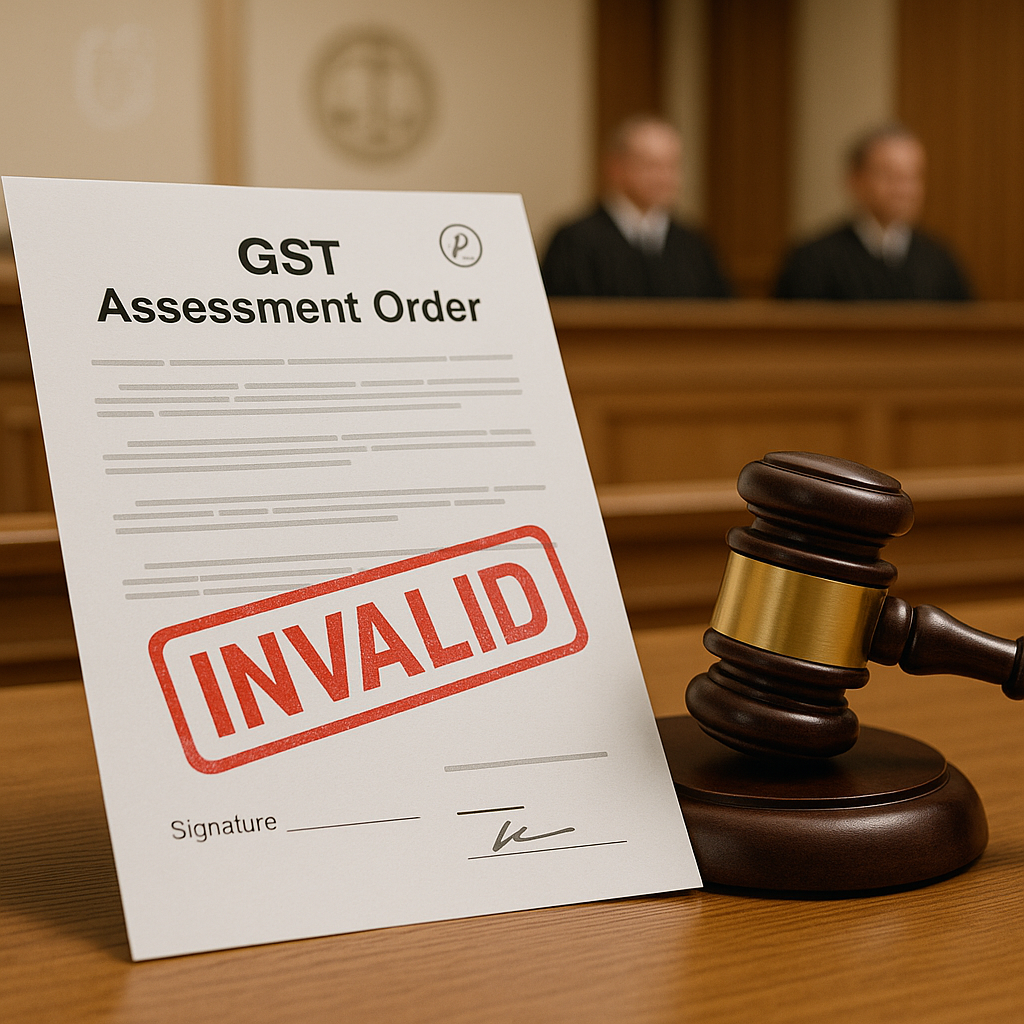
The petitioner, Thota Nagabhushanam, was issued an assessment order dated 29.09.2023 under the GST Act, 2017, for the tax periods 2017–18 to 2021–22 by the Assistant Commissioner. The order was in Form GST DRC-07. The petitioner challenged the order before the Andhra Pradesh High Court, contending that the assessment order was invalid as it bore no signature of the assessing officer, thereby lacking authenticity and legal force.
Questions Before the Court
Whether an assessment order under the GST Act, 2017, issued without the signature of the assessing officer, is a valid and enforceable order under law, or whether such an omission renders it void ab initio?
Observations (Paras 3–6)
The learned Government Pleader for Commercial Tax admitted that the impugned order indeed did not contain the signature of the assessing officer. The Court referred to its earlier Division Bench decisions in:
-
A.V. Bhanoji Row v. Assistant Commissioner (ST), W.P. No. 2830 of 2023 (decided on 14.02.2023)
-
M/s. SRK Enterprises v. Assistant Commissioner, W.P. No. 29397 of 2023 (decided on 10.11.2023)
-
M/s. SRS Traders v. Assistant Commissioner (ST), W.P. No. 5238 of 2024 (decided on 19.03.2024)
In all these cases, the Court held that signature on the assessment order is mandatory and cannot be dispensed with. The Court further clarified that Sections 160 and 169 of the CGST Act, 2017 — dealing with minor procedural irregularities and service of notice — cannot cure such a fundamental defect, as the signature authenticates the decision-making authority and reflects the exercise of quasi-judicial power.
Judgment (Paras 6–7)
Following the established judicial precedent, the Division Bench held that the absence of the assessing officer’s signature renders the assessment order invalid and unenforceable. The impugned assessment order dated 29.09.2023 was set aside. However, liberty was granted to the assessing officer to re-issue a fresh assessment order after due notice and proper signing.
The Court also directed that the period between the date of the impugned order and the receipt of this judgment shall be excluded for limitation purposes. No order as to costs was made.
Summary of Referred Cases
| Case Title | Citation / WP No. | Date | Key Verdict |
|---|---|---|---|
| A.V. Bhanoji Row v. Assistant Commissioner (ST) | W.P. No. 2830 of 2023 | 14.02.2023 | Signature on assessment order is mandatory; absence invalidates the order. |
| M/s. SRK Enterprises v. Assistant Commissioner | W.P. No. 29397 of 2023 | 10.11.2023 | Reaffirmed that unsigned GST assessment orders are void. |
| M/s. SRS Traders v. Assistant Commissioner (ST) | W.P. No. 5238 of 2024 | 19.03.2024 | Held that unsigned orders have no legal sanctity and must be set aside. |
Between Fine Lines
For the trade and tax administration, this judgment reinforces the non-negotiable procedural requirement of signature on GST assessment orders. An unsigned order is tantamount to a non-existent adjudication, lacking both authority and enforceability. Tax officers must ensure digital or manual signatures are affixed to preserve legal validity, and taxpayers can rely on this principle to contest mechanically generated or unsigned DRC-07 orders.
Disclaimer – “The above summary is for academic purpose only; not formal legal opinion. Seek professional opinion before application. Author or publisher or website shall not be responsible for any usage in any form.”

