


Case Title: Vincent and Sons v. Deputy Commissioner (GST Appeal) & Another
Court: Madurai Bench of the Madras High Court
Petition No.: W.P.(MD) No. 8377 of 2025
Date of Judgment: 26.03.2025
Category: Input Tax Credit (ITC) mismatch and applicability of Section 74
Relevant Sections: Sections 74 and 107 of the Tamil Nadu Goods and Services Tax Act, 2017
Facts (Paras 1–3)
The petitioner, Vincent and Sons, a wholesale dealer in cement, filed the writ challenging the assessment order dated 30.04.2024 for FY 2018–19 and the subsequent rectification order dated 22.01.2025 passed by the Assistant Commissioner (ST), Kuzhithurai. The dispute arose due to a mismatch between ITC claimed in GSTR-3B and the details reflected in GSTR-2A. Despite submitting detailed explanations to the show cause notice, the assessing officer invoked Section 74 of the TNGST Act, alleging wrongful claim of ITC, and demanded reversal of credit with interest and penalty. The petitioner claimed that the discrepancy was due to technical mismatches, not any wilful misstatement, and hence Section 74 was inapplicable. The rectification petition filed under Section 161 was rejected without reasons.
Questions of Law (Paras 3–4)
-
Whether invocation of Section 74 was justified in the absence of any wilful misstatement or suppression?
-
Whether the rectification order rejecting the correction application without reasons violated principles of natural justice?
-
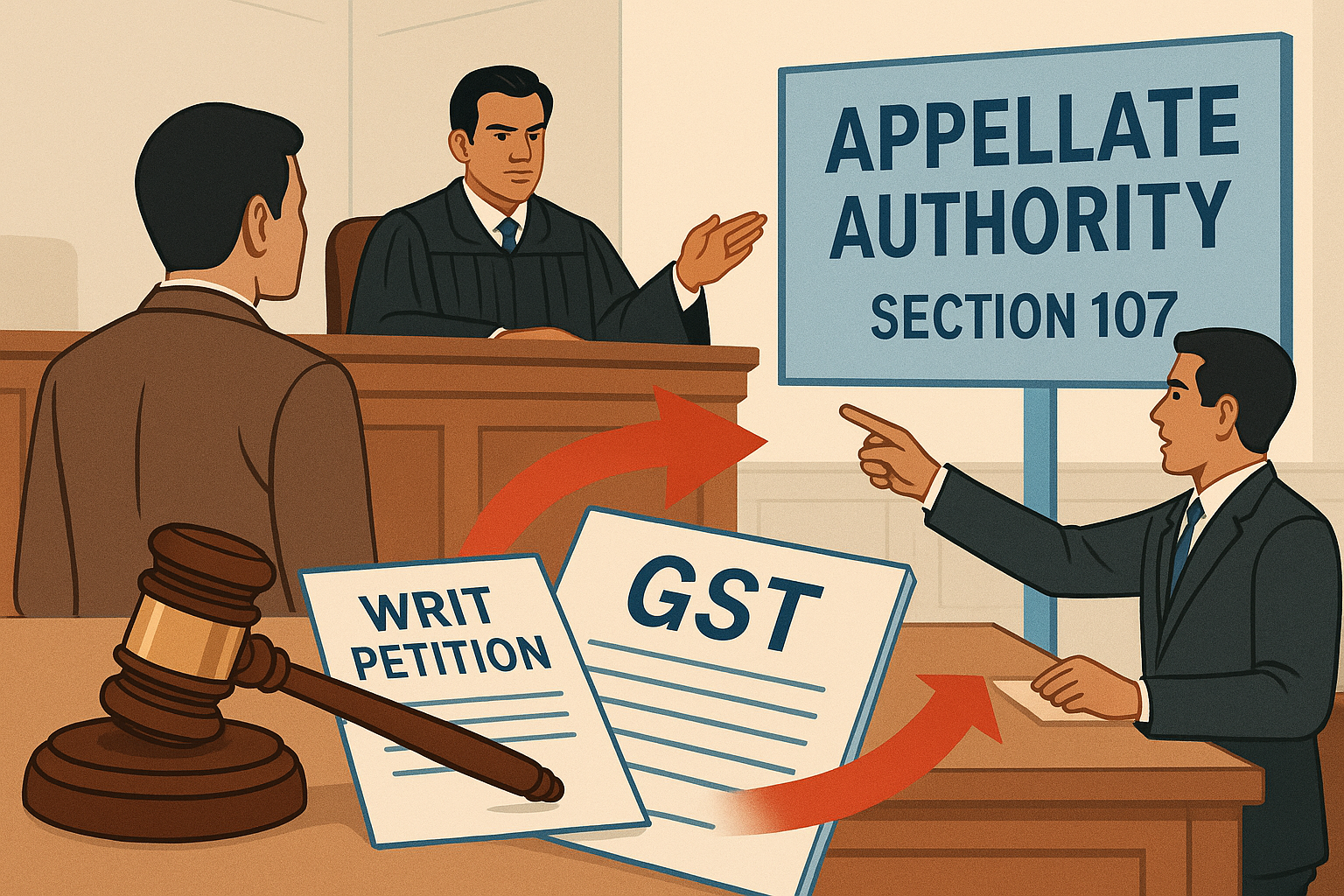
Whether the petitioner was entitled to directly invoke writ jurisdiction instead of availing the appellate remedy under Section 107?
Observations (Paras 4–5)
The Court observed that under Section 107 of the GST Act, an appellate remedy is available before the Deputy Commissioner (Appeals). Since the petitioner had not availed that remedy, the High Court held that the writ petition was premature. The Court emphasized the principle that when an effective alternative remedy is available, writ jurisdiction under Article 226 should not be invoked except in cases of jurisdictional error or violation of natural justice. The petitioner’s claim regarding Section 74 and ITC mismatch can be effectively adjudicated before the appellate authority.
Judgment (Para 5)
The Court disposed of the writ petition with liberty to the petitioner to approach the Deputy Commissioner (Appeals) within two weeks from receipt of the order. The appellate authority was directed to entertain the appeal without reference to limitation and decide it within three months. Meanwhile, the respondents were directed to maintain status quo as on the date of the order.
Summary of Cases Referred
| Case Name | Citation | Key Principle / Verdict |
|---|---|---|
| None cited explicitly in judgment | — | — |
Between Fine Lines
The Court reaffirmed the principle that GST disputes involving factual issues such as ITC mismatch should be pursued through the statutory appellate process rather than invoking writ jurisdiction directly. For taxpayers, this order emphasizes the importance of using the appeal mechanism under Section 107 before approaching the High Court, especially where the issue is procedural or computational rather than jurisdictional.
Disclaimer – “The above summary is for academic purpose only; not formal legal opinion. Seek professional opinion before application. Author or publisher or website shall not be responsible for any usage in any form.”

