
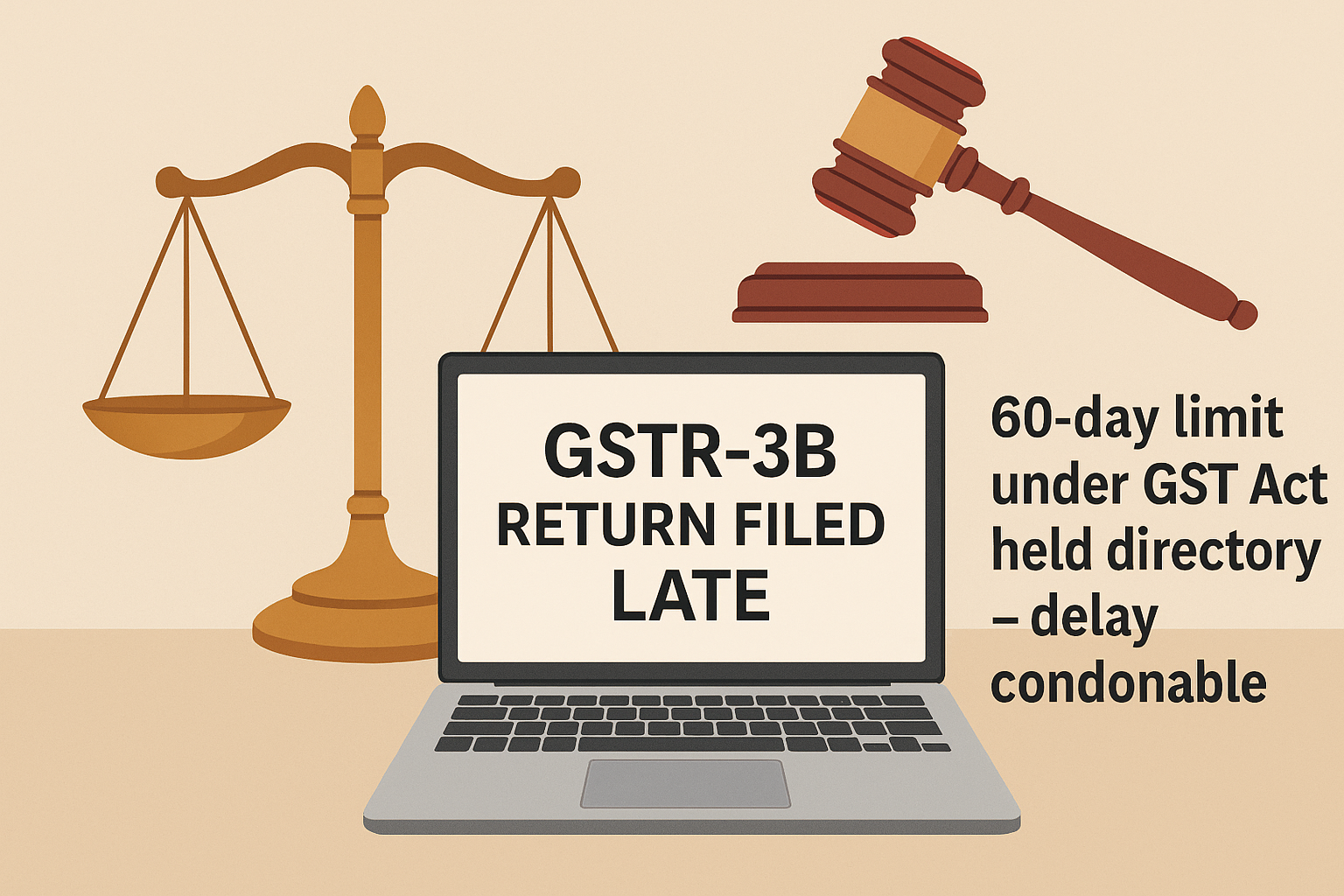
Case: Tvl. Uthapuram Kanmoi Pasana Vivasaigal Sangam v. The Commissioner of Commercial Taxes & Anr
Court: Madurai Bench of Madras High Court
Petition: W.P.(MD) No. 3202 of 2025
Judgment Date: 14.03.2025
Category: Filing of Returns / Assessment of Non-filers – Section 62 of the GST Act
Facts (Paras 3–5)
The petitioner, a registered dealer under the TNGST Act, 2017, failed to file GSTR-3B for February 2022. Consequently, the Assistant Commissioner issued a notice under Section 46 on 26.03.2022, and later passed a best-judgment assessment order on 12.05.2022 under Section 62(1), demanding ₹3,05,934. Due to illness, the petitioner could not file returns within 60 days as contemplated under Section 62(2) but later filed them on 25.11.2024 along with interest and late fee. However, the Department refused to withdraw the assessment and demanded payment. The petitioner sought quashing of the order, pleading for condonation of delay.
Questions Before the Court (Paras 4–5)
Whether the assessee can be permitted to file returns after expiry of the 60-day period prescribed under Section 62(2) of the GST Act, and whether such delay can be condoned if justified by reasonable cause.
Observations (Paras 7–16)
The Court analyzed Section 62 of the GST Act. It noted that the provision aims to provide a window for non-filers to regularize their returns within 60 days of the best-judgment assessment. However, it reasoned that the period is directory, not mandatory, as the right to file returns cannot be entirely extinguished if valid reasons prevent timely filing.
The Court emphasized that the assessing authority has five years from the end of the relevant financial year to pass best-judgment orders. Hence, restricting the taxpayer’s right due to early assessment would be unjust. If delay occurs for reasons beyond control, such as illness, authorities must examine the sufficiency of cause and may condone the delay, permitting filing upon payment of interest and late fee.
Judgment (Paras 16–17)
The Court directed:
-
The petitioner to file a condonation application within 15 days.
-
The Assistant Commissioner to consider the reasons and, if satisfied, permit filing of returns after condoning the delay.
The writ petition was disposed of accordingly, without costs.
Summary of Cases Referred
| Sl. No. | Case Name | Court | Principle / Verdict |
|---|---|---|---|
| 1 | Tvl. Uthapuram Kanmoi Pasana Vivasaigal Sangam v. Commissioner of Commercial Taxes | Madras HC (Madurai Bench) | 60-day limit in Section 62(2) of GST Act is directory, allowing delay condonation for sufficient cause. |
Between Fine Lines (Trade Perspective)
This judgment is significant for taxpayers who miss the 60-day deadline for filing returns after best-judgment assessments. The Madras High Court clarified that genuine delays — such as illness or unavoidable circumstances — may be condoned, ensuring that procedural rigidity does not override substantive justice. Businesses can thus seek relief by applying for delay condonation under Section 62(2), rather than being compelled to pay assessed dues.
Disclaimer – “The above summary is for academic purpose only; not formal legal opinion. Seek professional opinion before application. Author or publisher or website shall not be responsible for any usage in any form.”


 can be condoned for genuine reasons, making the provision directory in nature.)