Case Title: Aniket Sovasaria vs Union of India & Ors.
Court: Gauhati High Court
Petition Number: Bail Appln./1140/2025
Relevant Sections: Section 132(1)(c) of CGST Act, 2017 r/w Section 20 of IGST Act, 2017; Section 69 CGST Act, 2017; Section 483 BNSS, 2023
Category of Dispute: Bail in Alleged Input Tax Credit Fraud
Date of Judgement: 08.05.2025
Relevant CGST Provisions: Sections 69 & 132(1)(c) of CGST Act, 2017
Relevant Criminal Procedure Provisions: Sections 35(3), 41, 41A & 479(2) of BNSS, 2023
Facts of the Case
[Para 3–5]
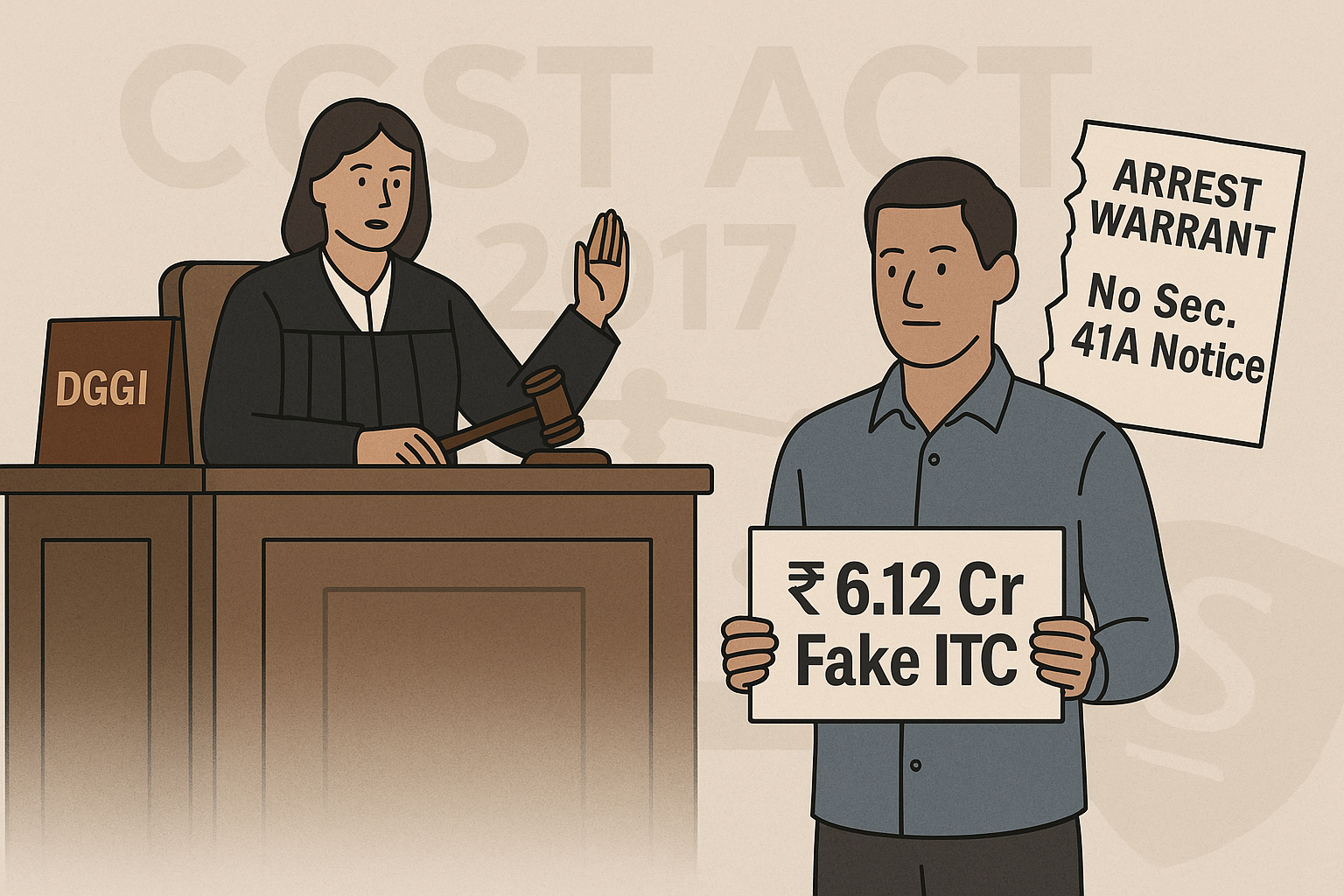
The petitioner, Aniket Sovasaria, a partner in M/s Aadi Enterprises and M/s Trident Consulting, was arrested in a case involving alleged passing of fake Input Tax Credit (ITC) worth ₹6.12 Crores without actual supply of goods. He had been in judicial custody for over 98 days. It was alleged that the arrest was carried out without issuing a mandatory notice under Section 41A CrPC (now Section 35(3) BNSS), without fulfilling arrest pre-conditions under Section 69 of the CGST Act, and without any assessment.
Questions in Consideration
[Para 6, 7, 8]
-
Whether the arrest of the petitioner without issuing a notice under Section 35(3) BNSS (Section 41A CrPC) and without authorisation under Section 69 of the CGST Act is illegal.
-
Whether bail should be granted given that charge-sheet has been filed and custody has exceeded 90 days.
-
Whether pendency of another GST evasion case bars bail under Section 479(2) BNSS.
Observation of Court
[Para 10–12]
-
The court noted that Section 41A CrPC (Section 35(3) BNSS) notice is mandatory for offences with punishment up to 7 years, which was not followed in this case.
-
It relied on the Apex Court rulings in Arnesh Kumar v. State of Bihar and Satender Kumar Antil v. CBI, where the Court mandated compliance with arrest procedures for such offences.
-
The Court held that any non-compliance would entitle the accused to bail.
-
While another case was pending, charge-sheet was already filed in the present matter, and the petitioner was in custody for more than three months.
Judgement of the Court
[Para 12–16]
The Gauhati High Court granted bail to the petitioner on furnishing a bond of ₹50,000 with two sureties, subject to conditions including:
-
Not leaving the territorial jurisdiction without permission,
-
Regular court attendance and cooperation in trial,
-
No inducement or threat to witnesses,
-
No similar offences in future.
Breach of any condition would lead to bail cancellation.
Between Fine Lines (Summary in Simple Words):
-
The Court granted bail due to procedural lapses in arrest, especially non-issuance of notice under Section 41A CrPC.
-
Custodial detention of over 90 days and filing of charge-sheet also weighed in petitioner’s favour.
-
The case reaffirms importance of complying with procedural safeguards in arrest.
-
Multiple pending cases alone cannot bar bail if pre-conditions under the law are unmet.
-
The ruling follows Supreme Court directives ensuring liberty in economic offences unless properly arrested.
Summary of Referred Cases
| Name of Case | Citation | Summary | Verdict |
|---|---|---|---|
| Radhika Agarwal v. Union of India | WP(C) No.336/2018 | Arrest without notice under Section 41A CrPC was held illegal | Bail granted |
| Natwar Kumar Jalan v. Union of India | WP(C) 6821/2024 | Addressed procedural requirements before arrest in GST fraud cases | Relief granted |
| Vineet Jain v. Union of India | Criminal Appeal No.2269/2025 | Upheld need for Section 41A notice before arrest in economic offences | Bail granted |
| Arnesh Kumar v. State of Bihar | (2014) 8 SCC 273 | Laid down arrest guidelines in offences punishable ≤7 years | Landmark directive |
| Satender Kumar Antil v. CBI | (2022) 10 SCC 51 | Reinforced Section 41A compliance for grant of bail | Bail encouraged |
| CIT, Mumbai v. Amitabh Bachchan | (2016) 11 SCC 748 | Concerned with income tax issues – cited on procedural clarity | Not relevant to arrest |
| Madhya Pradesh Industries Ltd. v. ITO, Nagpur | (1965) SCC Online SC 189 | Addressed quasi-judicial authority in taxation | General reference |
Disclaimer – “The above summary is for academic purpose only; not formal legal opinion. Seek professional opinion before application. Author or publisher or website shall not be responsible for any usage in any form.”