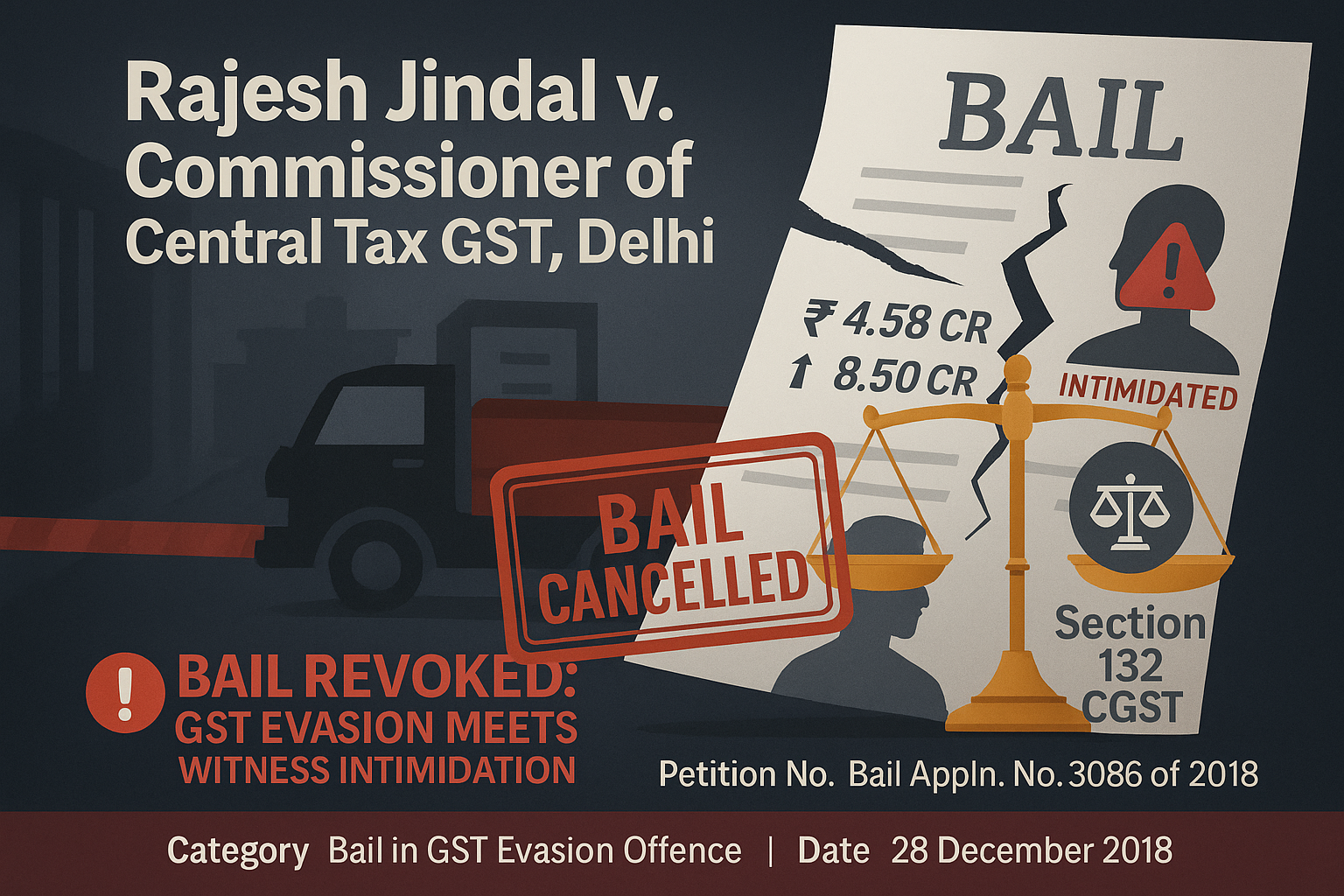
Case Title: Rajesh Jindal vs. Commissioner of Central Tax GST, Delhi
Court Name: High Court of Delhi
Petition Number: Bail Appln. No. 3086 of 2018, CRL.M.(Bail) No. 2003 of 2018
Category of Dispute: Bail in GST Evasion Offence
Date of Judgement: 28 December 2018
Relevant Sections: Sections 132(1)(i), 132(4), 132(5) of the CGST Act, 2017
Facts of the Case
- The petitioner, Rajesh Jindal, was arrested on 01.08.2018 for alleged tax evasion and was granted bail shortly thereafter. [Para 3(i)]
- The Revenue filed a first application for cancellation of bail on 02.08.2018, which was dismissed on 14.08.2018. A second application was later filed, which led to the cancellation of the bail by the Sessions Court on 22.12.2018. [Para 3(ii)]
- The main ground for seeking cancellation in the second application was an alleged increase in the quantum of tax evasion from Rs. 4.58 crores to Rs. 85 crores, which the petitioner argued was a misleading and fabricated figure. [Para 3(iii)]
- The petitioner also denied the allegation that he intimidated witnesses and claimed there was no material to support such a charge. [Para 3(iv)]
Questions in Consideration
- Whether the Sessions Court’s cancellation of the petitioner’s bail was justified on the grounds of alleged intimidation of witnesses? [Paras 3–6]
- Whether the increase in the stated tax evasion amount (from Rs. 4.58 crores to Rs. 85 crores or 8.5 crores) was relevant for determining bail eligibility under Section 132 of the CGST Act? [Paras 3(iii), 5]
Observations of the Court
- The Court found that the figure alleged to have been altered in handwriting as “85” was in fact “8.5”, and further held that the precise quantum (Rs. 85 crore or Rs. 8.5 crore) was immaterial because under Section 132(1)(i), offences involving tax evasion above Rs. 5 crore are punishable with up to 5 years imprisonment. [Para 5]
- The Court held that the cancellation of bail by the Sessions Court was not based on the quantum of tax evasion but primarily on allegations that the petitioner threatened witnesses (dummy directors used in the creation of fake firms). [Para 6]
- Statements of key witnesses alleging intimidation were part of the investigation record and supported the Sessions Court’s decision. [Para 4]
Judgement of the Court
The High Court upheld the order of the Sessions Court dated 22.12.2018 cancelling the bail of Rajesh Jindal. It held that the petitioner misused the liberty granted to him by attempting to influence witnesses and thus was not entitled to the benefit of bail at this stage. Both bail applications were dismissed with no order as to costs. [Para 7–8]
Between Fine Lines
- Bail can be revoked if the accused misuses liberty, regardless of the stage of trial.
- Even minor discrepancies in evidence (like handwritten alterations) do not vitiate bail cancellation if other grounds like witness intimidation exist.
- Under CGST Act, evasion above Rs. 5 crore qualifies as a serious offence attracting stringent punishment.
- Statements of dummy directors alleging threats by accused can be valid grounds for cancellation of bail.
- Quantum of evasion becomes less relevant if the conduct of the accused justifies revocation.
Summary of Referred Cases
| Name of Case | Citation | Summary | Verdict |
| Not specifically cited | – | The case did not cite other judicial precedents but relied on factual investigation including witness statements and CGST statutory provisions | Not Applicable |