
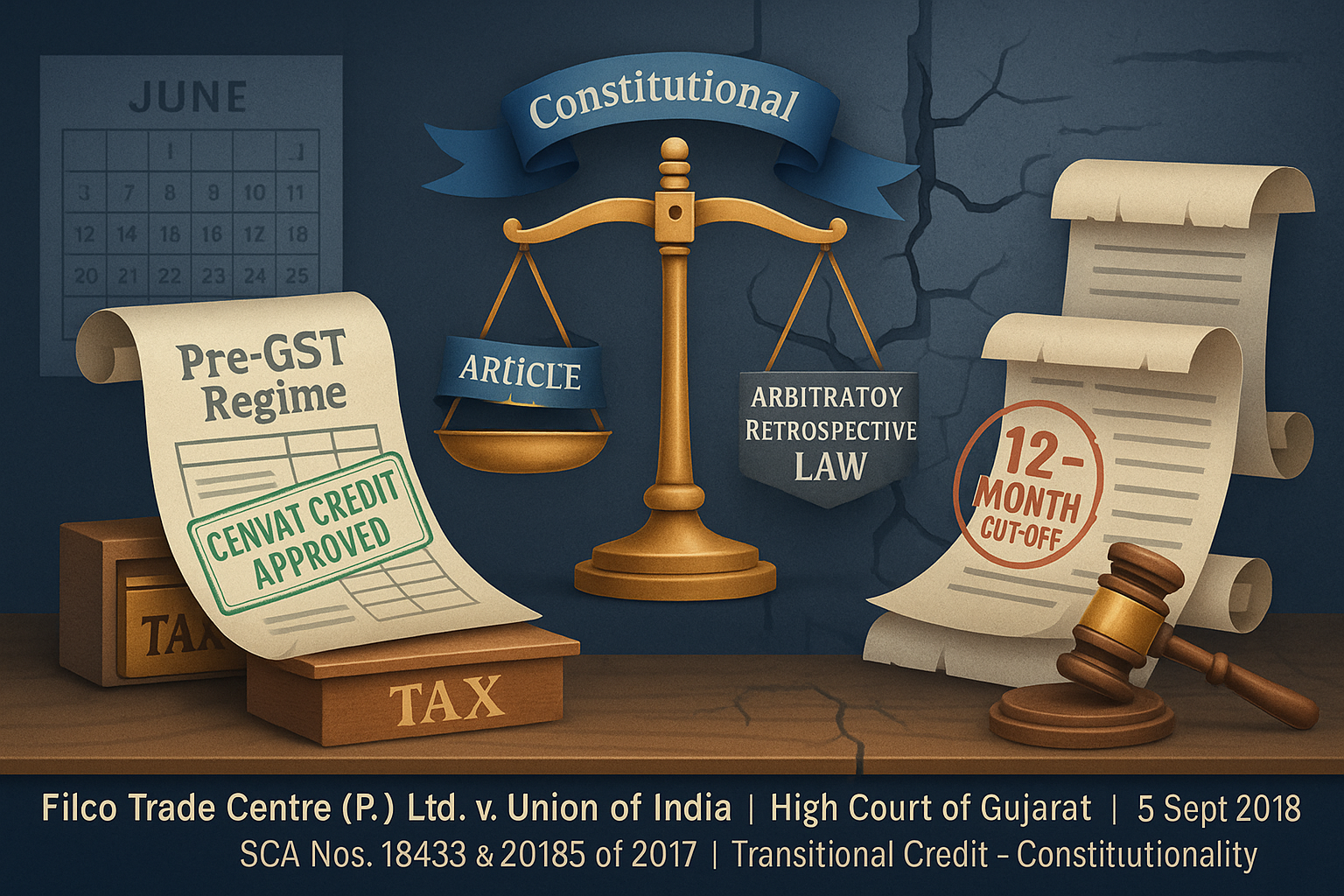
Case Title: Filco Trade Centre (P.) Ltd. v. Union of India
Court: High Court of Gujarat
Petition No.: Special Civil Application Nos. 18433 and 20185 of 2017
Category of Dispute: Transitional Credit under GST
Date of Judgement: 5 September 2018
Relevant Sections: Section 140(3)(iv) of the CGST Act, 2017
Relevant Rules: CENVAT Credit Rules, 2004
Facts of the Case [¶2–4, ¶25–27]
- The petitioner, a trader and importer of specialized industrial bearings, functioned as a first stage dealer under the erstwhile indirect tax regime, availing and passing on CENVAT credit to its buyers without time restrictions.
- With the introduction of the CGST Act, 2017, transitional provisions allowed dealers to carry forward such credits; however, Section 140(3)(iv) imposed a condition that only credits based on invoices issued within the 12 months before 1 July 2017 would be allowed.
- The petitioner challenged this time limitation as arbitrary, claiming it retroactively removed a vested right, affecting their ability to claim input tax credit on unsold stock purchased before the 12-month cut-off.
Questions in Consideration [¶9]
- Does Section 140(3)(iv) create an impermissible distinction between similarly situated persons?
- Does it retrospectively take away vested rights without justification?
- Should this clause be declared unconstitutional on these grounds?
Observations of the Court [¶16–30]
- The Court reaffirmed that CENVAT credit under the old regime was a vested right and not a concession, especially supported by precedents like Eicher Motors Ltd. and Dai Ichi Karkaria Ltd. [¶25–27].
- Imposing a one-year cut-off retrospectively with no corresponding provision in the prior regime was found to be arbitrary and unreasonable. The Court held that legislative reasons like administrative convenience or preventing misuse were insufficient justification for such retrospective restriction [¶27].
- The Court noted that transitional provisions in tax law can be retrospective but must meet fairness and rationality. In this case, the retrospectivity lacked justification and infringed vested rights [¶27–28].
- While referring to judgments on legislative competence and reasonable classification (e.g., R.K. Garg, Vatika Township), the Court held that though economic legislations are given latitude, the impugned clause failed the test of reasonableness and manifest arbitrariness [¶20–24].
Judgement of the Court [¶31–32]
- The Court declared clause (iv) of Section 140(3) of the CGST Act unconstitutional as it imposed an unjustified retrospective burden by taking away vested credit rights for purchases older than one year before GST implementation.
- The judgment was stayed till 31.10.2018 to allow the revenue department time to appeal or adjust administratively.
Between Fine Lines (Simplified Summary)
- The Gujarat High Court ruled that the time limit of 12 months for availing transitional CENVAT credit under GST is unconstitutional.
- The credit available to first stage dealers under the previous regime was a vested right.
- Imposing a time-bar retrospectively, without any similar past restriction, was held unreasonable.
- Administrative convenience was not sufficient justification to curtail vested rights.
- The court’s decision protected taxpayers holding older inventory from losing their legitimate transitional credits.
Summary of Referred Cases
| Case Name | Citation | Summary | Verdict / Holding |
| Eicher Motors Ltd. v. UOI | 1999 taxmann.com 1769 (SC) | CENVAT credit is a vested right; cannot be retrospectively taken away. | Retrospective withdrawal struck down. |
| Dai Ichi Karkaria Ltd. v. CCE | 1999 (112) ELT 353 (SC) | CENVAT credit is indefeasible upon duty payment. | Credit allowed; reaffirmed it’s as good as duty paid. |
| Jayaswal Neco Ltd. v. CCE | [2015] 62 taxmann.com 10 | Delay in tax payment doesn’t invalidate CENVAT use. | CENVAT use upheld. |
| Osram Surya (P.) Ltd. v. CCE | [2002] 122 Taxman 583 | Time limit for MODVAT credit upheld as prospective change. | Provision upheld; distinguished from retrospective cases. |
| R.K. Garg v. UOI | 1982 taxmann.com 240 (SC) | Greater deference in economic legislation but fairness is essential. | Judicial restraint advised in economic matters. |
| CIT v. Vatika Township | [2014] 49 taxmann.com 249 (SC) | Retrospective laws require fairness and clarity; presumption is of prospectivity. | Tax laws not to be applied retrospectively unless justified. |
| Shayra Bano v. UOI | [2017] 9 SCC 1 | Arbitrariness can be a valid ground to strike down legislation. | Manifest arbitrariness invalidates laws under Article 14. |
| JCB India Ltd. v. UOI (Bombay HC) | [2018] 92 taxmann.com 131 | Upheld 140(3)(iv) restriction as valid. | Gujarat HC disagreed with this view. |
| Indsur Global Ltd. v. UOI | 2014 (310) ELT 833 (Guj.) | Rule restricting CENVAT use post default struck down as arbitrary. | Provision struck down as unconstitutional. |