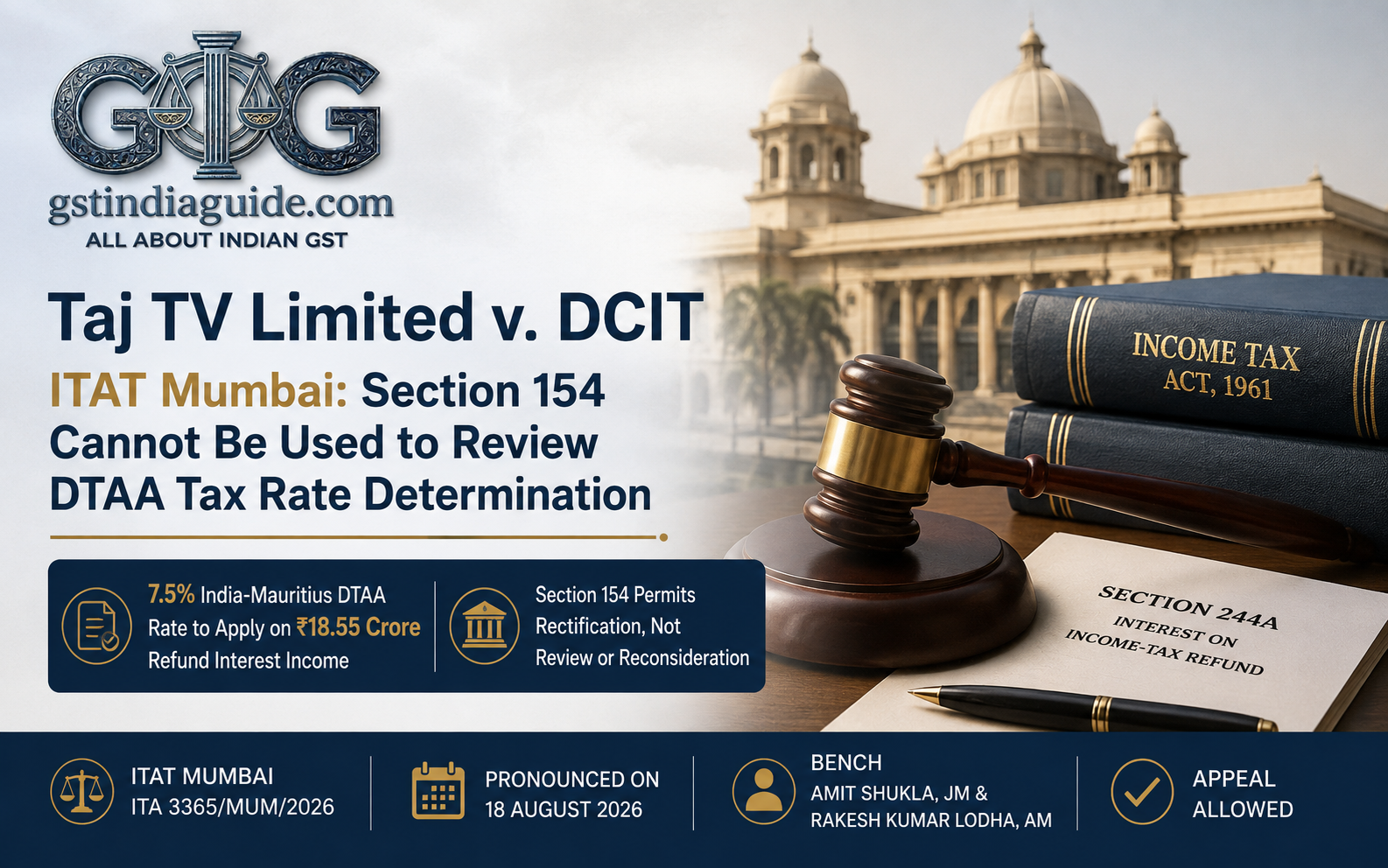
The Mumbai Bench of the Income Tax Appellate Tribunal has held that the limited rectification jurisdiction under Section 154 of the Income-tax Act, 1961 cannot be used to reconsider or review a tax treatment that had already been expressly determined in a final assessment order.
The dispute concerned interest of ₹18,55,93,487 received on an income-tax refund under Section 244A. In the final assessment order dated 12 April 2021, passed under Section 143(3) read with Section 144C(13), the Assessing Officer had specifically recorded that the interest income was “Taxable @ 7.5% under India-Mauritius DTAA.”
Background of the Dispute
Taj TV Limited had originally offered the refund interest to tax under the domestic provisions in its return. However, while completing the final assessment, the Assessing Officer expressly applied the 7.5% treaty rate under the India-Mauritius DTAA.
Certain unrelated additions subsequently travelled in appeal, and after relief was granted by the Tribunal, the Assessing Officer passed an order giving effect on 30 May 2023. While doing so, the interest income was subjected to the domestic tax rate instead of the 7.5% rate recorded in the final assessment order.
The assessee filed a rectification application under Section 154. By order dated 28 November 2023, the Assessing Officer accepted that the assessee’s contention was “verified and found tenable” and restored the treaty rate.
However, through another Section 154 order dated 19 February 2025, the Assessing Officer again reversed the position and applied the domestic rate on the basis that the assessee had originally offered the income to tax under the Act. The CIT(A) upheld this action.
Section 154 Is Rectification, Not Review
The ITAT held that Section 154 permits correction only of a mistake apparent from the record. Such a mistake must be manifest and self-evident and should not require reconsideration of competing legal positions or substitution of one possible view by another.
According to the Tribunal, the final assessment order was unambiguous. Against the interest income of ₹18.55 crore, it specifically recorded the applicable rate as 7.5% under the India-Mauritius DTAA. The computation forming part of an assessment order could not be disregarded merely because there was no elaborate discussion about the treaty rate in the body of the order.
The Tribunal further observed that this treatment had never been independently rectified, revised or otherwise disturbed through any statutory proceeding.
Order Giving Effect Could Not Disturb a Final Determination
The issues that had travelled in appeal were different from the taxation of the refund interest. Therefore, while passing the consequential order giving effect to the appellate decision, the Assessing Officer was required to preserve those portions of the original assessment that had neither been challenged nor disturbed.
The Tribunal held that an order giving effect could not provide jurisdiction to alter an independent determination in the final assessment order that had already attained finality.
Conflicting Views Showed That No “Apparent” Mistake Existed
A significant factor considered by the ITAT was the Assessing Officer’s own earlier rectification order dated 28 November 2023, in which the applicability of the 7.5% rate had been verified and accepted.
The subsequent attempt to apply the domestic rate therefore represented a reconsideration of the same material rather than correction of a patent mistake.
The Tribunal observed that questions such as whether the original Assessing Officer consciously allowed treaty benefit, whether the return prevented application of the beneficial treaty rate, and whether the Supreme Court’s decision in Goetze (India) Ltd. applied would themselves require legal examination and reasoning.
Once such an argumentative exercise is required, the matter falls outside the narrow scope of a “mistake apparent from the record” under Section 154.
ITAT Quashes Rectification Order
The ITAT consequently held that the Assessing Officer exceeded the jurisdiction vested under Section 154 in passing the rectification order dated 19 February 2025.
The Tribunal quashed that order and directed the Assessing Officer to apply the 7.5% rate to the Section 244A interest income of ₹18,55,93,487, as specifically determined in the final assessment order dated 12 April 2021, and grant consequential effect in accordance with law.
Accordingly, Taj TV Limited’s appeal was allowed.
Key Takeaway
Section 154 is confined to correcting patent and self-evident mistakes. It cannot be invoked to review or substitute a different view on an issue that has already been expressly determined in a final assessment order. Where determining the alleged error requires legal interpretation, debate or reconsideration of competing positions, the matter falls outside rectification jurisdiction.