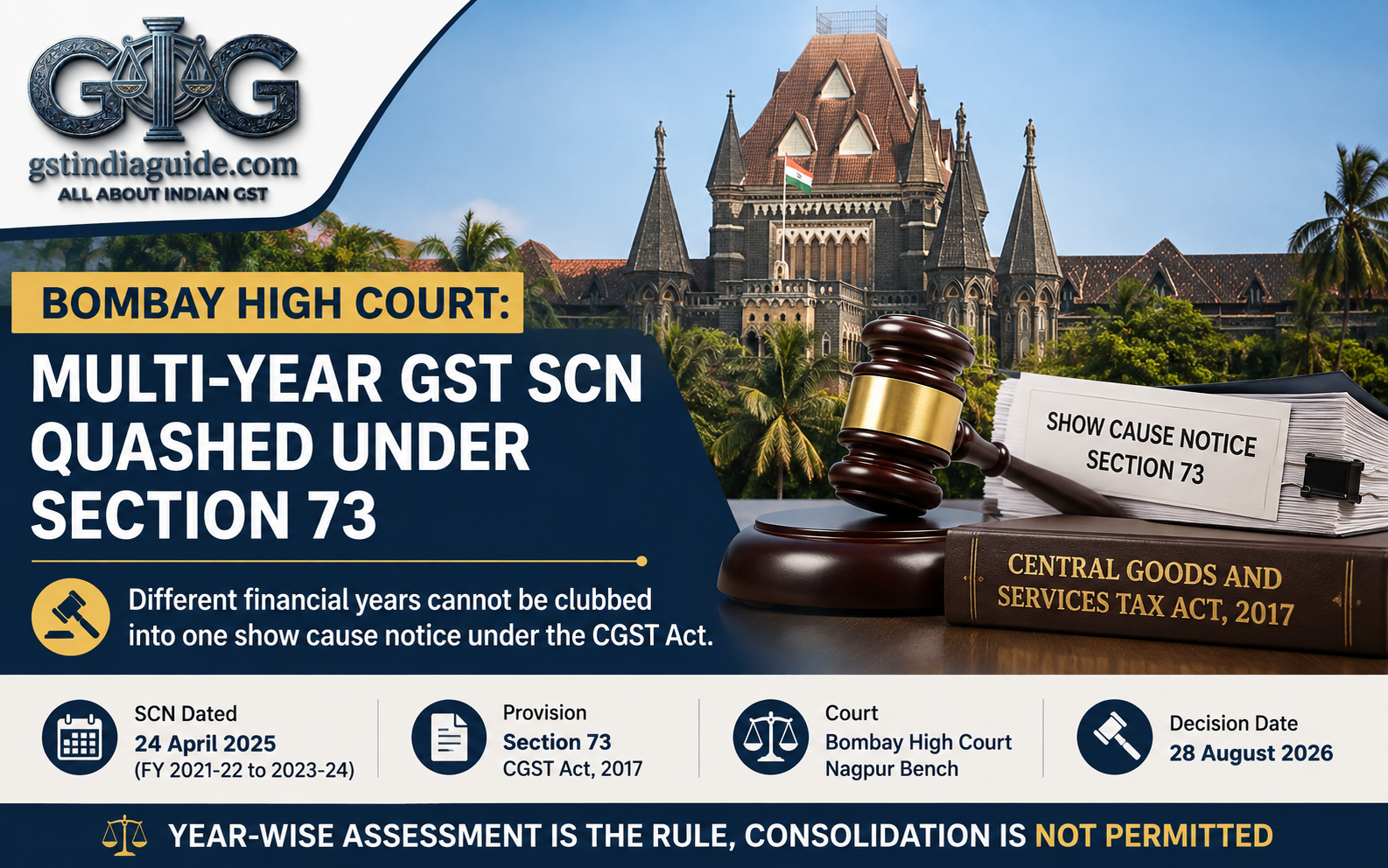
The Bombay High Court, Nagpur Bench, in M/s. Mehadia & Sons C & F Division, through its Partner Mr. Sharda R. Mehadia v. Assistant Commissioner of CGST & Central Excise, Nagpur-II, Nagpur & Ors., has quashed a show cause notice issued under Section 73 of the Central Goods and Services Tax Act, 2017 which consolidated demands relating to three different financial years. The judgment was delivered on 28 August 2026 in Writ Petition No. 4844 of 2026 by a Division Bench comprising Justice Anil L. Pansare and Justice Nivedita P. Mehta.
The impugned show cause notice dated 24 April 2025 covered financial years 2021-22 to 2023-24 and alleged suppression of taxable value resulting in short payment of Central GST. The petitioner challenged the notice primarily on the ground that separate financial years or tax periods could not lawfully be clubbed into one consolidated proceeding under Section 73.
Bombay High Court Reaffirms Year-Wise GST Assessment
The Court relied upon the earlier decisions in M/s. Milroc Good Earth Developers v. Union of India & Ors. and Rite Water Solutions (India) Ltd. v. Joint Commissioner, CGST & Central Excise, Nagpur & Ors., where it had been held that there is no scope under the CGST Act for consolidating different financial years or tax periods while issuing a show cause notice under Section 73.
The Court emphasised that the GST statutory framework operates with reference to defined tax periods and financial years. Limitation for determination and recovery also runs independently for each relevant financial year. Consequently, consolidation of several years into a single notice would combine tax periods having different statutory timelines and could impair the taxpayer’s ability to respond separately to the allegations relating to each period.
Delhi High Court View Not Followed
The Revenue relied upon the Delhi High Court decision in M/s. Mathur Polymers v. Union of India & Ors., where issuance of a consolidated notice covering multiple years had been accepted in the context of alleged fraudulent availment of input tax credit.
The Bombay High Court noted that the Special Leave Petition against the Delhi High Court judgment had been dismissed by the Supreme Court in limine. It held that such dismissal did not result in merger of the Delhi High Court judgment with an order of the Supreme Court on merits. The Court therefore maintained that authorities functioning within the territorial jurisdiction of the Bombay High Court were bound by the law declared by the Bombay High Court in its subsequent decisions.
The Court also referred to its decision in M/s. Hakikatrai and Sons, Akola v. Union of India & Ors., reiterating the principle concerning the binding nature of the jurisdictional High Court’s view upon authorities operating within its jurisdiction.
Larger Bench Reference Noted
The Revenue pointed out that the issue concerning clubbing of tax periods had been referred to a Larger Bench in M/s. Rollmet LLP v. Union of India & Ors., Writ Petition No. 16848/2025, by an order dated 17 April 2026. The Court therefore granted liberty to the respondents to seek revival if the earlier Bombay High Court judgments are subsequently set aside or if the Larger Bench takes a different view.
Decision
The Bombay High Court partly allowed the writ petition and quashed the show cause notice dated 24 April 2025. However, the respondents were granted liberty to issue a fresh notice strictly in accordance with Section 73 of the CGST Act, provided there was no other legal impediment. No order as to costs was passed.
The ruling reinforces the Bombay High Court’s position that GST demand proceedings under Section 73 must respect the financial-year and tax-period-specific structure of the CGST Act and that multiple financial years cannot presently be consolidated into a single show cause notice within its jurisdiction.