
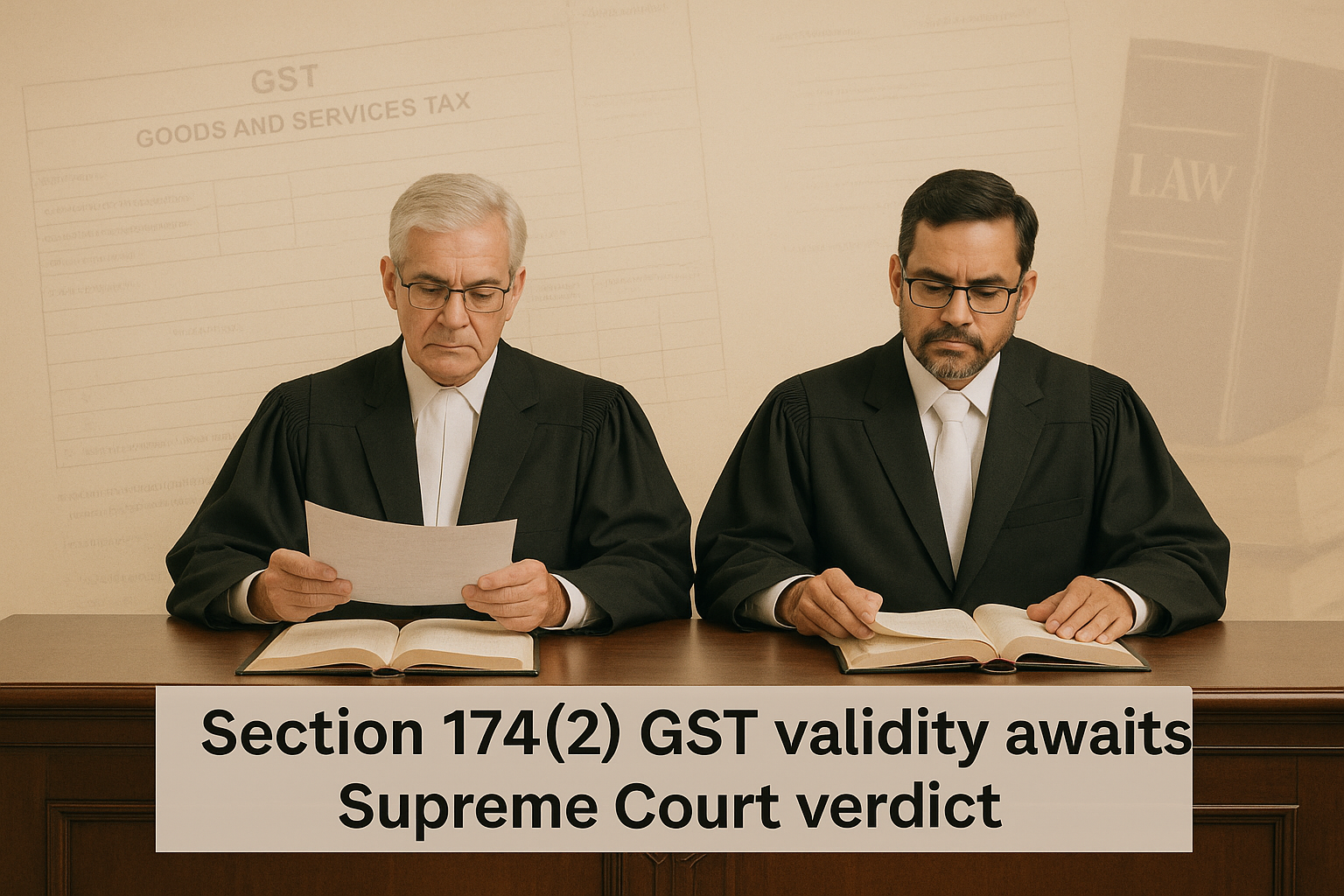
Case Title: Tecnimont SPA India Project Office & Others v. State of Punjab & Others
Court: High Court of Punjab and Haryana, Chandigarh
Petition No.: CWP-18967-2020 (O&M) and connected 65 petitions
Date of Judgment: 10.12.2024
Category: Constitutional Validity – Transitional Provisions under GST
Relevant Section: Section 174(2) of the Punjab/Haryana State Goods and Services Tax Acts, 2017 (corresponding to Section 174(2) of the CGST Act, 2017)
Facts:
(Paras 1–3)
A batch of 66 writ petitions was filed before the Punjab & Haryana High Court challenging the constitutional validity of Section 174(2) of the Punjab and Haryana GST Acts, 2017. The said provision allows continuation of proceedings, investigations, and recovery under the erstwhile VAT/Service Tax regimes even after the advent of GST. Petitioners contended that such retrospective continuation was unconstitutional and ultra vires the framework of the GST legislation, which replaced all indirect tax laws with effect from 1 July 2017.
The State Governments of Punjab and Haryana, supported by the Union of India, defended the provision as a necessary transitional measure ensuring continuity of tax administration, relying on similar provisions upheld earlier by the Kerala High Court in T.S. Belaraman v. Commercial Tax Officer.
Questions for Determination:
(Para 1–3)
Whether Section 174(2) of the State GST Acts, which permits continuation of legacy proceedings post-GST implementation, violates the constitutional framework of GST under Articles 246A and 279A of the Constitution of India, or is within the legislative competence of the respective States.
Observations:
(Paras 3–5)
The Bench noted that the Kerala High Court had already upheld the validity of Section 174(2) in T.S. Belaraman and similar cases, ruling it consistent with constitutional principles. The said judgment has now been challenged before the Supreme Court of India through C.A. No. 006724/2024 [arising out of SLP(C) No. 640/2023], wherein the Supreme Court, by order dated 14.05.2024, granted leave and passed an interim order restraining the Revenue from taking coercive measures under the impugned provision.
The Punjab & Haryana High Court observed that since the Supreme Court is seized of the matter, and the outcome will determine the constitutional validity of Section 174(2) nationally, there is no need for parallel adjudication by individual High Courts.
Judgment:
(Paras 5–8)
The Court disposed of all 66 writ petitions with the following directions:
-
The challenge to Section 174(2) of the GST Act shall be subject to the final outcome of the Supreme Court’s decision in T.S. Belaraman v. Commercial Tax Officer & Others.
-
All interim orders passed earlier by the High Court in respective cases shall continue to operate until the Supreme Court pronounces its final judgment.
-
No coercive steps shall be taken against the petitioners in the meantime.
-
All connected miscellaneous applications were also disposed of.
Summary of Referred Case:
| Case Name | Court | Issue | Verdict |
|---|---|---|---|
| T.S. Belaraman v. Commercial Tax Officer & Others | Kerala High Court | Constitutional validity of Section 174(2) of the Kerala GST Act, 2017 | Upheld provision as intra vires; held that saving clause enabling continuation of pre-GST proceedings does not violate constitutional scheme. Pending before the Supreme Court (SLP(C) No. 640/2023, leave granted 14.05.2024). |
Between Fine Lines:
The High Court has effectively placed the question of the constitutional validity of Section 174(2) in abeyance, leaving it for final determination by the Supreme Court. For trade and industry, this means that pending VAT/Service Tax investigations or recovery proceedings under the pre-GST regime remain in suspension but not extinguished. Businesses should monitor the forthcoming Supreme Court verdict closely, as it will conclusively decide whether legacy proceedings can lawfully continue after the GST regime commenced.
Disclaimer – “The above summary is for academic purpose only; not formal legal opinion. Seek professional opinion before application. Author or publisher or website shall not be responsible for any usage in any form.”

 SGST Act, 2017, making their validity subject to the Supreme Court’s forthcoming ruling in T.S. Belaraman.)