
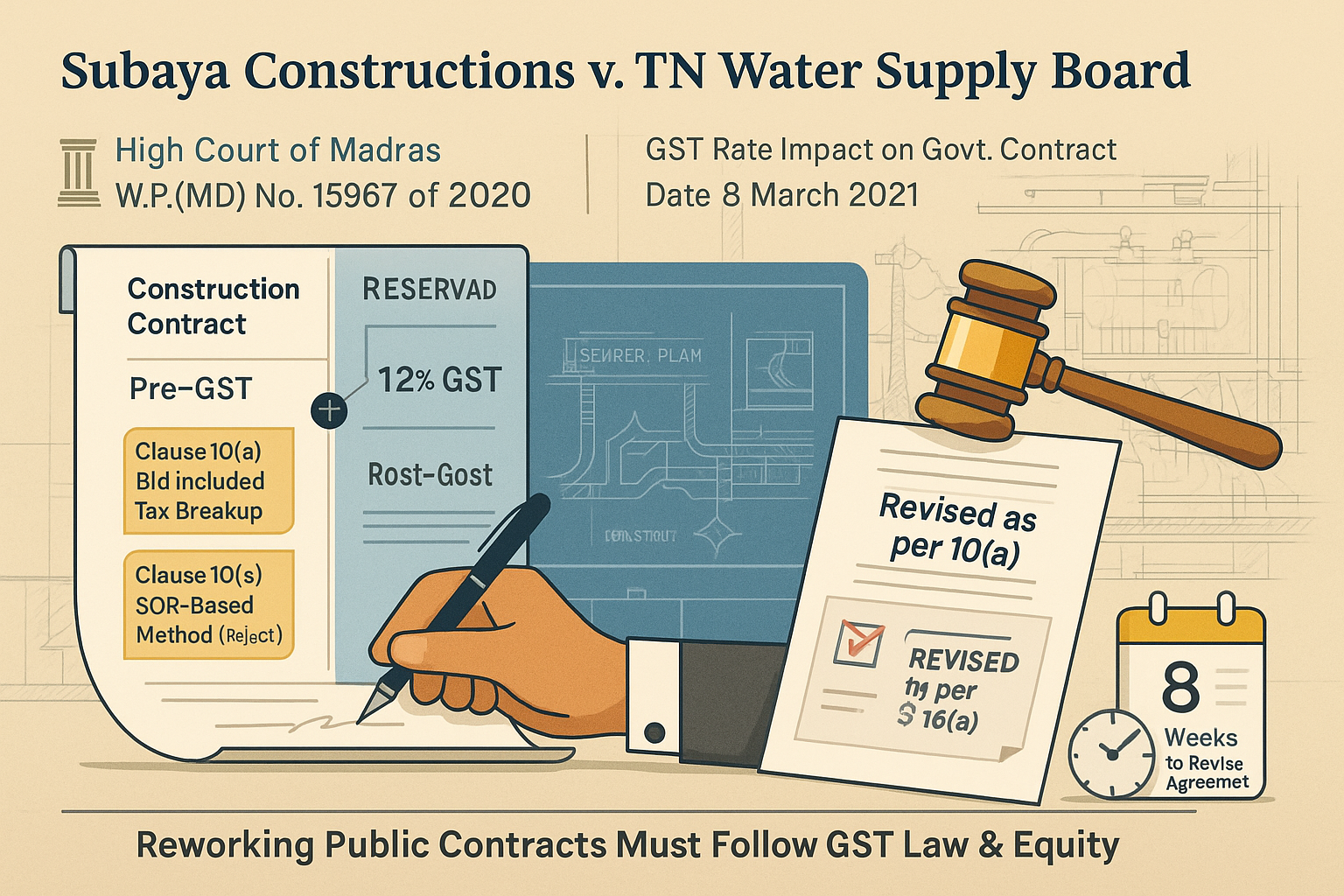
Case Title: Subaya Constructions Company Ltd. v. Tamil Nadu Water Supply and Drainage Board
Court: High Court of Madras
Petition No.: W.P.(MD) No. 15967 of 2020
Date of Judgment: 8 March 2021
Category of Dispute: Rate of GST / Reworking of Contractual Tax Components Post-GST
Relevant Provisions:
Clause 46 of contract (pre-GST TDS deduction)
G.O.Ms. No. 296 Finance (Salaries) Department dated 9-10-2017
Para 10(a), 10(b), 10(c) and Para 11 of the above GO
Relevant Sections of CGST Act: Sections 9 and 15 (levy and value of supply)
Facts of the Case [Paras 2–5, 9–12]
- The petitioner entered into a contract with the Tamil Nadu Water Supply and Drainage Board on 25.01.2016 for underground sewerage works for Karaikudi Municipality, inclusive of TNVAT and excise duty [Para 2].
- Clause 46 of the contract prescribed TDS of 2% for civil works and 5% for other works [Para 3].
- With the introduction of GST from 01.07.2017, the tax regime changed—works contracts were uniformly taxed at 12%, necessitating contract reworking [Para 3].
- G.O.Ms.No.296 dated 09.10.2017 laid down three methods (para 10(a), (b), (c)) to compute subsumed tax in contract value [Para 5].
- The petitioner claimed its contract should be reworked using method 10(a) (bid had break-up of taxes), but the respondents applied 10(c) (SOR-based estimation) [Paras 6–7].
- Petitioner alleged coercion in signing a revised agreement due to fund-release pressure post-GST [Para 12].
Question(s) in Consideration [Paras 6–7, 13]
- Whether the petitioner’s contract should be revised using clause 10(a) or 10(c) of G.O.Ms. No. 296 for determining the GST impact?
- Whether the petitioner can be bound by a revised agreement allegedly signed under financial duress?
Observation of Court [Paras 8–15]
- The court noted the contract clearly included a tax component at pre-GST rates (2%-5%) and that post-GST, this increased to 12% [Para 9].
- The government policy under G.O.Ms. No. 296 mandates that the GST burden be borne by the purchaser, not contractor [Para 9].
- The contract had item-wise quoted rates inclusive of taxes, and there was no departmental schedule of rates attached to the tender, making clause 10(c) inapplicable [Para 9].
- The court referred to its own previous ruling in W.P.Nos. 21196 and 21198 of 2019 (Subaya with Salem Municipal Corp.), where clause 10(a) was applied [Para 10].
- Court accepted the petitioner’s explanation that the revised agreement was signed due to financial compulsion, not free consent [Paras 12–13].
- Paragraph 11 of the GO allows adopting the highest value among (a), (b), or (c), but the tax burden must still fall on the Board, not the contractor [Para 15].
Judgment of the Court [Paras 14–16]
- The High Court directed the respondent Board to rework the contract terms applying para 10(a) of G.O.Ms. No. 296 [Para 14].
- The Board is required to recalculate the tax component and revise the agreement accordingly, ensuring that the contractor is not saddled with GST burden [Para 15].
- The entire exercise must be completed within 8 weeks of receipt of the order [Para 15].
- Writ petition allowed. No costs [Para 16].
Between Fine Lines
- GST transition altered tax rates, warranting contract price restructuring in public works.
- The government policy mandates that increased GST burden is to be borne by the purchaser, not the contractor.
- When item-wise tax breakup is given, method 10(a) from G.O.Ms. No. 296 applies for reworking.
- A revised agreement signed under financial compulsion does not negate the petitioner’s right to seek proper tax adjustment.
- The court reaffirmed that public authorities must act in line with declared tax policies and equitable treatment.
Summary of Referred Cases
| Name | Citation | Summary | Verdict |
| Subaya Constructions Company Ltd. v. Salem City Municipal Corporation | W.P.Nos. 21196 & 21198 of 2019 | Subaya had a similar contract with Salem Corporation; the court held that price restructuring post-GST must follow para 10(a) and para 12 of G.O.Ms.No.296 | Court ruled in favor of Subaya and directed recalculation under para 10(a) |