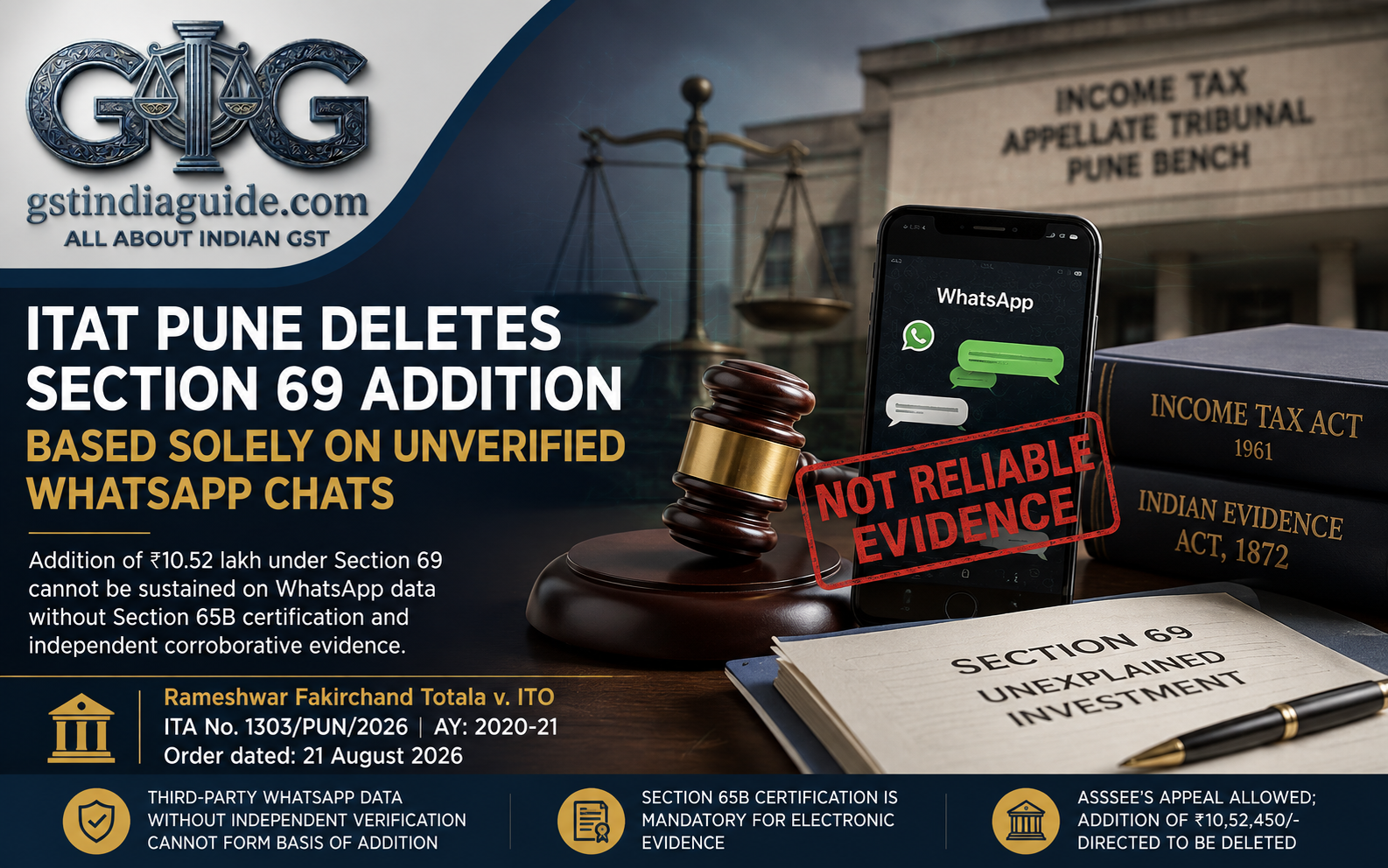
The Pune Bench of the Income Tax Appellate Tribunal, in Rameshwar Fakirchand Totala v. ITO, Ward 1(1), Aurangabad, has deleted an addition of ₹10,52,450 made under Section 69 of the Income-tax Act, 1961, where the addition was founded essentially upon WhatsApp data recovered from the mobile phone of a third party during a search. The Tribunal held that such electronic material, in the absence of the prescribed certification and independent corroborative evidence, could not form the basis of the addition.
The case concerned Assessment Year 2020-21 and arose from a search and seizure action under Section 132 conducted on 30 November 2023 in the case of the Manjeet Pride Group, Gadiya Group and associated entities. During the search, WhatsApp data was recovered from the mobile phone of Shri Prakash Motwani. On the basis of information subsequently forwarded to the Assessing Officer, the assessee’s assessment was reopened under Section 148. The assessee had filed a return declaring total income of ₹36,62,110.
According to the Assessing Officer, the WhatsApp material indicated payments aggregating to ₹10,52,450 towards “Bhisi” transactions during Financial Year 2019-20. Treating the amount as an unexplained investment, the Assessing Officer made an addition under Section 69. The CIT(A)/NFAC subsequently upheld the addition.
Before the Tribunal, the assessee challenged the reassessment as well as the addition on several grounds. It was contended, among other things, that the proceedings were based upon third-party material without adequate independent verification, complete copies of the electronic material were not supplied, cross-examination of Shri Prakash Motwani was not afforded, and there was no independent evidence establishing that the assessee had actually made the alleged investment.
A significant objection concerned the evidentiary value of the WhatsApp data. The assessee argued that electronic records could not be relied upon without compliance with Section 65B of the Indian Evidence Act, 1872, and also referred to Section 79A of the Information Technology Act, 2000. Reliance was placed upon the Supreme Court ruling in Arjun Panditrao Khotkar v. Kailash Kushanrao Gorantyal concerning certification of electronic evidence.
ITAT’s Findings
The Tribunal observed that the entire basis of the addition was the WhatsApp chats retrieved from Shri Prakash Motwani’s mobile phone. It further noted that although similar cases had apparently been reopened on the basis of information gathered during the search, the Assessing Officer had not brought on record the final outcome of additions made in any such other cases.
Importantly, the Tribunal held that the presumption under Section 132(4A) attaching to material found during search could not be used to bind a third party in the manner sought by the Revenue. The Tribunal also found that the authenticity of the WhatsApp chats had not been established by satisfying the requirement of certification under Section 65B of the Indian Evidence Act. Apart from the WhatsApp material recovered from Shri Motwani’s mobile phone, the Department had no other independent evidence against the assessee.
Referring to the Supreme Court decision in Arjun Panditrao Khotkar, the ITAT observed that a certificate under Section 65B(4) is a condition precedent for admissibility of electronic records. The Tribunal also recorded that the Revenue had not demonstrated compliance with the requirements referred to under Section 79A of the Information Technology Act, 2000.
Accordingly, the ITAT concluded that an addition merely on the basis of WhatsApp data recovered from a third party could not be sustained in the facts of the case. It set aside the order of the CIT(A)/NFAC and directed the Assessing Officer to delete the addition of ₹10,52,450. The assessee’s appeal was allowed.
Key Legal Takeaway
The ruling emphasises the evidentiary safeguards applicable where an Income Tax addition is founded upon electronic material recovered from a third party. On the facts before it, the Tribunal refused to sustain a Section 69 addition where the Department relied essentially upon WhatsApp chats without the required electronic evidence certification and without independent corroborative material establishing that the assessee had actually made the alleged unexplained investment.
The decision is particularly relevant to reassessment and search-related proceedings involving WhatsApp chats, mobile-phone extracts, digital records and third-party electronic evidence, especially where such material is used as the principal basis for alleging undisclosed transactions.