
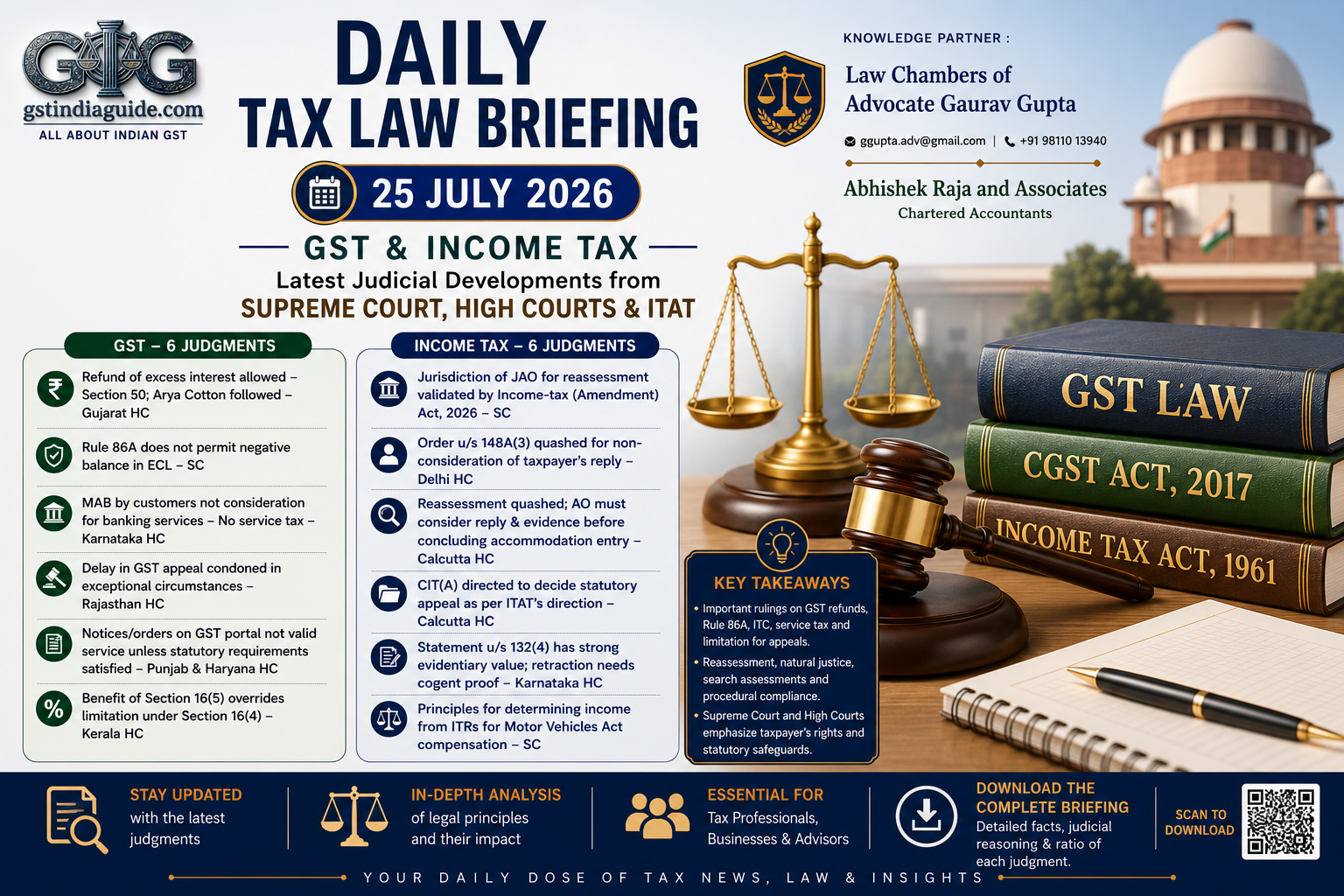
The Daily Tax Law Briefing – 25 July 2026 presents the latest judicial developments under the Goods and Services Tax (GST) and Income-tax laws. This edition analyses twelve significant judicial pronouncements, comprising six GST judgments and six Income Tax decisions, delivered by the Supreme Court of India, Gujarat High Court, Karnataka High Court, Rajasthan High Court, Punjab & Haryana High Court, Kerala High Court, Delhi High Court and Calcutta High Court. The rulings examine important issues relating to GST interest refunds, Rule 86A, service tax, limitation for GST appeals, input tax credit, reassessment proceedings, search assessments and principles of natural justice.
The GST section features several important rulings concerning refund of excess interest, electronic credit ledger restrictions and statutory appellate remedies. The Gujarat High Court held that where sufficient balance existed in the Electronic Cash Ledger, interest under Section 50 of the CGST Act is payable only up to the date of deposit into the ledger and not until the delayed filing of the return. The Court quashed the rejection of the refund application, directed refund of the excess interest with statutory interest, and imposed costs on the authorities for failing to follow the binding precedent in Arya Cotton Industries.
Another significant ruling came from the Supreme Court in Union of India v. M/s K K Alloys, where the Court declined to interfere with the Punjab & Haryana High Court’s decision holding that Rule 86A of the CGST Rules does not empower authorities to create a negative balance in the Electronic Credit Ledger. The High Court had clarified that Rule 86A permits only temporary restriction of the existing Input Tax Credit available in the ledger and does not authorise blocking future credits. While dismissing the Revenue’s Special Leave Petitions, the Supreme Court kept open the Department’s liberty to recover any wrongly availed credit through the statutory mechanisms available under the CGST Act.
The briefing also covers important GST decisions on service tax, appellate remedies and input tax credit. The Karnataka High Court held that maintenance of Minimum Average Balance (MAB) by bank customers does not constitute consideration for banking services and therefore cannot be subjected to service tax under the Finance Act, 1994. The Rajasthan High Court exercised its writ jurisdiction to condone delay in filing a GST appeal where exceptional circumstances prevented the taxpayer from approaching the appellate authority within the statutory period. The Punjab & Haryana High Court reiterated that merely uploading notices and orders under the “View Additional Notices and Orders” tab on the GST portal does not amount to valid service under the CGST Act unless statutory requirements are satisfied. The Kerala High Court also held that the benefit of Section 16(5) overrides the limitation under Section 16(4) where the relevant returns were filed before the statutory cut-off date, remanding the matter for reconsideration of the taxpayer’s Input Tax Credit claim.
The Income Tax section analyses six significant judicial pronouncements concerning reassessment, appellate remedies, natural justice and evidentiary principles. The Supreme Court in Income Tax Officer, Ward 2(1), Chandigarh v. Tej Partap Singh held that the retrospective amendments introduced by the Income-tax (Amendment) Act, 2026 validate the jurisdiction of Jurisdictional Assessing Officers to issue reassessment notices. The Court accordingly set aside the High Court judgment only on the jurisdictional issue and remitted the matters for fresh consideration on all remaining questions.
The briefing further includes important rulings safeguarding procedural fairness. The Delhi High Court quashed an order passed under Section 148A(3) after finding that the Assessing Officer failed to consider the taxpayer’s reply before issuing the reassessment notice. Similarly, the Calcutta High Court held that reassessment proceedings cannot continue where the Assessing Officer fails to properly examine the taxpayer’s explanations and supporting documents before concluding that transactions constitute accommodation entries. The Court therefore remanded the matter for fresh consideration after granting an effective opportunity of hearing. The Calcutta High Court also directed the Commissioner (Appeals) to comply with the Income Tax Appellate Tribunal’s earlier direction and dispose of the pending statutory appeal through a reasoned order.
Another noteworthy decision comes from the Karnataka High Court, which reaffirmed that a statement recorded during a search under Section 132(4) carries substantial evidentiary value and cannot be retracted merely by filing a return inconsistent with the original admission. The Court held that any retraction must be prompt and supported by cogent evidence demonstrating coercion or duress. In the absence of such evidence, the addition made under Section 69 was rightly sustained. The Supreme Court also laid down important principles governing the determination of income from Income Tax Returns while computing compensation under the Motor Vehicles Act, distinguishing between salaried individuals and self-employed persons.
The Daily Tax Law Briefing – 25 July 2026 serves as a valuable resource for advocates, chartered accountants, company secretaries, tax consultants, businesses and corporate tax teams seeking concise updates on the latest judicial developments. It provides practical insights into GST litigation, reassessment proceedings, procedural safeguards and statutory interpretation while helping professionals remain informed of emerging judicial trends.
, reassessment, natural justice, service tax and search assessments.)