
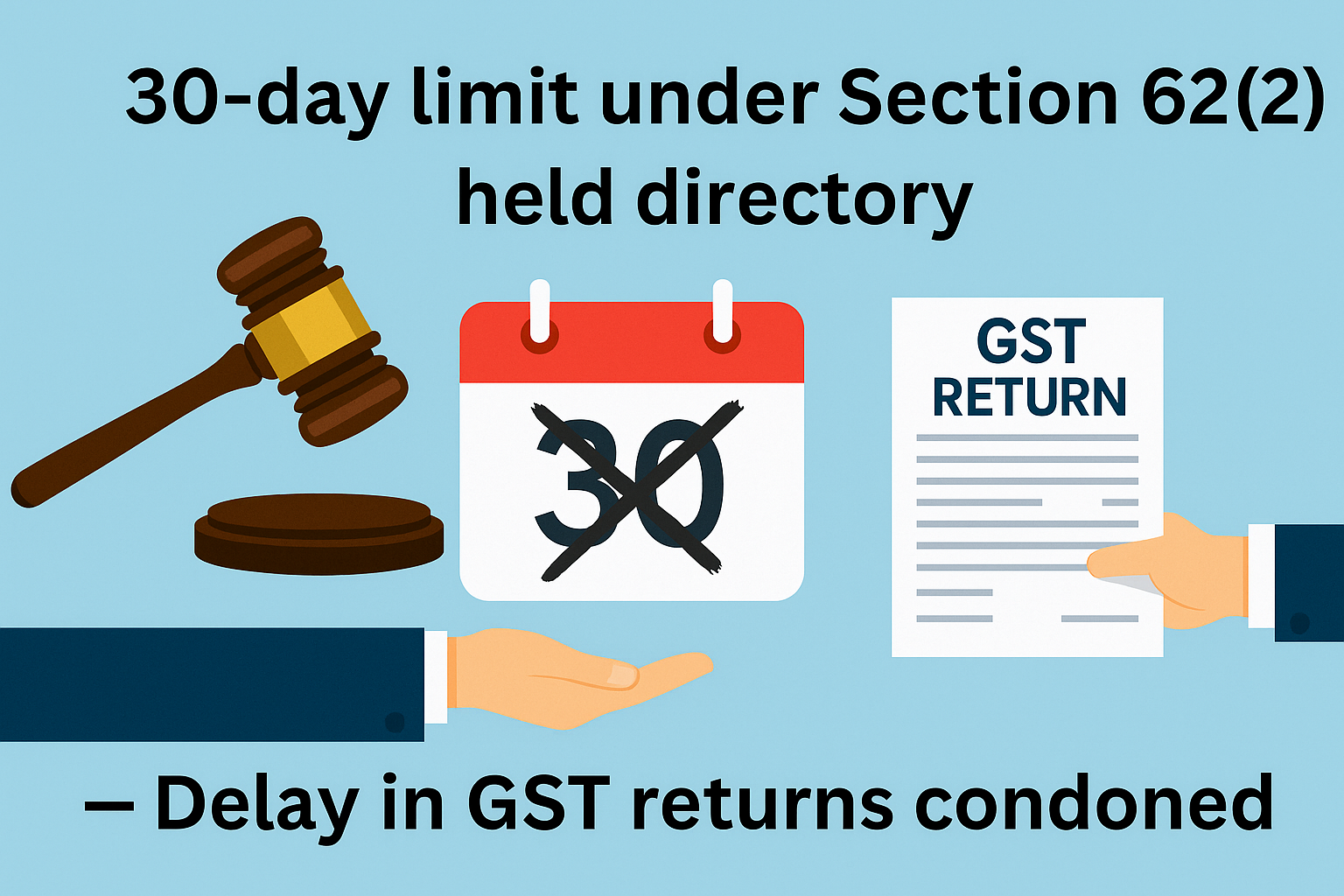
Case Title: Tvl. Solutions Online vs. Assistant Commissioner (ST), Velandiyapalayam Assessment Circle, Coimbatore
Court: Madras High Court
Petition No.: W.P. Nos. 10766, 10816, 10831 & 10834 of 2025
Date of Judgment: 27.03.2025
Relevant Sections: Section 62(1) & (2) and Section 74 of the CGST/TNGST Act, 2017
Category: Assessment of Non-filers of Returns / Condonation of Delay
Facts (Paras 3–5)
The petitioner, Tvl. Solutions Online, challenged four assessment orders issued under Section 62 of the TNGST Act, 2017 for October 2023 to January 2024. The orders were passed since the monthly returns were not filed within the prescribed time. Subsequently, the petitioner filed returns belatedly in July 2024, explaining that financial hardship caused the delay. However, the Department rejected the returns as time-barred under Section 62(2), which prescribes filing within 30 days from service of assessment order.
The petitioner argued that Section 62(2) should be read with Section 74, which allows the Department to complete best-judgment assessment within five years from the end of the financial year. Hence, the right to file returns cannot be curtailed merely because the 30-day period expired early.
Questions for Determination (Para 4–6)
Whether the 30-day limit under Section 62(2) for filing returns post best-judgment assessment is mandatory, thereby extinguishing the right to file, or merely directory, permitting delay to be condoned on valid grounds?
Observations (Paras 7–9)
The Court relied heavily on its earlier ruling in W.P. No. 34770 of 2023 (Order dated 14.12.2023), where it had held that:
-
Section 62(2) of the GST Act is directory, not mandatory.
-
The taxpayer’s right to file valid returns remains intact during the five-year window available for best-judgment assessment under Section 74.
-
Authorities may condone delay if sufficient cause is shown, provided the taxpayer pays interest and late fee as applicable.
Justice Krishnan Ramasamy reiterated that the legislative intent of Section 62(2) is to facilitate compliance, not to deprive the taxpayer of the right to regularize their returns. Hence, denial of the opportunity solely on account of 30-day delay would be unjust and contrary to the scheme of the Act.
Judgment (Paras 9–10)
The Court condoned the delay in filing the GST returns for the relevant months and directed as follows:
-
The petitioner shall file an application for condonation of delay within 15 days from receipt of the order.
-
The Assessing Officer shall consider the application, and upon satisfaction with the reasons, permit filing of revised returns.
-
Upon filing of revised returns, the impugned assessment orders dated 08.03.2024, 12.01.2024, 12.02.2024, and 11.03.2024 shall stand withdrawn.
-
The Department retains the liberty to levy applicable late fees for the delayed period.
Thus, the writ petitions were disposed of, upholding the right of the taxpayer to regularize delayed returns even after expiry of 30 days, subject to payment of statutory dues.
Between Fine Lines
This judgment reiterates that procedural timelines under Section 62(2) are directory — taxpayers can still file returns beyond 30 days if justified. Authorities must adopt a facilitative approach and permit delayed filing with condonation, especially when tax compliance intent is evident. The decision provides crucial relief for businesses facing financial or technical constraints in timely return submission.
Summary of Cases Referred
| Case | Citation | Held |
|---|---|---|
| Tvl. Solutions Online v. AC (ST) | W.P. Nos. 10766, 10816, 10831 & 10834 of 2025 (Madras HC, 27.03.2025) | Delay in filing returns condoned; Section 62(2) directory; 30-day limit not absolute. |
| W.P. No. 34770 of 2023 | Madras HC (14.12.2023) | Laid down principle that right to file returns survives beyond 30 days; delay can be condoned with justification. |
Disclaimer – “The above summary is for academic purpose only; not formal legal opinion. Seek professional opinion before application. Author or publisher or website shall not be responsible for any usage in any form.”



 of the GST Act is directory, allowing condonation of delay in filing GST returns beyond the prescribed period.)