


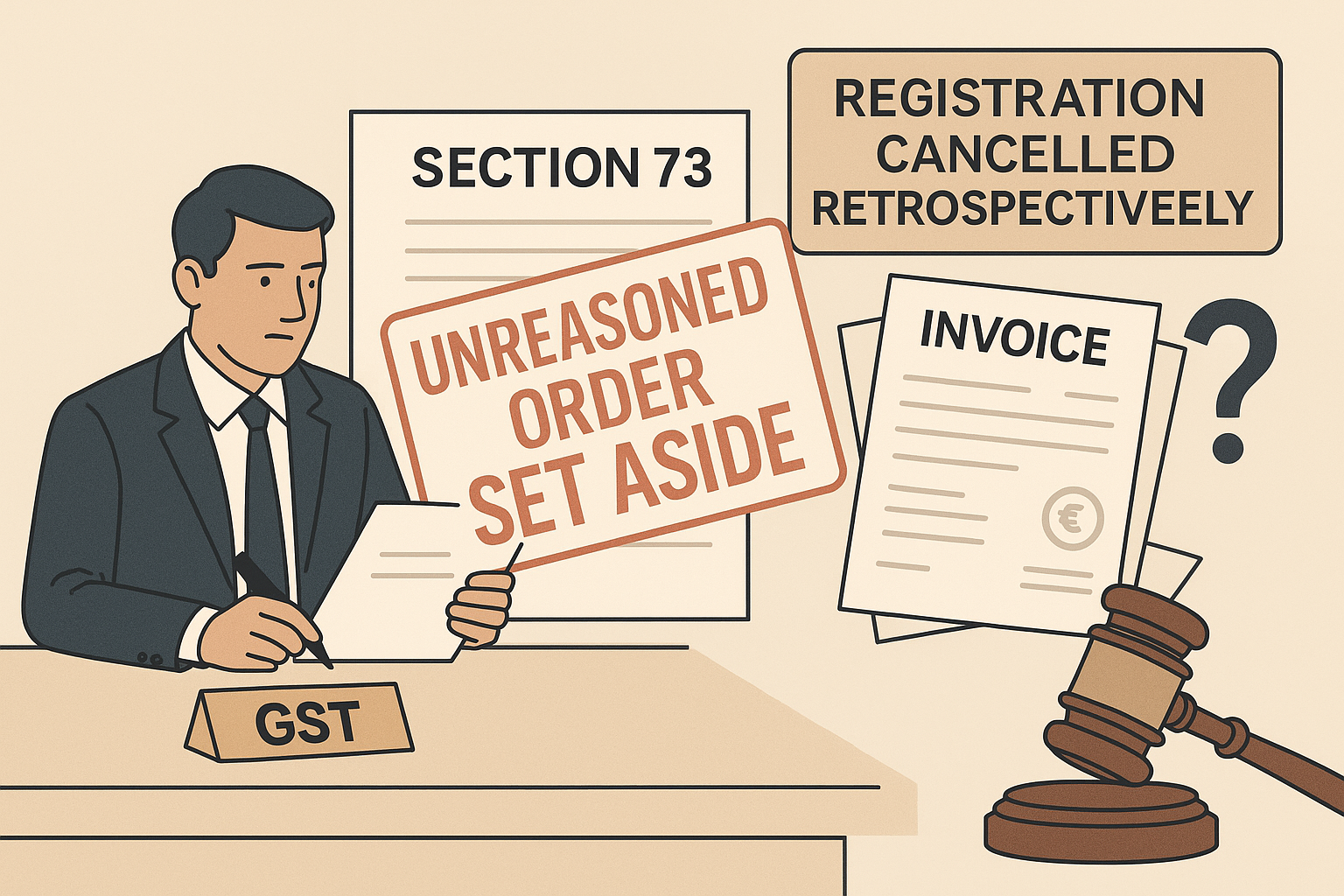
M/s APN Sales and Marketing v. Union of India & Anr.
Delhi High Court | W.P.(C) 9536/2024 | Decision dated 15.07.2024
Category: Input Tax Credit (ITC) – Alleged excess ITC on supplies from a supplier whose registration was retrospectively cancelled
Relevant Provisions: Sections 16(2)(b), 16(2)(c), 73, 168A CGST Act; corresponding DGST Act provisions
Facts (Paras 3–8, 10–11)
The petitioner, a registered dealer, was served with a show cause notice dated 26.09.2023 alleging excess ITC of ₹17,43,356/− for FY 2017-18. The basis recorded in the annexure was that purchases were made from Modern Traders, whose GST registration had been cancelled retrospectively w.e.f. 01.07.2017 (para 6). According to the department, invoices from a retrospectively cancelled supplier disentitled ITC under Section 16(2)(c).
The petitioner replied on 23.11.2023, enclosing invoices, ledger accounts, and banking proofs of payment to the supplier (para 7). No allegation was made in the SCN that the petitioner failed to receive goods under Section 16(2)(b). No material was provided to establish that Modern Traders had not paid the tax (para 8).
Despite this, the adjudicating authority passed an order dated 29.12.2023 raising a demand of ₹18,30,522/−, dismissing the petitioner’s reply merely on the ground that it was “not satisfactory” without providing reasons (para 9).
At the hearing, the department attempted to introduce a new ground that the case involved “goods-less invoices”, asserting absence of e-way bills and proof of receipt of goods (para 10). However, the High Court noted that the SCN carried no allegation under Section 16(2)(b) regarding non-receipt of goods, and the adjudicating authority had not invoked such reasoning (para 11).
Questions / Issues (Integrated from paras 3–11 & 12–15)
-
Whether ITC can be denied solely on the basis that the supplier’s registration was cancelled retrospectively, even if the assessee produced invoices and payment proof.
-
Whether the adjudicating authority’s order satisfies the requirement of a reasoned order under Section 73 proceedings.
-
Whether new grounds such as “goods-less invoices” can be introduced at the stage of arguments when the SCN did not contain such allegations.
-
Whether the assessee should be relegated to the appellate remedy, or whether the writ court can intervene in light of an unreasoned order.
Court’s Observations (Paras 8–15)
The Court observed that the adjudicating authority failed to record any finding on crucial aspects, including:
-
No examination of the petitioner’s documents showing that purchases were made from Modern Traders and tax-inclusive payments were made (para 8).
-
No finding whether the supplier failed to deposit tax, which was the foundation of the SCN under Section 16(2)(c) (para 8).
-
The order merely stated that the reply was “not satisfactory”, which the Court held to be unreasoned and legally inadequate (para 9).
-
The attempt to shift the basis of denial to Section 16(2)(b) (non-receipt of goods) was impermissible because the SCN contained no such allegation (para 11).
-
Proceedings under Section 73 must comply with the principles of natural justice, requiring reasoned adjudication reflecting application of mind (para 9).
The Court held that relegating the petitioner to the appellate remedy was inappropriate in the circumstances because the order suffered from foundational illegality (para 12).
Judgment / Final Directions (Paras 12–16)
The High Court:
-
Set aside the order dated 29.12.2023 as being unreasoned (para 13).
-
Remanded the matter to the adjudicating authority for fresh consideration in accordance with law, after granting a proper hearing (para 13).
-
Permitted the petitioner to furnish additional documents, including evidence of receipt of goods, in view of subsequent allegations by the department (para 14).
-
Clarified that the challenge to the Section 168A notification dated 31.03.2023 was not adjudicated and remains open to be raised later (para 15).
-
Disposed of the writ petition in above terms (para 16).
Between Fine Lines – Practical Takeaways
-
Retrospective cancellation of supplier’s registration cannot automatically lead to ITC denial. Authorities must first establish that the supplier failed to deposit tax or that the recipient did not receive goods.
-
SCN must disclose all allegations. New grounds cannot be introduced later.
-
Adjudication under Section 73 must be reasoned. A mechanical order will be quashed even if an appellate remedy exists.
-
Businesses must maintain strong evidentiary trails—invoices, ledger entries, bank statements, e-way bills—as subsequent department allegations may shift.
Cases Referred – Summary Table
(This judgment does not expressly cite external cases; therefore, no case-law table arises.)
Disclaimer – “The above summary is for academic purpose only; not formal legal opinion. Seek professional opinion before application. Author or publisher or website shall not be responsible for any usage in any form.”

