
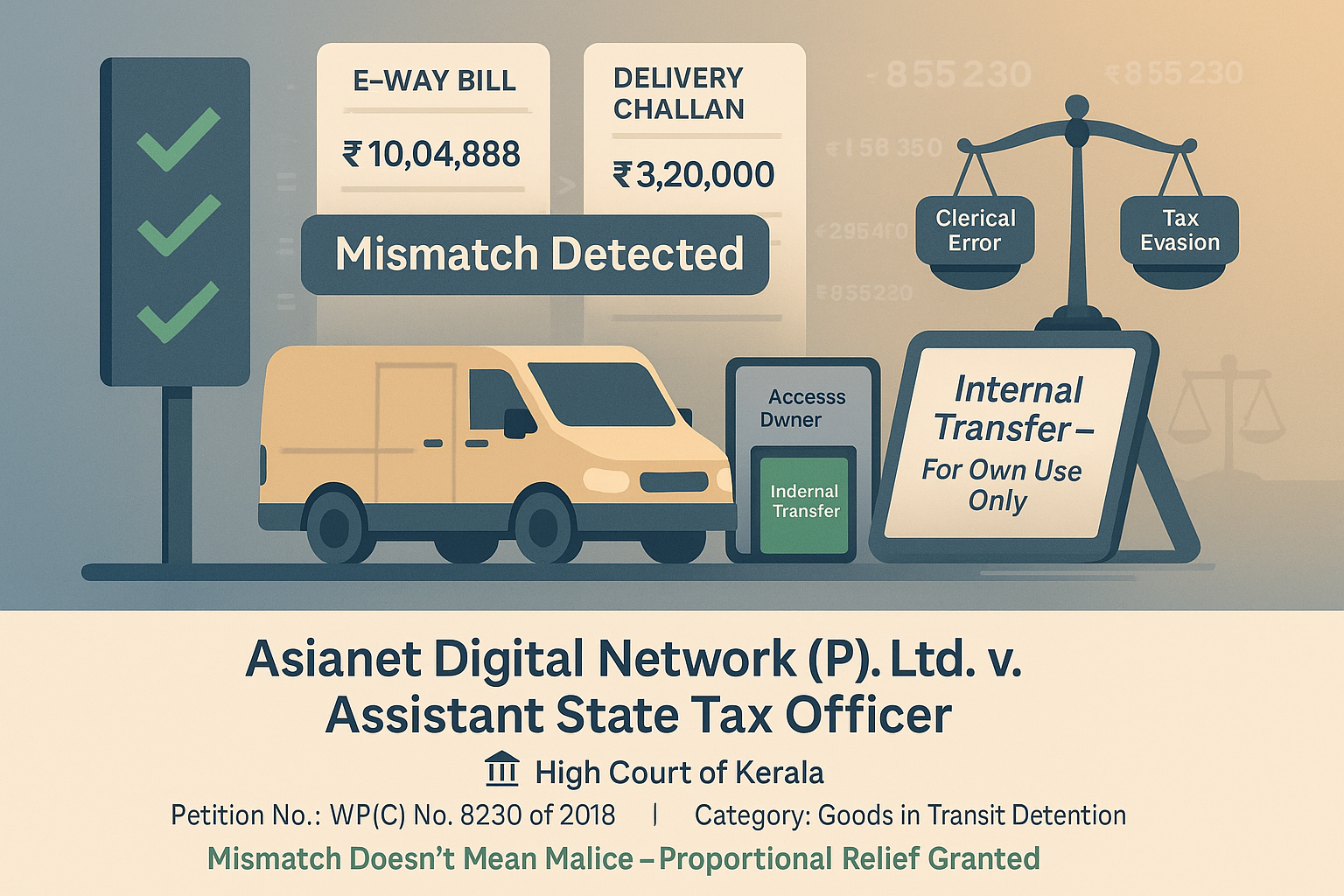
Case Title: Asianet Digital Network (P.) Ltd. v. Assistant State Tax Officer
Court Name: High Court of Kerala
Petition Number: W.P. (C) No. 38747 of 2018
Date of Judgement: 29 November 2018
Category of Dispute: Detention of Goods / E-way Bill Mismatch
Relevant Section: Section 129 of CGST Act, 2017
Facts of the Case
- The petitioner, Asianet Digital Network (P.) Ltd., a provider of cable TV and internet services, was transporting set-top boxes when their vehicle was intercepted and detained by the Assistant State Tax Officer (ASTO) on 14.11.2018 citing discrepancies in documents [Para 1].
- The discrepancy involved a mismatch between the value mentioned in the e-way bill (Rs. 10,04,888) and the delivery challan (Rs. 3,20,000) [Para 2].
- According to the petitioner, the delivery challan divided the goods into two lots: 200 boxes valued at Rs. 3,20,000 and 600 boxes with zero value, the latter due to a computer error. However, the e-way bill correctly reflected the total value [Para 3].
- The petitioner contended that the goods were moved internally between business locations for own use and hence were not subject to tax under Section 129 [Para 4].
Question(s) in Consideration
- Whether the mismatch between the e-way bill and delivery challan justified the detention of goods under Section 129 of the CGST Act? [Para 2]
- Whether tax and penalty could be imposed on the entire consignment in the absence of intent to evade tax? [Para 6]
Observations of the Court
- The Court noted that the delivery challan did contain the full quantity (800 set-top boxes) though the value for 600 of them was shown as zero, which was explained as a clerical error [Para 3].
- The mismatch, while technically incorrect, did not necessarily imply suppression or intent to evade tax, especially since the e-way bill carried the correct value [Para 3].
- The Department was within its rights to invoke Section 129(1)(a), but imposing tax and penalty on all 800 boxes without considering the partial compliance (200 boxes declared) was disproportionate [Para 6].
Judgement of the Court
The High Court held that while the Department could invoke Section 129(1)(a) for interim release, the demand should be limited to the 600 boxes not valued in the delivery challan. It allowed the petitioner to release the goods by furnishing a bank guarantee and personal bond limited to the value of these 600 boxes. The writ petition was disposed of with these directions [Para 6].
Between Fine Lines
- Clerical/documentary mismatch alone does not prove tax evasion.
- Courts may allow partial relief where compliance is partly established.
- E-way bill value being correct played a key role in mitigating the penalty.
- Internal transfers for business use without sale do not automatically attract tax.
- Section 129 proceedings must be proportionate to the nature of discrepancy.
Summary of Referred Cases
| Name of Case | Citation | Summary | Verdict |
| No specific external case law was cited in the judgement. | — | — | — |