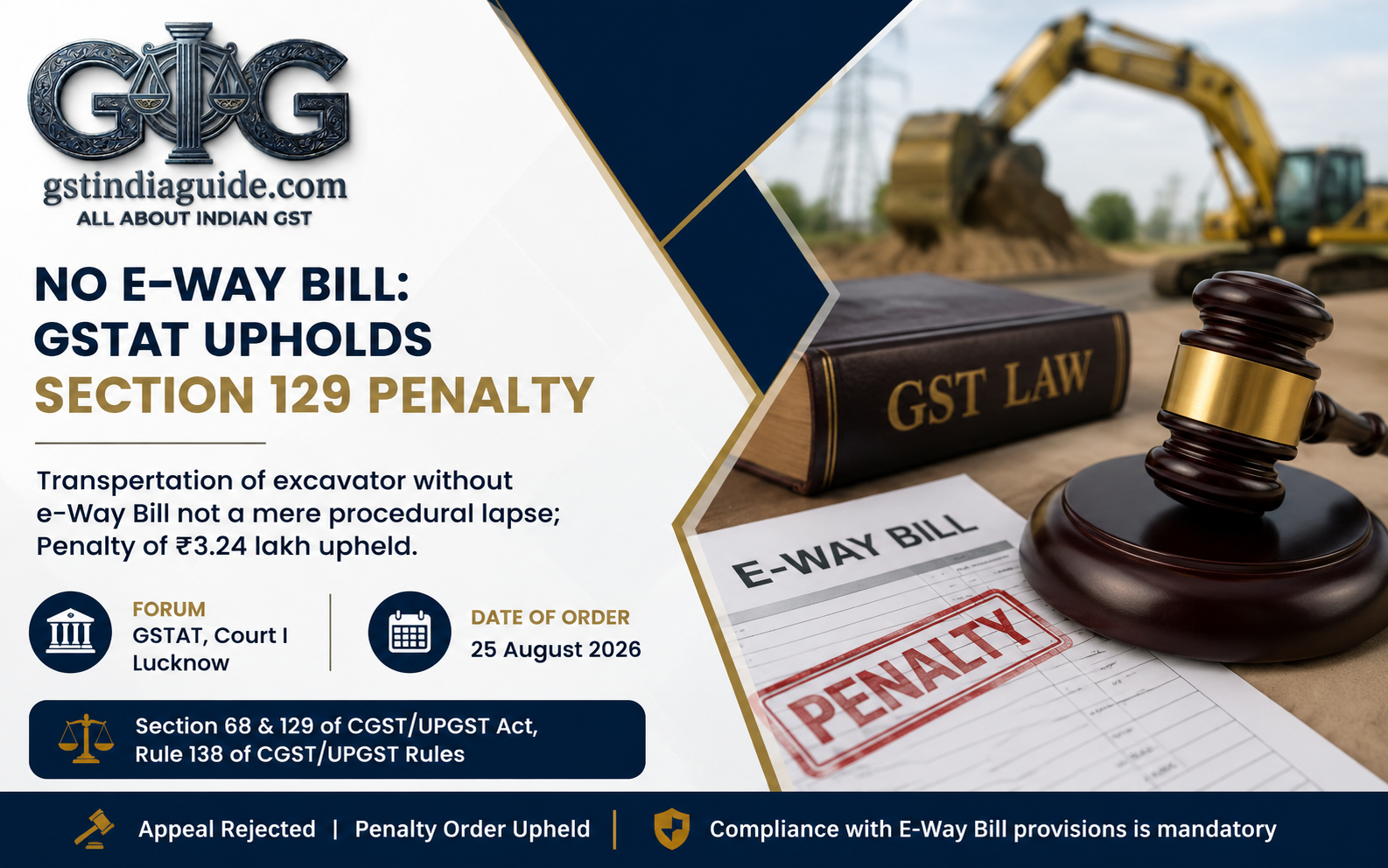
The GSTAT considered an appeal filed by D.S Traders against a penalty imposed under Section 129(3) of the U.P. GST Act, 2017 in connection with transportation of an excavator machine without an e-Way Bill.
The excavator was intercepted on 18 July 2025 while being transported in vehicle No. UP78GN8559. The movement was supported by Delivery Challan No. 01 dated 18 July 2025, but no valid e-Way Bill accompanied the goods. According to the appellant, the excavator had earlier been sent to the work site of M/s OPSIS Projects India Pvt. Ltd. at Trans Ganga City, Unnao, and was being returned to the appellant’s registered place of business at Kanpur. The value of the machine was stated to be approximately Rs. 9 lakh.
The proper officer imposed a total penalty of Rs. 3,24,000, consisting of Rs. 1,62,000 CGST and Rs. 1,62,000 SGST. The first appellate authority subsequently upheld the action.
Appellant’s Contention: No Sale or Tax Evasion
D.S Traders argued that the movement did not relate to a sale. The excavator was its own machinery and was merely being returned from the project site to its registered business premises. Both the consignor and consignee shown in the delivery challan carried the same GSTIN.
The appellant therefore contended that there was no second registered person, buyer, recipient or transferee involved and that the non-generation of an e-Way Bill was, at most, a technical or procedural lapse without any intention to evade tax.
It was also contended that the movement was within 20 kilometres, accompanied by a valid delivery challan, and was therefore claimed to fall within an exemption from the e-Way Bill requirement.
GSTAT: Ownership of Goods Does Not Dispense With E-Way Bill
The Tribunal observed that it was an admitted fact that the excavator had been intercepted while being transported without an e-Way Bill.
Referring to Section 68 read with Rule 138, the GSTAT held that the prescribed documents/e-Way Bill requirements apply to movement of goods, including movement for reasons other than supply, subject to the specified exceptions.
Accordingly, the mere fact that the excavator belonged to the appellant and was being returned to its registered premises did not, by itself, exempt its movement from the e-Way Bill requirement.
Tribunal Rejects Plea of Mere Technical Lapse
An important aspect considered by the Tribunal was the appellant’s inability to satisfactorily establish the tax treatment of the consideration received for use of the excavator at the project site.
Although the appellant stated that the machine was operated on an hourly basis, the Tribunal recorded that sufficient evidence relating to the hours of operation, consideration charged and corresponding discharge of GST had not been produced.
The GSTAT held that this circumstance, coupled with transportation of the machine without an e-Way Bill, gave rise to a reasonable inference of intention to evade tax. The lapse therefore could not be treated merely as a technical or procedural violation.
20-Kilometre Exemption Not Established
The Tribunal also rejected the appellant’s claim that the movement was covered by a 20-kilometre exemption.
It held that the appellant had failed to produce satisfactory evidence demonstrating that the particular movement was specifically covered by the applicable statutory exemption under Rule 138(14) or by any relevant notification issued by the competent authority.
Thus, the claimed exemption could not be accepted merely on assertion.
Judicial Precedents Distinguished
The appellant had relied upon several judicial decisions concerning e-Way Bill violations and procedural lapses. The GSTAT, however, found those precedents distinguishable on their facts.
The Tribunal particularly noted that, in the present case, the appellant had failed to establish the tax treatment of the consideration associated with the use of the excavator and the goods were admittedly transported without an e-Way Bill. It therefore held that the precedents relied upon could not be mechanically applied to the facts before it.
GSTAT’s Ruling
The GSTAT concluded that D.S Traders had failed to establish either:
a valid exemption from the e-Way Bill requirement, or that the absence of an e-Way Bill was merely a procedural lapse having no revenue implications.
Consequently, the Tribunal found the action taken under Section 68 read with Rule 138 and Section 129 of the CGST/UPGST Acts to be justified.
The original adjudicating authority’s order dated 18 July 2025, as well as the First Appellate Authority’s order dated 27 November 2025, were upheld and the appeal was rejected.
Key Legal Principle
Movement of a taxpayer’s own goods for reasons other than supply does not automatically dispense with the statutory e-Way Bill requirement. Where the taxpayer cannot establish a valid exemption and surrounding facts indicate possible revenue implications, transportation without an e-Way Bill may not be treated as a mere technical lapse, and proceedings under Section 129 can be sustained.
Conclusion
The ruling emphasises that the nature of the underlying transaction and the documentary requirements for movement of goods are distinct considerations. Even where goods are merely being returned to their owner and no sale is claimed, the taxpayer must independently establish compliance with the e-Way Bill provisions or demonstrate that the movement falls within a specific statutory exemption.
In D.S Traders, the failure to establish the claimed exemption, together with inadequate evidence regarding the tax treatment of the excavator’s use at the project site, resulted in the Tribunal sustaining the Rs. 3.24 lakh penalty and rejecting the appeal.