

Preamble
The Goods and Services Tax (“GST”) was envisaged as a “one nation, one tax” regime built on the principles of cooperative federalism. However, the duality of governance between Central and State tax administrations occasionally led to overlapping investigations and multiple proceedings on the same transactions, thereby unsettling the very spirit of GST. Section 6(2)(b) of the Central Goods and Services Tax Act, 2017 (“CGST Act”) was introduced precisely to guard against such dual proceedings, yet divergent interpretations had plagued the field. Various High Courts extended relief to taxpayers by quashing parallel proceedings, but the matter remained unsettled until the Supreme Court authoritatively pronounced its ruling on 14 August 2025, bringing finality to the issue. This article analyses the statutory scheme, judicial journey, and the ultimate verdict of the Supreme Court.
The Statutory Framework – Section 6(2)(b) CGST Act
The CGST Act, 2017 embodies the principle of “cross-empowerment” whereby either the Central or the State tax authority can initiate proceedings. However, Section 6(2)(b) makes it clear that:
“Where a proper officer under the State Goods and Services Tax Act or the Union Territory Goods and Services Tax Act has initiated any proceedings on a subject matter, no proceedings shall be initiated by the proper officer under this Act on the same subject matter.”
This statutory injunction ensures a single interface with taxpayers and prevents duplication of proceedings. Yet, the expression “same subject matter” became a fertile ground for disputes, with divergent administrative interpretations leading to double jeopardy for taxpayers.
Judicial Relief by High Courts – A Precursor to the Supreme Court
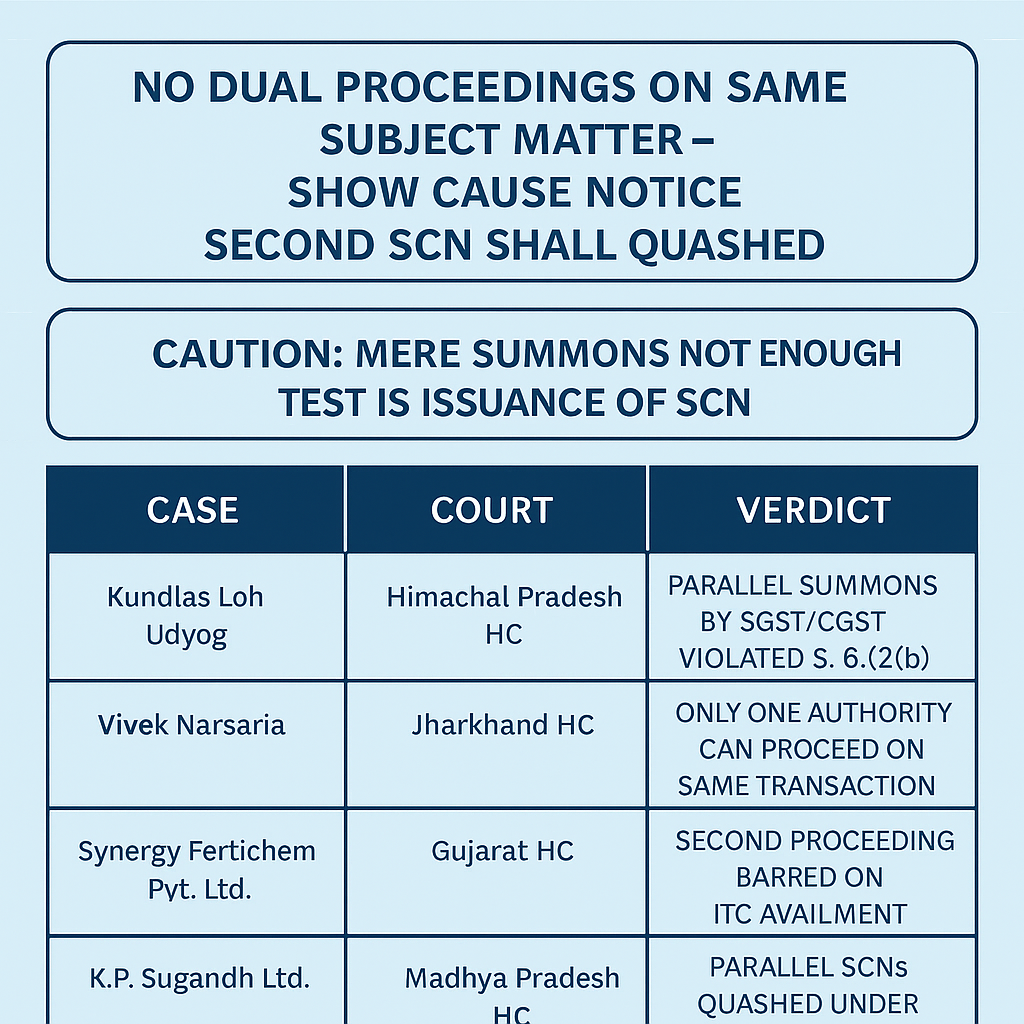
Before the apex court’s intervention, several High Courts were already grappling with taxpayers’ grievances against dual proceedings. They generally leaned towards protecting taxpayers from harassment. The following table summarises some prominent cases referred to by the Supreme Court:
| Case | Court & Citation | Issue | Verdict |
| Kundlas Loh Udyog v. State of HP, CMPMO No. 273 of 17 September 2024 | Himachal Pradesh HC | Parallel summons by SGST and CGST for same suppliers | Held dual summons violated Section 6(2)(b); one proceeding must continue, not both. |
| Vivek Narsaria v. State of Jharkhand, WP (T) No. 4491 of 2023, 15 Jan 2024 | Jharkhand HC | Both SGST and CGST required ITC reversal on same transaction | Struck down dual proceedings; only one authority could proceed on same subject matter. |
| Chief Commissioner of Central Goods and Service Tax v. Safari Retreats Pvt. Ltd. Civil Appeal No. 2948 and 2949 of 2023 | Supreme Court of India | Both CGST and SGST wanted to initiate the proceedigs. | Bar on initiation of any proceeding by proper officer under CGST Act on the same subject matter where proceedings have been initiated by officer under SGST Act |
These rulings reflected a uniform judicial sentiment—that taxpayers must not be subjected to parallel investigations on identical issues, lest it amount to double jeopardy.
The Supreme Court’s Ruling – Final Word on Dual Proceedings
In its landmark decision (Civil Appeal M/s Armour Security ltd. V. Commissioner, CGST, Delhi East Commissionerate & Anr. , SLP (C) No. 6092 of 2025 arising out of W.P. (C) No. 721 of 2022 and connected matters, judgment dated 14.08.2025, delivered by J.B. Pardiwala and R. Mahadevan JJ.), the Supreme Court settled the controversy. The Court observed that the object of Section 6(2)(b) is to eliminate dual proceedings and provide a single interface. It held:
- Any show cause notice issued by one authority for a liability already covered by another SCN must be quashed.
- Authorities are expected to confer and decide inter-se which one will carry the proceedings forward, and the other shall forward all records and materials.
- If no consensus is reached, the authority who initiated proceedings first shall continue, ensuring that the taxpayer faces only one proceeding.
- Taxpayers cannot demand that a particular authority (State or Central) should exclusively handle their matter; the statutory scheme allows both, but not concurrently on the same subject matter.
A Word of Caution from the Apex Court
While protecting taxpayers from harassment, the Supreme Court also issued an important caveat. It clarified that mere issuance of summons by two different authorities cannot by itself be construed as dual proceedings under Section 6(2)(b). The Court explained that the conclusive test of duplication is the issuance of a show cause notice on the same subject matter. Thus, while multiple summons may be issued in the course of inquiry, it is the initiation of formal adjudicatory proceedings through Show cause notice that triggers the statutory bar on duplication. This observation ensures that investigative flexibility is retained, while preventing taxpayers from being penalised twice for the same cause.
Practical Implications of the Ruling
The ruling brings far-reaching relief and clarity for taxpayers:
- No More Overlaps – Once proceedings are initiated by either SGST or CGST, taxpayers are safe from duplicate notices or summons on the same issue.
- Administrative Discipline – Revenue authorities must now coordinate internally to avoid infringing Section 6(2)(b).
- Judicial Economy – Courts will be spared repetitive litigation on the same controversy.
- Ease of Doing Business – The ruling promotes the GST vision of a taxpayer-friendly regime and shields businesses from arbitrary duplication.
Conclusion
With the Supreme Court’s ruling, the law is now unequivocally settled—dual proceedings on the same subject matter are impermissible under Section 6(2)(b) of the CGST Act, 2017. While earlier High Courts had consistently provided relief against such duplication, the apex court has now laid down binding clarity. The judgment cements the principle of “one issue, one proceeding”, while simultaneously cautioning that mere issuance of summons is not conclusive of dual proceedings. In this balance, the Court has safeguarded taxpayer rights without curtailing investigative powers of revenue.
Disclaimer
This article is intended solely for educational purposes and does not constitute legal advice. Readers should seek professional consultation before relying on its contents.

(b), ruling that once proceedings are initiated by one authority, another cannot issue SCN on the same subject matter.)