

The Snippet
The Goods and Services Tax Network (GSTN) has, by its Advisory dated 20 May 2026[1], notified a set of functional enhancements to the e-Way Bill (EWB) Portal, directed at strengthening data integrity, improving the traceability of goods movement and enabling system-driven closure of transactions. Two changes, in particular, warrant the attention of taxpayers and stakeholders.
Mandatory capture of “Ship To GSTIN”
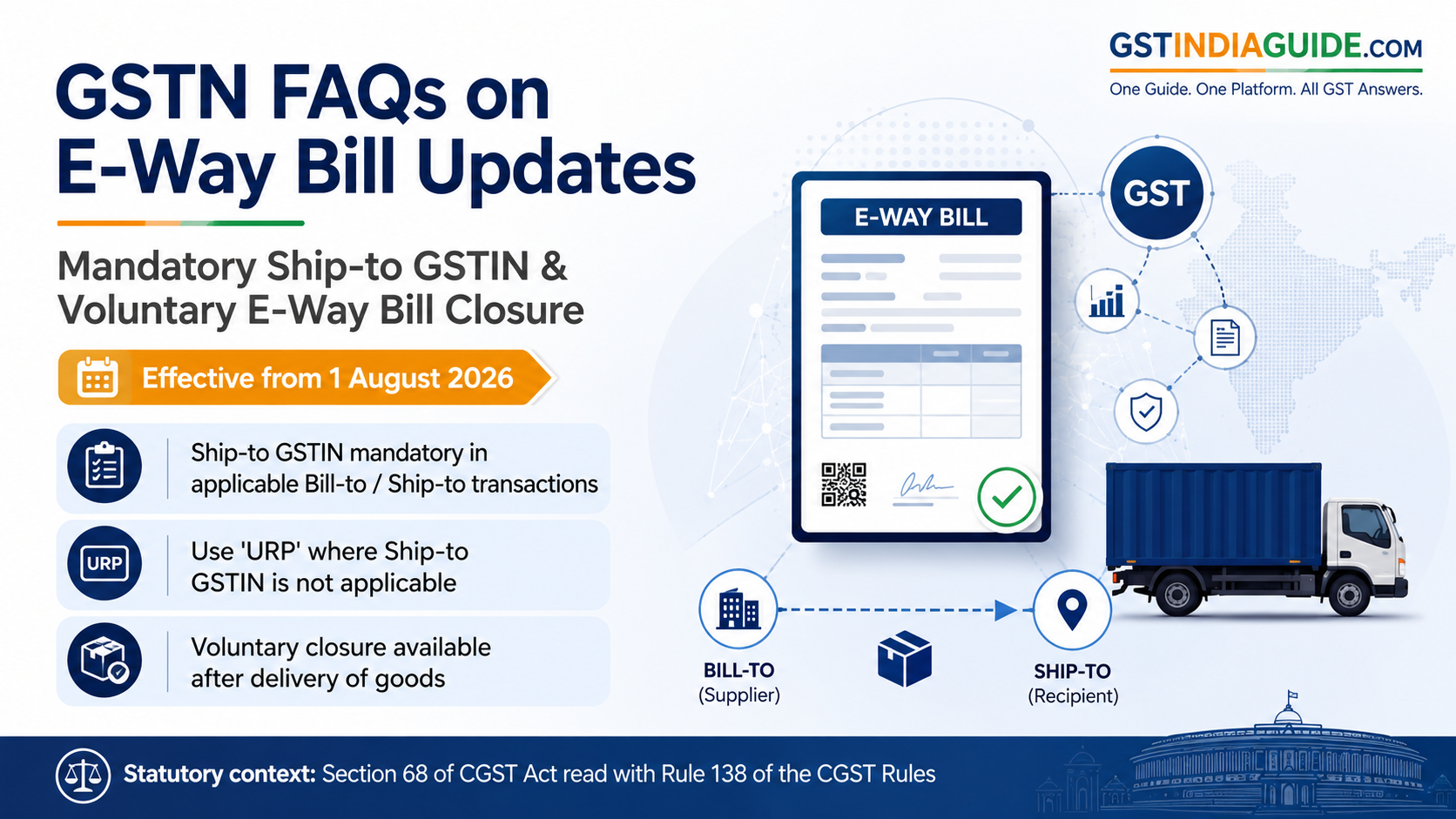
In Bill-To/Ship-To transactions, the “Ship To GSTIN” field is now to be captured as a mandatory data element at the time of e-Way Bill generation. Where the consignee is an unregistered person, the value “URP” is to be entered in that field. The change ensures that every movement under a Bill-To/Ship-To arrangement carries an identifiable end-recipient, whether registered or otherwise.
Voluntary e-Way Bill closure facility
A new facility permits closure of an e-Way Bill once delivery of the goods stands completed. Closure may be effected by the supplier, the recipient, the transporter, or the driver / authorised person whose mobile number has been furnished—either e-Way Bill-wise or date-wise, and on the day of delivery or the immediately succeeding day. A mobile number-based closure facility has been provided under the Search option on the Common Portal, and a corresponding API has been made available for system integrators requiring the e-Way Bill number, closure date and remarks.
Readiness timeline
The requisite API changes have been released by NIC in the Sandbox environment, with deployment in production scheduled by 15 June 2026. ERP vendors, GSPs, ASPs and system integrators have been advised to access the updated specifications, undertake testing in the Sandbox and effect the necessary configuration changes to ensure a seamless transition.
Author’s Note
The mandate to capture the “Ship To GSTIN”, or in its absence the marker “URP”, is best read not as a mere data-entry formality but as a deliberate step to capture the buyer of every “ship-to” supply and to verify that the person shown as “Bill-To” on the e-Way Bill has in turn raised a proper and complete invoice—of a value exceeding that reflected in the e-Way Bill—upon such person.
Where a GSTIN is stated in the “Ship To” field, the system is placed in a position to cross-check the invoices reflecting supplies made by the Bill-To person to that Ship-To GSTIN. Where, on the other hand, the entry is “URP”, the Government’s systems are enabled to examine the aggregate of supplies made to unregistered persons—inter-State and intra-State reckoned separately. In effect, a further round of checks stands incorporated within the GSTN portal, bringing diverted supplies, and the beneficiaries of such diversion, squarely within the ambit of the tax.
It bears recalling that the reconciliation of the e-Way Bill against the GSTR-1 was already under the Government’s examination. The present enhancement, however, operates as an entry-level check vis-à-vis the e-Way Bill itself, and extends further to test what the recipient of such supply does with the corresponding input tax credit, where the supply has in fact been invoiced. Read together, these measures are material in keeping track of the movement of goods along the entire chain—from the manufacturer through to the end consumer.
Illustrations: Bill-To / Ship-To in Practice
The working of the check is best seen through a few concrete situations.
Illustration 1 — Registered consignee (Delhi → Haryana → Rajasthan)
A supplier at Delhi, acting on the instructions of a registered dealer in Haryana (the Bill-To party), dispatches goods directly to a registered dealer in Rajasthan (the Ship-To party). The tax invoice runs from Delhi to Haryana, while the e-Way Bill records Haryana as Bill-To and the Rajasthan dealer’s GSTIN as Ship-To. In the ordinary course, the Haryana dealer is expected to raise its own invoice upon the Rajasthan dealer for the onward supply. With the Ship-To GSTIN now captured as a mandatory field, the portal is enabled to verify whether the Haryana dealer has, in its GSTR-1, declared an outward invoice to that very Rajasthan GSTIN—of a value exceeding the e-Way Bill—within a reasonable period, say two months. Should no such invoice surface, the system may legitimately raise a query with the Haryana dealer: the goods have admittedly moved to Rajasthan at its instance, yet the corresponding onward supply stands unreported. The gap points either to a suppressed sale, or to input tax credit availed on the inward leg without a matching output liability.
Illustration 2 — Unregistered consignee (the “URP” entry)
Let the same Delhi supplier and Haryana Bill-To dealer remain, but let the consignee—say in Uttar Pradesh—be an unregistered person, requiring the entry “URP” in the Ship-To field. Here the portal cannot match a counterpart GSTIN, and therefore turns to the aggregate: it reckons the total value of supplies routed to unregistered persons, inter-State and intra-State separately. A dealer who repeatedly ships goods to unregistered consignees while declaring little by way of B2C outward supply, or whose URP consignments are disproportionate to its declared turnover, invites scrutiny—the pattern being a familiar signature of goods diverted into the grey market, or of a registered buyer masquerading as unregistered so as to sever the credit chain.
Illustration 3 — Undervaluation and credit without onward supply
A subtler case arises where the Bill-To dealer does raise an onward invoice, but for a value lower than that recorded on the e-Way Bill; or where it avails input tax credit on the inward consignment while reporting no onward supply at all. Because the check operates at the level of the e-Way Bill itself, and proceeds on the premise that the onward invoice ought to exceed the e-Way Bill value, both undervaluation and credit-without-output are liable to be surfaced at the entry stage—rather than years later in the course of audit or investigation.
A Closer Look at Voluntary Closure
The closure facility, though presently voluntary, is significant less for its mechanics than for what it asks of the taxpayer—a positive self-declaration that the goods have been received and the movement concluded. An e-Way Bill that merely lapses on expiry conveys nothing to the system; a closed e-Way Bill records, in the taxpayer’s own hand and as of a stated date, that delivery is complete. That self-declaration is precisely the kind of assertion the department can test by random verification, matching declared closures against transporter records, delivery challans and the recipient’s inward returns.
The direction of travel is not difficult to anticipate. With the movement of vehicles increasingly captured through toll and FASTag infrastructure, it is a short step to a system in which the crossing of a truck past the toll nearest its destination triggers an automatic intimation to the receiving person to close the e-Way Bill. Physical movement would then be tethered to tax reporting almost in real time, and the window for interposing a diversion between dispatch and delivery would narrow considerably. What is offered today as a voluntary convenience may, in that light, be understood as an early step towards a mandatory, movement-linked confirmation of receipt.
Source: GSTN Advisory dated 20.05.2026 – Advisory to Taxpayers and Stakeholders: Enhancements in the e-Way Bill (EWB) Portal.