Case Reference
M/s Vardhman Ispat Udyog v. State of Himachal Pradesh & Ors.
High Court of Himachal Pradesh, Shimla
CMPMO No. 447 of 2023
Judgment Date: 18.08.2023
Hon’ble Justice: Sandeep Sharma
Category: Appeal remedy – Non-constitution of Appellate Tribunal
Relevant Sections: Sections 73, 74, 107, 109, 112, 113 of the CGST/HPGST Act, 2017
Facts (Paras 1–5)
The petitioner, M/s Vardhman Ispat Udyog, was issued a show cause notice under Section 73(5)/74(5) of the HPGST Act (Annexure P-1) on 09.08.2021. Despite filing a representation, the Joint Commissioner directed deposit of tax, interest and penalty by order dated 30.08.2022 (Annexure P-2). The appeal before Commissioner (Appeals) under Section 107 was dismissed on 19.05.2023 (Annexure P-3).
Ordinarily, a further appeal would lie under Section 112 before the GST Appellate Tribunal, but since no Tribunal under Section 109 has yet been constituted in Himachal Pradesh, the petitioner invoked Article 227 jurisdiction of the High Court seeking protection against enforcement of the order until the Tribunal becomes functional.
Questions before Court
-
Whether a writ petition under Article 227 is maintainable when the statute provides for an appellate remedy under Section 112 of the Act, but the Appellate Tribunal is not yet constituted?
-
Whether taxpayers can be compelled to comply with appellate orders without being given an opportunity to file further appeal due to non-constitution of the Tribunal?
Observations (Paras 6–15)
-
The State argued that writ jurisdiction under Article 227 was not maintainable as the Act already provides an appellate mechanism.
-
The petitioner countered that absence of the Tribunal leaves no efficacious remedy, thus justifying recourse to writ jurisdiction. Reliance was placed on Rochem India Pvt. Ltd. v. Union of India (Bom HC, 2023), where similar relief was granted.
-
The Court examined Sections 107, 109, 112, and 113, holding that these provisions explicitly envisage appellate scrutiny by the Tribunal, and taxpayers cannot be deprived of this statutory right merely because the Tribunal is not constituted.
-
The Ministry of Finance’s Order dated 03.12.2019 and CBIC Circular No. 132/2/2020-GST dated 18.03.2020 were noted, which clarified that limitation for filing Tribunal appeals would begin only after its constitution.
-
Referring to Bombay HC’s detailed directions in Rochem India Pvt. Ltd., the Court reiterated that taxpayers must be protected from coercive recovery till the Tribunal is established.
Judgment (Paras 10–11)
The Court held that:
-
The petition under Article 227 was maintainable since the petitioner had no other remedy.
-
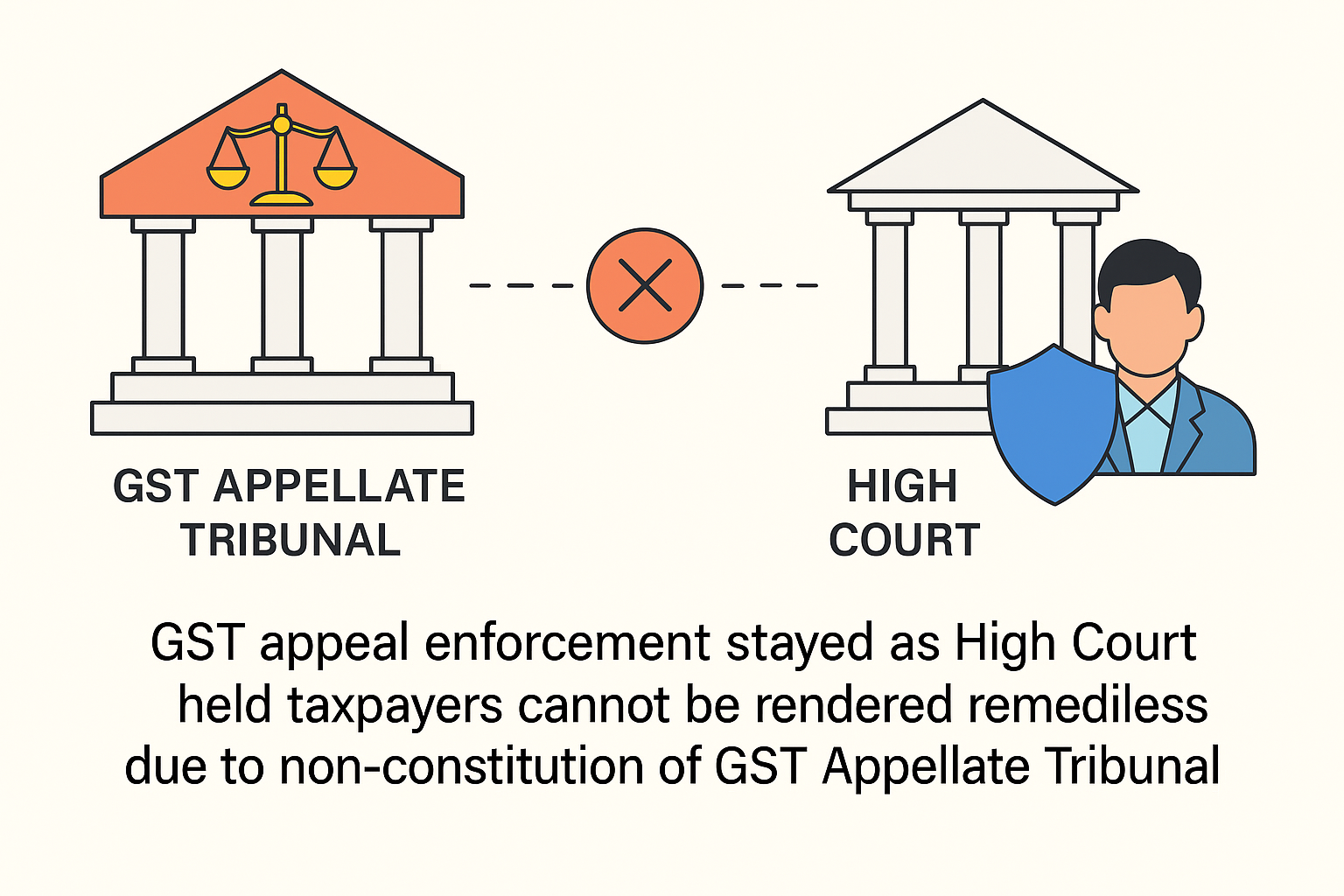
No person can be rendered remediless due to State’s failure to constitute the Tribunal under Section 109.
-
Accordingly, respondent authorities were directed not to act upon the appellate order dated 19.05.2023 until the Appellate Tribunal is constituted and the petitioner is able to file an appeal within the prescribed limitation period.
Table of Cases Referred
| Case | Court | Citation/Date | Verdict |
|---|---|---|---|
| Rochem India Pvt. Ltd. v. Union of India | Bombay HC | WP No. 10883 of 2019, decided 08.02.2023 | Held that in absence of GSTAT, writ petitions are maintainable; appellate orders not to be enforced till Tribunal is constituted; limitation period deferred under Removal of Difficulties Order. |
| Revenue Bar Association v. Union of India | Madras HC (2019) | WP No. 21147/2018 | Challenged constitution of GSTAT; provisions struck down, leading to delay in Tribunal formation. |
| Rojer Mathews v. Union of India | Supreme Court | CA No. 8588/2019, decided 13.11.2019 | Struck down Tribunal rules; directed fresh framing of rules for qualifications and appointment. |
| Madras Bar Association v. Union of India | Supreme Court | WP(C) No. 804/2020, decided 27.11.2020 | Directed changes in Tribunal rules; later led to Tribunal Reforms Act, 2021. |
Between Fine Lines
This judgment ensures that taxpayers in Himachal Pradesh, and by extension in other States where the GST Appellate Tribunal is not yet functional, cannot be forced to comply with adverse appellate orders without an opportunity to file a second appeal. It safeguards businesses from premature recoveries and clarifies that limitation for filing Tribunal appeals will start only after its constitution.
Disclaimer – “The above summary is for academic purpose only; not formal legal opinion. Seek professional opinion before application. Author or publisher or website shall not be responsible for any usage in any form.”