Case: M/s. SKT Swamy Auto Agency & Ors. v. Union of India & Ors.
Court: High Court of Judicature at Madras
Petition Nos.: W.P. Nos. 4562 of 2025 & connected batch
Date of Judgment: 28.07.2025
Category of Dispute: Limitation under GST / Validity of Notifications
Relevant Sections: Section 73(2) & 73(10), Section 168A of CGST Act, Articles 14, 19(1)(g), 21, 246A & 265 of the Constitution
Facts (Paras 1–7)
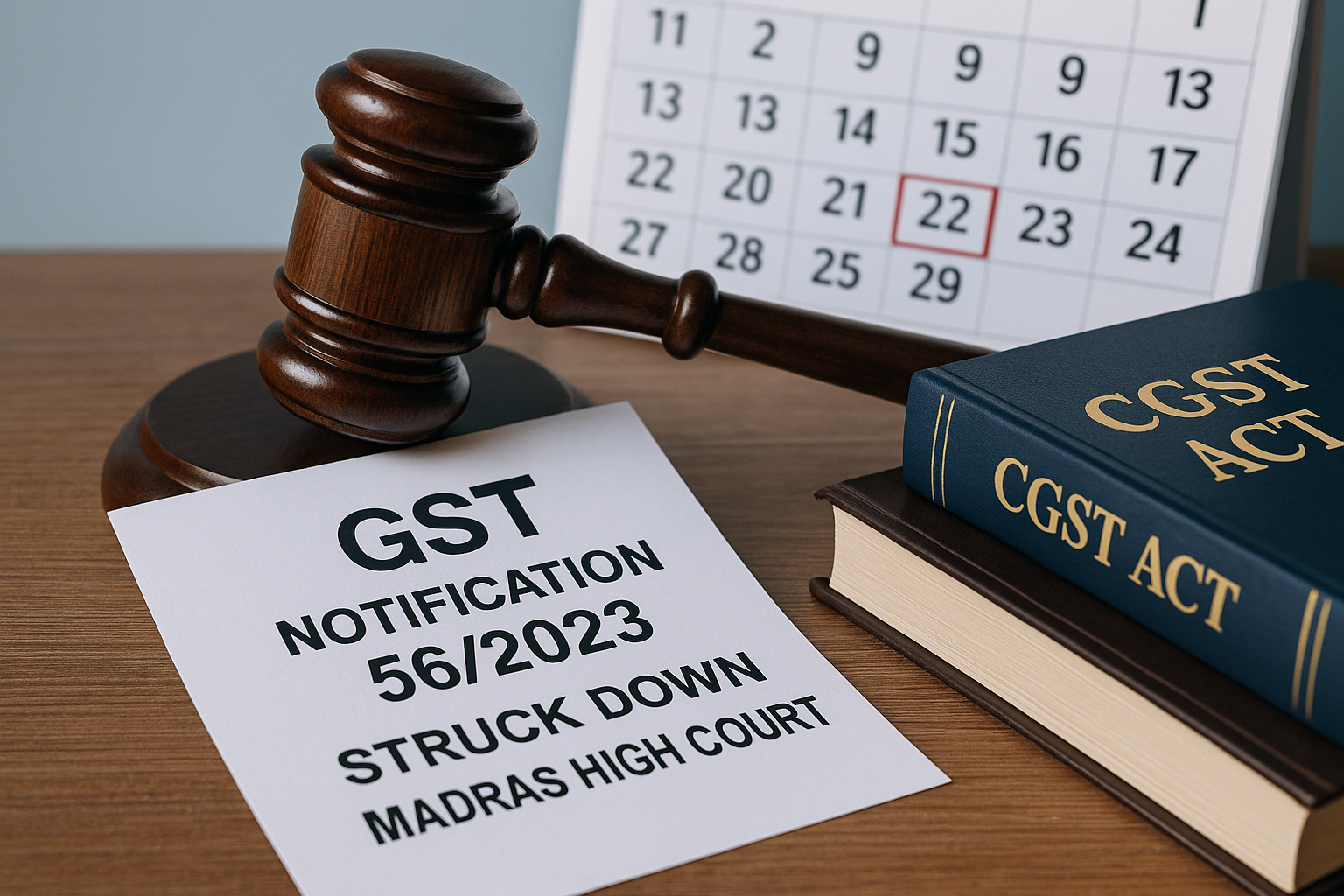
A large batch of writ petitions was filed by various taxpayers, including dealers, manufacturers, and service providers, challenging orders and notices issued under Section 73 of the CGST/TNGST Act for FY 2017–18 to 2019–20. The core grievance was that Notification No. 56/2023 dated 28.12.2023 and corresponding G.O.s issued by Tamil Nadu were arbitrary, ultra vires Section 168A of the GST Act, and violative of fundamental rights.
The petitioners argued that the notification unlawfully restricted the limitation period for issuing demand notices despite the Supreme Court’s suo motu extension order (10.01.2022 under Article 142), which had granted exclusion of time between 15.03.2020 and 28.02.2022.
Questions of Law (Paras 3–5)
-
Whether Notification 56/2023 validly exercised powers under Section 168A of the CGST Act.
-
Whether the notification could curtail the extended limitation available to authorities under the Supreme Court’s order.
-
Whether orders passed pursuant to the said notification are sustainable in law.
Observations (Paras 9–12)
-
The Court noted its earlier common order dated 12.06.2025 (W.P. 17184/2024 batch) where identical issues had been adjudicated.
-
It was reiterated that Notification Nos. 9/2023 and 56/2023 were illegal as they:
-
Wrongly curtailed limitation contrary to Supreme Court’s exclusion order (Para 9(i)).
-
Were based on erroneous assumptions and diminished vested rights of tax authorities (Para 9(ii)(a–c)).
-
Were issued without proper GST Council recommendation and instead on GIC’s advice (Para 9(ii)(f)).
-
-
The Court emphasized that principles of natural justice were violated, and all assessments would need reconsideration by assessing authorities after proper hearing.
Judgment (Paras 12–13, 5–6)
-
Notification No. 56/2023 dated 28.12.2023 declared illegal and vitiated.
-
All impugned orders set aside.
-
Where assessment/adjudication orders were challenged, they would be treated as show cause notices. Petitioners have 8 weeks to file objections.
-
Authorities to pass fresh orders after granting personal hearing.
-
Similarly, where notices were challenged, petitioners can file objections within 8 weeks, and authorities must re-decide.
-
No costs imposed.
Table of Cases Referred
| Case | Court & Citation | Ratio / Verdict |
|---|---|---|
| Supreme Court Suo Motu Writ (Civil) 3/2020, Order dated 10.01.2022 | Supreme Court | Excluded period 15.03.2020–28.02.2022 for limitation under all general and special laws. |
| Batch of W.P. 17184/2024 (Madras HC, 12.06.2025) | Madras High Court | Held Notifications 9/2023 and 56/2023 arbitrary and ultra vires; remanded all cases for fresh consideration. |
Between Fine Lines
For taxpayers, this ruling means that any demand order or notice issued solely relying on Notification 56/2023 lacks legal sanctity. Both taxpayers and authorities now return to the position that the Supreme Court’s limitation extension governs. Practically, businesses should treat such orders as fresh show cause notices and promptly file objections within the prescribed 8-week window to safeguard their rights.
Disclaimer – “The above summary is for academic purpose only; not formal legal opinion. Seek professional opinion before application. Author or publisher or website shall not be responsible for any usage in any form.”