

W.P.(C) 5933/2019 — High Court of Delhi — Classification Dispute (Polypropylene Woven/Non-Woven Bags) — Circular Quashed
Case Details
Case Title: Association of Technical Textiles Manufacturers and Processors & Anr. vs. Union of India & Ors.
Court: High Court of Delhi
Petition No.: W.P.(C) 5933/2019
Category: Classification – PP woven & non-woven bags
Date of Judgment: Reserved: 13.10.2023 | Pronounced: 16.11.2023
Relevant Provisions:
-
CGST Act: Section 168 (power to issue instructions), Sections 96–103 (advance ruling framework)
-
Customs Tariff Act, 1975: Chapters 39, 56, 63, Note provisions
Title (Required Format)
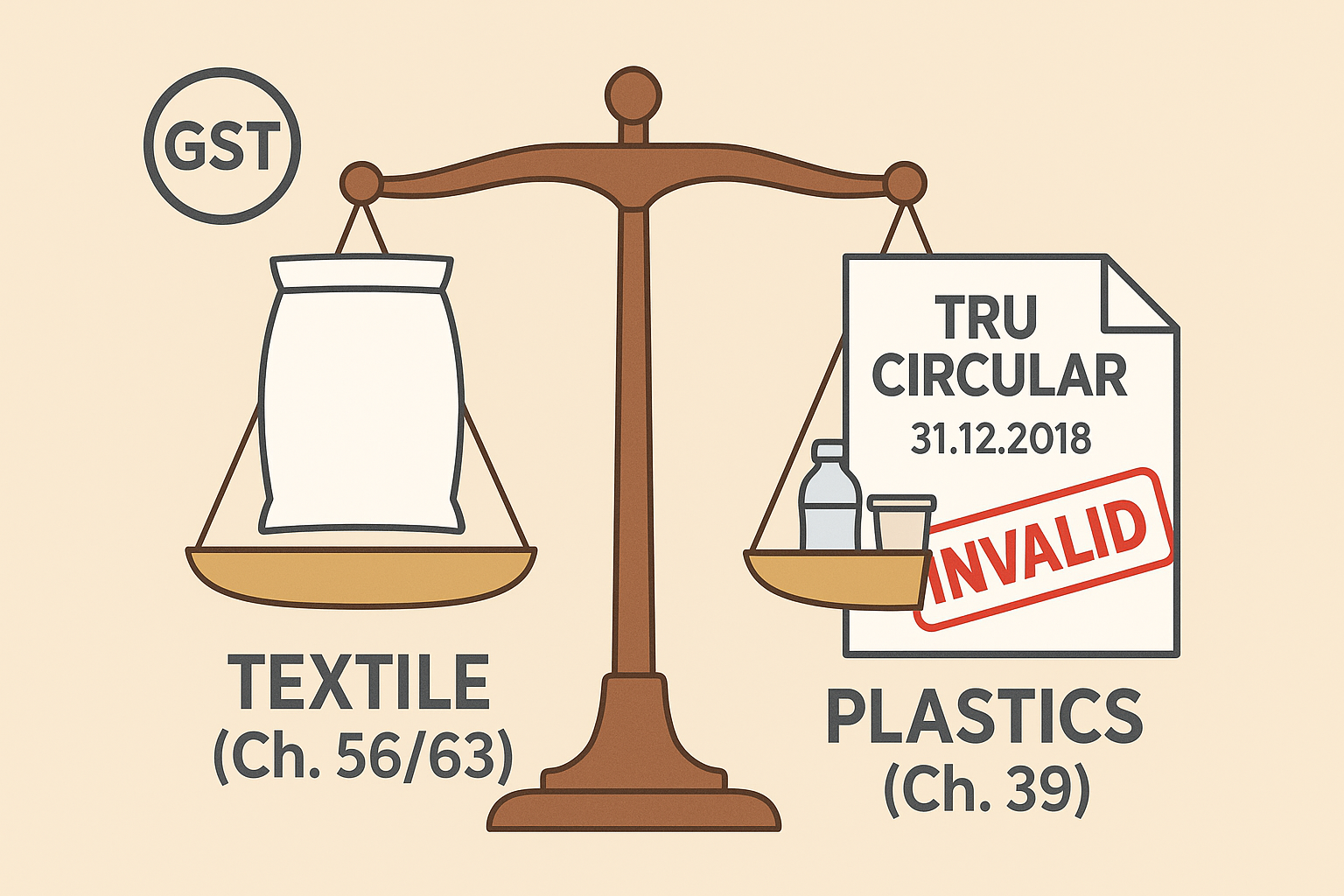
Circular on BOPP-laminated polypropylene bags quashed as TRU lacked Section 168 power and failed to evaluate textile–plastic distinction under the Tariff
Facts (Paras 1–14)
The petitioners—an industry association and a member manufacturer—challenged Circular No. 80/54/2018-GST dated 31.12.2018, issued by the Tax Research Unit (TRU), which clarified that polypropylene woven and non-woven bags, including BOPP-laminated bags, fall under Tariff Heading 3923 (Plastics). They argued that PP non-woven fabrics are textiles falling under Chapter 56, and sacks made from such materials fall under Tariff Heading 6305. They also questioned TRU’s statutory competence under Section 168, which vests clarification powers solely in the Central Board of Indirect Taxes and Customs (CBIC). They cited AAR rulings favouring classification under 6305.
Questions for Determination (Paras 1, 6–8, 15–17)
-
Whether the TRU had the statutory authority under Section 168 of the CGST Act to issue a classification clarification.
-
Whether the impugned circular correctly classified polypropylene woven and non-woven bags under Chapter 39, ignoring Chapters 56 and 63.
-
Whether conflicting AAR rulings can be resolved through a circular issued by a non-empowered body.
Court’s Observations (Paras 6–27)
(1) TRU lacks statutory power (Paras 6–7, 23, 25–26)
The Court held that Section 168 vests power exclusively in the CBIC, and no provision clothes the TRU with authority to issue binding instructions or clarifications.
-
Respondents failed to point to any legal source empowering TRU.
-
Circular is therefore ultra vires.
(2) Circular failed to examine statutory tariff structure (Paras 9–14, 26)
The circular:
-
Considered only Chapter 39,
-
Ignored Section XI, Chapter 56, Chapter 63, and
-
Failed to consider Notes 1 & 2 to Chapter 39, which explicitly exclude textiles.
The Court noted that PP non-woven fabrics fall under 5603, which was not denied by the respondents.
(3) Conflicting AAR rulings cannot be resolved by TRU circular (Para 25)
The Supreme Court’s ruling in Bharat Forge was relied on to hold that:
-
Classification disputes fall within the advance ruling mechanism,
-
Circulars cannot override statutory mechanisms,
-
Clarifications cannot be issued by bodies not statutorily empowered.
(4) Court declined to decide final classification (Paras 27–28)
The Court refused to decide whether the bags fall under 3923, 5603, or 6305, citing:
-
Lack of complete factual material on record,
-
Industry-wide implications,
-
Need for proper adjudication by competent authority.
Judgment (Paras 23, 26, 29)
-
Circular dated 31.12.2018 is quashed as TRU had no jurisdiction under Section 168.
-
The circular also suffers from incomplete statutory analysis.
-
Issue of classification is left open for adjudication before the appropriate authority.
-
Petition allowed.
Table of Cases Referred
| Case | Court | Ratio / Verdict |
|---|---|---|
| Mega Flex Plastics Ltd. (2023) | Calcutta HC | PP leno bags held classifiable under Ch. 39; under appeal but no stay. |
| Praveen Mittal (2009) | Delhi HC | PP non-woven bags considered “plastic bags” under environmental ban; not relevant for tariff classification. |
| Bharat Forge Ltd. (2022) | Supreme Court | Classification disputes must follow statutory advance-ruling procedure; circulars cannot override law; Section 168 limited in scope. |
| AAR rulings cited by petitioners (U.S. Polytech, JJ Fabrics, SMVD Polypack, K. Sharmila) | Various AARs | PP bags treated as textile sacks classifiable under 6305. |
| AAAR/AAR rulings cited by respondents (RLJ Woven Sacks, Mahalaxmi Polypack, Mount Fab Packaging) | Various AARs | PP bags treated as plastic bags under 3923. |
Between Fine Lines (Industry Takeaways)
This judgment is significant for textile, packaging and PP-bag manufacturers because it removes the binding force of a circular that compelled classification under 3923 (Plastics). Manufacturers may now independently pursue classification under textile-based headings such as 5603/6305, and assessment authorities must adjudicate classification based on statutory tariff structure rather than the quashed circular. The industry can challenge past assessments relying solely on the TRU circular.
Disclaimer – “The above summary is for academic purpose only; not formal legal opinion. Seek professional opinion before application. Author or publisher or website shall not be responsible for any usage in any form.”

