


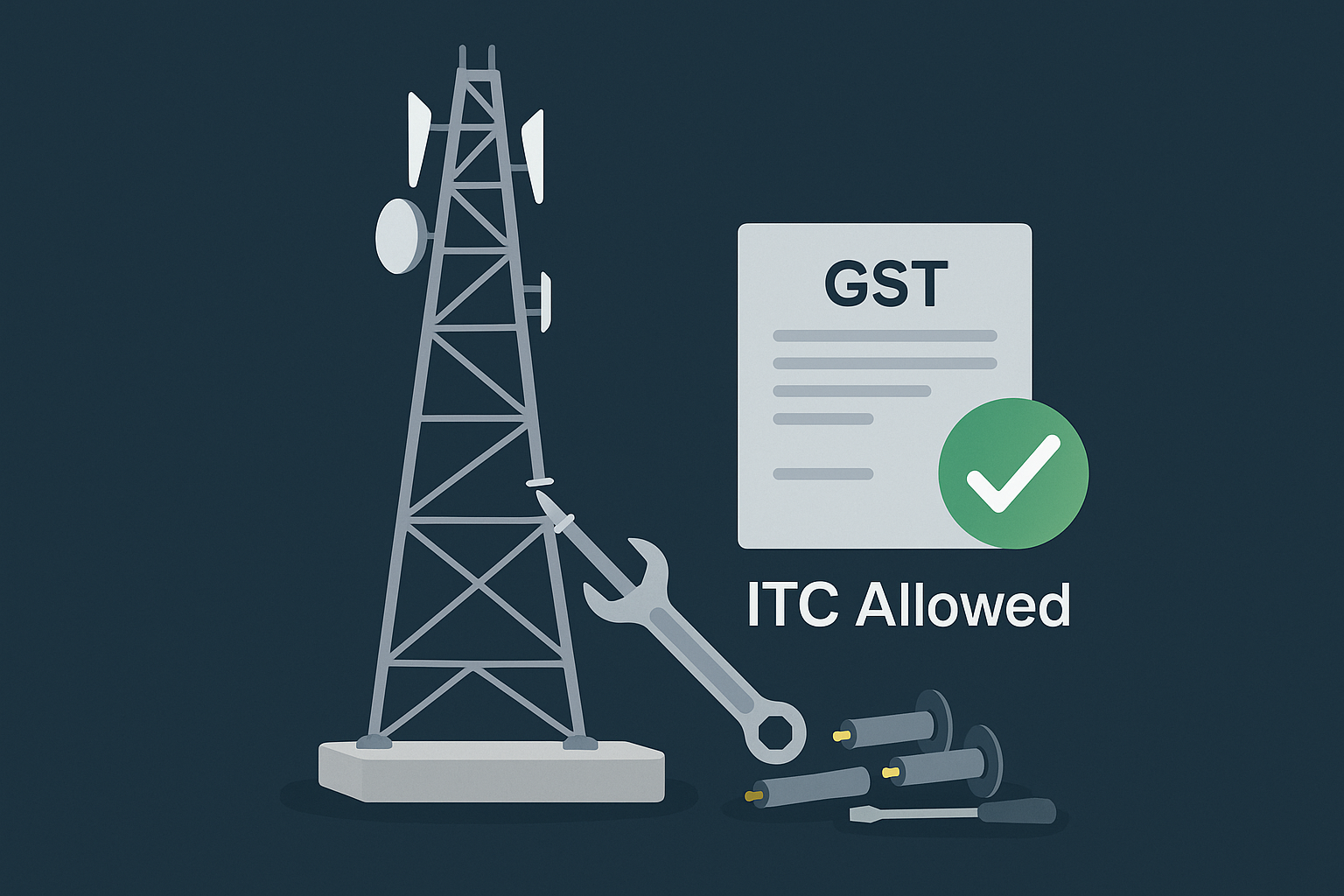
A. CASE SUMMARY
Telecommunication towers held movable; ITC disallowance under Section 17(5)(d) quashed as premise of “immovable property” found legally untenable
B. Case Reference
-
Case Title:
M/s Bharti Airtel Ltd. v. Commissioner, CGST Appeals-1, Delhi
Indus Towers Ltd. v. Union of India & Ors.
Elevar Digitel Infrastructure Pvt. Ltd. v. Union of India & Ors. -
Court: High Court of Delhi at New Delhi
-
Petition Numbers:
-
W.P.(C) 13211/2024
-
W.P.(C) 14710/2024
-
W.P.(C) 16477/2024
-
-
Category of Dispute: Input Tax Credit – Interpretation of Section 17(5)(d) (Blocked Credits) – Characterisation of Telecom Towers as Movable/Immovable Property
-
Date of Judgment: 12 December 2024
-
Relevant Statutory Provisions:
-
CGST Act, 2017: Sections 16(1), 17(5)(c)–(d) (with Explanation), 74
-
Transfer of Property Act, 1882: Section 3 (definition of “attached to earth”)
-
General Clauses Act, 1897: Section 3(36) (“movable property”)
-
C. Facts of the Case (Paras 1–7)
The petitioners Bharti Airtel, Indus Towers and Elevar Digitel were served with adjudication orders and/or extensive nationwide SCNs under Section 74 of the CGST Act alleging wrongful availment of input tax credit on goods and services used for setting up telecommunication towers. The Revenue characterised these towers as immovable property, thereby invoking Section 17(5)(d) to deny ITC on the premise that such inward supplies were used for “construction of immovable property”. The petitioners countered that telecom towers are steel structures assembled on concrete bases, capable of dismantling and relocation without structural impairment, and therefore constitute movable equipment. They relied heavily on the Supreme Court’s recent authoritative ruling in Bharti Airtel Ltd. v. CCE Pune (2024 SCC OnLine SC 3374), which affirmed the Delhi High Court judgment in Vodafone Mobile Services Ltd., conclusively holding telecom towers movable in nature and not immovable property.
D. Questions / Issues Before the Court (Paras 1–8, 17–19)
-
Whether telecommunication towers constitute “immovable property” for purposes of Section 17(5)(d) of the CGST Act, 2017?
-
Whether ITC can be blocked under Section 17(5)(d) merely because towers are excluded from “plant and machinery” in the Explanation to Section 17?
-
Whether Show Cause Notices issued on the premise of towers being immovable property are sustainable in law post the Supreme Court ruling in Bharti Airtel?
E. Court’s Observations (with integrated narrative & para references)
1. Supreme Court has conclusively determined that telecom towers are movable (Paras 10–16)
The Bench undertook a detailed analysis of Bharti Airtel (SC) and extracted the operative discussion wherein the Supreme Court applied the tests of permanency, annexation, object of attachment, intendment of parties, functionality and marketability (Paras 11.8.1–11.9.9). The Supreme Court held that towers:
-
are assembled on-site in CKD/SKD form;
-
can be unbolted, dismantled and relocated without causing damage;
-
are attached to the concrete base only for stability, not for permanent enjoyment of land;
-
are marketable movable goods.
Therefore, they fail to qualify as “immovable property” under Section 3 of the Transfer of Property Act.
2. Explanation to Section 17(5) does not convert movable towers into immovable property (Para 18)
The Court clarified that although the Explanation excludes telecom towers from the expression “plant and machinery”, this does not imply that towers become immovable property.
-
Exclusion only means towers are not eligible for ITC under the plant & machinery limb,
-
But to invoke Section 17(5)(d), towers must first independently qualify as “immovable property”, which they do not.
3. Revenue’s premise for issuing SCNs was fundamentally flawed (Paras 8, 16–19)
Once the Supreme Court characterisation is applied, the Court held that the Revenue’s assumption that towers are immovable was untenable.
Since the very jurisdictional fact underlying the SCNs—immovable property—failed, the entire proceedings collapse.
F. Final Judgment / Verdict (Paras 20–22)
-
W.P.(C) 13211/2024 (Bharti Airtel):
The Court quashed the adjudication order dated 24.03.2023 and the appellate order dated 31.05.2024. -
W.P.(C) 14710/2024 (Indus Towers) & W.P.(C) 16477/2024 (Elevar Digitel):
The Court quashed the Show Cause Notices stating that they proceeded on an untenable and legally incorrect premise that towers are immovable property.
Thus, all three petitions were allowed, and the denial of ITC was held unsustainable in law.
G. Cases Referred – Summary Table
| Case | Court & Citation | Principle / Verdict |
|---|---|---|
| Bharti Airtel Ltd. v. CCE Pune (2024) | Supreme Court | Telecom towers and prefabricated shelters are movable property, capable of dismantling and relocation; eligible as capital goods/inputs under CENVAT Rules; immovability test not satisfied. |
| Vodafone Mobile Services Ltd. (2018) | Delhi High Court | Towers not “attached to earth”; stability attachment does not create immovability; towers are movable equipment. |
| Solid & Correct Engineering Works (2010) | Supreme Court | Test of annexation and permanence; equipment bolted merely for operational stability is not immovable. |
| Sirpur Paper Mills (1998) | Supreme Court | Fixing machinery to base for efficient functioning does not make it immovable property. |
H. Between the Fine Lines – Practical Trade Takeaways
The judgment provides industry-wide clarity that telecom towers do not constitute immovable property, irrespective of their exclusion from “plant and machinery”. Accordingly, the blockage of ITC under Section 17(5)(d) cannot be invoked for tower-related inputs or input services. This ruling neutralises pan-India SCNs issued to tower companies and telecom operators on the immovable property theory, thereby protecting multi-crore ITC positions and eliminating long-pending uncertainty for the passive infrastructure sector.
Disclaimer – “The above summary is for academic purpose only; not formal legal opinion. Seek professional opinion before application. Author or publisher or website shall not be responsible for any usage in any form.”

(d). Detailed case analysis with statutory reasoning and Supreme Court references.)