
Case Reference:
Nilgiris Silverline Builders Private Limited v. Deputy State Tax Officer – 2, Gudalur Assessment Circle, The Nilgiris
High Court of Judicature at Madras | W.P. No. 4718 of 2025 | Judgment dated 12.02.2025
Category: Input Tax Credit (ITC) – Limitation under Section 16(4) and retrospective relief under Section 16(5)
Relevant Provisions: Sections 16(4), 16(5) of the CGST Act, 2017; Section 73 of CGST Act
Facts (Para 1–3)
The petitioner, Nilgiris Silverline Builders Pvt. Ltd., a registered dealer under the GST Act, challenged the assessment order dated 23.08.2024 issued by the Deputy State Tax Officer, Gudalur. The Department had reversed the petitioner’s Input Tax Credit (ITC) and imposed tax, interest, and penalty under Section 73 of the CGST Act on the ground that ITC claims were time-barred under Section 16(4). The petitioner argued that subsequent legislative developments and clarifications extended the permissible time for availing ITC for earlier financial years, and therefore the denial was unjustified.
Questions before the Court
Whether the reversal of ITC and consequential recovery orders passed by the department were sustainable in light of the retrospective insertion of Section 16(5) by Finance Act (No. 2) of 2024, which extended the time limit for availing ITC up to 30.11.2021 for FYs 2017–18 to 2020–21?
Observations (Para 9–12 of W.P. No. 25081/2023 batch order applied)
The Court referred to its earlier decision dated 17.10.2024 in W.P. Nos. 25081 of 2023 & batch, where it analyzed the retrospective amendment to Section 16 by inserting sub-sections (5) and (6) via the Finance Act (No. 2) of 2024. It noted that the 53rd GST Council meeting on 22.06.2024 recommended extending the ITC timeline, which was accepted through Notification No. 17/2024-Central Tax dated 27.09.2024 and Circular No. 237/31/2024-GST dated 30.09.2024.
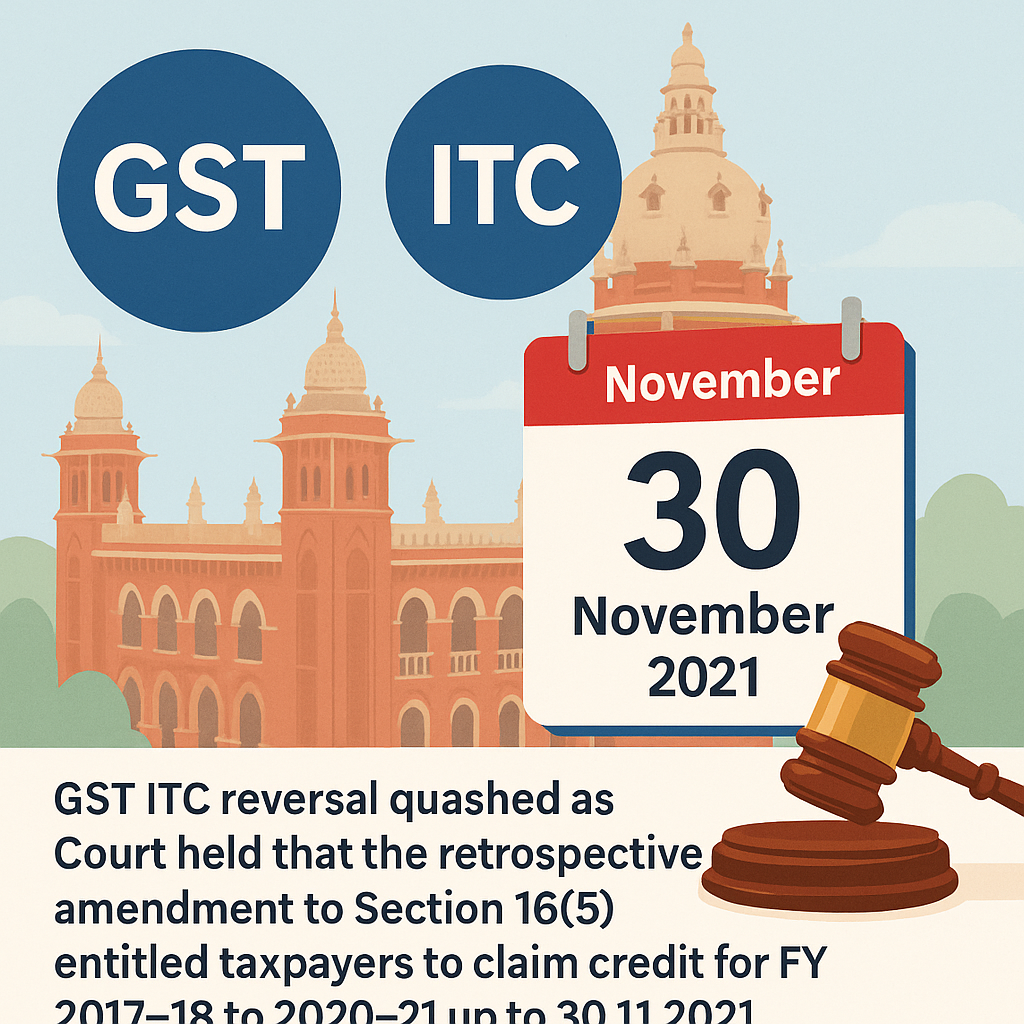
Accordingly, Section 16(5) now permitted taxpayers to avail ITC for invoices pertaining to FYs 2017–18 to 2020–21 if filed by 30.11.2021, overriding the earlier bar in Section 16(4). Hence, any denial of ITC solely on limitation grounds became unsustainable.
Judgment (Para 5–6)
Applying the above ratio, the Madras High Court quashed the impugned ITC reversal order dated 23.08.2024 and directed as follows:
-
The ITC denial based on limitation under Section 16(4) is set aside since the petitioner’s claim falls within the extended period under Section 16(5).
-
The department is restrained from initiating further proceedings against the petitioner on this issue.
-
The bank account freeze must be lifted immediately, and any recovery proceedings dropped.
-
If any amount was collected, it must be refunded or allowed for future tax adjustment.
-
The department retains liberty to proceed only on other issues such as fake/excess ITC claims, if any, in accordance with law.
Between Fine Lines
This ruling reinforces that the retrospective amendment to Section 16(5)—allowing ITC till 30 November 2021 for FYs 2017–18 to 2020–21—has overriding effect. Tax authorities can no longer deny credit merely citing the old limitation under Section 16(4). For trade and industry, it ensures relief for genuine taxpayers who faced compliance challenges during COVID-19 and earlier years.
Disclaimer – “The above summary is for academic purpose only; not formal legal opinion. Seek professional opinion before application. Author or publisher or website shall not be responsible for any usage in any form.”



 permits credit for FY 2017–18 to 2020–21 up to 30.11.2021.)