
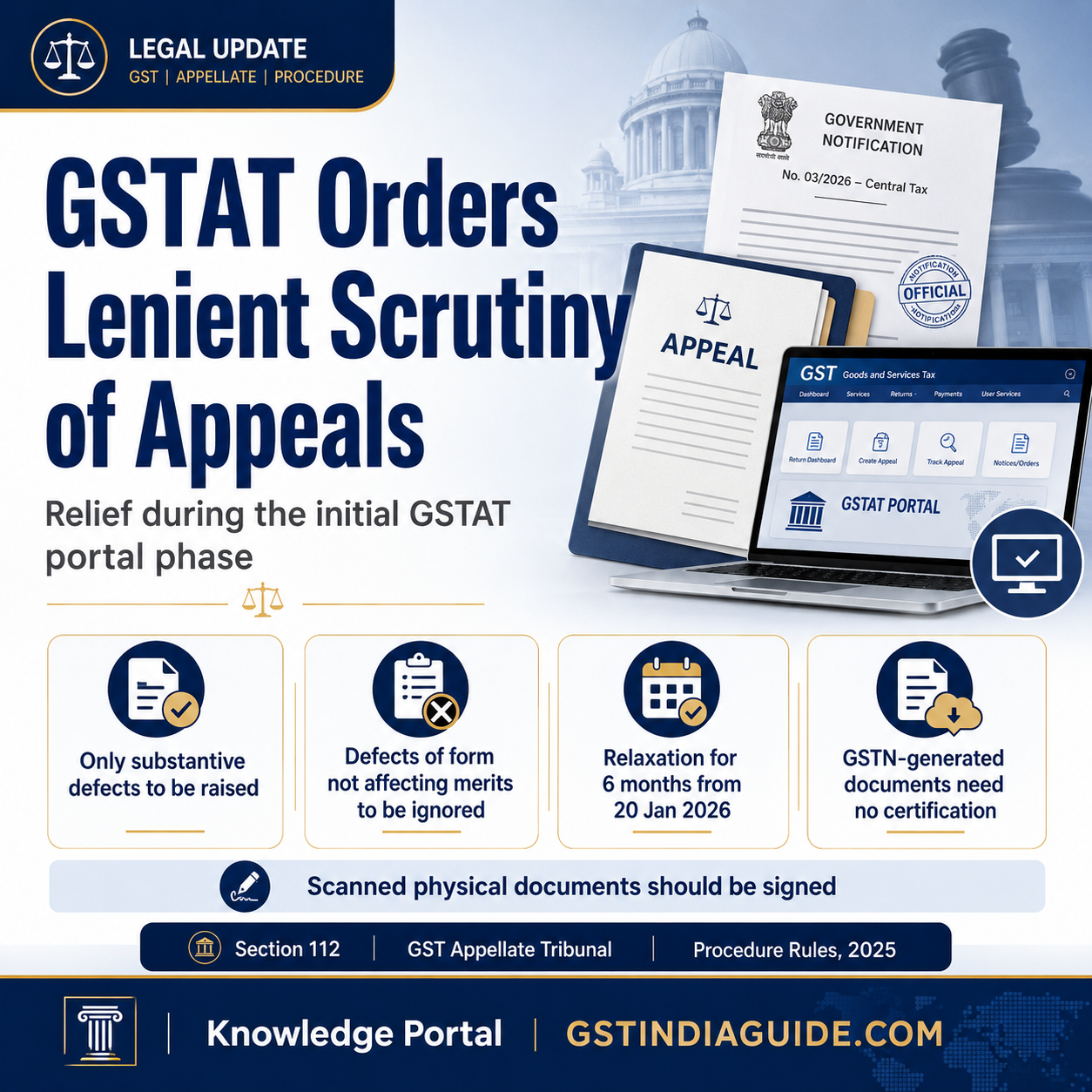
Statutory Background and Authority of the Order
The Office Order dated 20 January 2026 has been issued by the GST Appellate Tribunal, Principal Bench, New Delhi, in exercise of powers under Rule 123 of the Goods and Services Tax Appellate Tribunal (Procedure) Rules, 2025. The order records that, considering the difficulties being faced by appellants in the initial phase of filing appeals on the GSTAT Portal, the President has directed all Benches to adopt a liberal approach while scrutinising appeal documents.
The order is significant because the right of appeal before the Appellate Tribunal under section 112 of the CGST Act, 2017 is a substantive statutory remedy. Once the Tribunal has become functional and the portal mechanism has been introduced, procedural defects in electronic filing ought not to defeat the statutory right of appeal, particularly during the transition period. The direction therefore aligns the working of the Registry with the larger appellate scheme of Chapter XVIII of the CGST Act.
Direction for Lenient Scrutiny of Appeal Documents
The principal direction in the order is that the Registry of each Bench shall keep a lenient view during scrutiny of appeal documents and shall raise only defects of substance. Defects of form, namely defects which do not affect the merit of the case, are not to be raised for an initial period of six months from the date of issuance of the order, i.e. from 20 January 2026.
This is a pragmatic and legally sound direction. In appellate proceedings, a distinction has always been maintained between defects which go to the maintainability or substance of the appeal and defects which are merely procedural or clerical. A defect affecting limitation, payment of statutory pre-deposit, identity of the appellant, authority of the signatory, completeness of the impugned order, or jurisdictional particulars may be regarded as substantive. On the other hand, minor formatting defects, non-uniform pagination, minor upload imperfections, clerical description errors, sequencing of annexures, or technical irregularities in the manner of document compilation would ordinarily be defects of form, unless they prejudice identification or adjudication of the appeal.
For instance, if M/s A Steel Traders files an appeal against an order-in-appeal dated 15 December 2025 and uploads the impugned order, statement of facts, grounds of appeal and proof of pre-deposit, but the annexures are not indexed in the preferred format or one document carries a minor page-numbering inconsistency, such defect should not ordinarily result in Registry objection during the six-month relaxation period. However, if the appeal is filed without the impugned order, without proof of pre-deposit where applicable, or by a person whose authority is not ascertainable, the Registry may still raise a substantive defect.
Meaning of “Defect of Substance” and “Defect of Form”
The order does not define the expressions “defect of substance” and “defect of form”, but its intent is clear. A defect of substance is one which affects the legal competence, maintainability, identity, limitation, statutory compliance, or adjudicatory readiness of the appeal. A defect of form is one which concerns presentation, certification, formatting, sequencing, or technical manner of filing without impairing the merits or maintainability of the appeal.
This distinction is important because GSTAT is being operationalised after a long institutional gap. A large number of appeals, including appeals against orders passed years earlier, are expected to be filed within the notified timelines. In such a phase, strict Registry scrutiny on every formal requirement may create avoidable bottlenecks and could indirectly impair the appellate remedy under section 112. The order therefore seeks to prevent procedural scrutiny from becoming a substitute for adjudication.
Certification of Digitally Generated GSTN Documents
The order further clarifies that documents generated digitally through the GSTN system are not required to be certified. However, where scanned copies of physical documents are attached with the appeal, such scanned copies are required to be signed.
This clarification is commercially and procedurally important. Many documents in GST litigation, such as orders, summaries, challans, returns, electronic liability registers, electronic credit ledger extracts, appeal acknowledgements, and DRC forms, are generated from the GST portal. Requiring separate certification of such documents would unnecessarily duplicate authentication, since the source itself is the statutory electronic system. On the other hand, scanned copies of physical records, such as manually issued orders, correspondence, authorisations, board resolutions, affidavits, or physical challans, may require signature to establish responsibility for the document being uploaded.
For example, where M/s N P Pvt. Ltd. uploads a GST portal-generated order summary and electronic pre-deposit challan while filing its GSTAT appeal, the appellant need not separately certify those portal-generated documents. But if it uploads a scanned copy of a physical authorisation letter dated 10 February 2026 or a manual communication issued by the department, the scanned document should be signed before being uploaded.
Practical Impact for Appellants and Professionals
The order gives immediate relief to taxpayers, advocates, chartered accountants and authorised representatives who are filing appeals in the initial phase of the GSTAT Portal. The Registry is now expected to focus on whether the appeal is substantially complete and legally capable of being processed, rather than objecting to every formal imperfection.
However, the relaxation should not be read as a waiver of statutory requirements. The appellant must still ensure that the appeal is filed within the applicable time, the correct order is challenged, the proper appellant is named, statutory pre-deposit requirements are complied with, grounds and statement of facts are properly drafted, and necessary documents are uploaded. The order only softens Registry scrutiny for non-material formal defects; it does not dilute the statutory discipline of appeal filing.
Relevance in the Larger GST Appellate Framework
This order reflects an important administrative philosophy: the GSTAT Registry should facilitate access to appellate adjudication and should not obstruct it on account of avoidable procedural formalism. In the initial phase of any new electronic appellate system, portal limitations, unfamiliar filing workflows, and uncertainty over document format are expected. The order recognises this reality and protects the taxpayer’s appellate remedy from being frustrated by technical scrutiny.
The direction is also consistent with the general principle that procedural law is intended to advance justice and not to defeat it. In GST litigation, where demands may involve tax, interest, penalty, blocked credit, registration consequences and recovery proceedings, access to the Tribunal is a critical safeguard. The six-month lenient scrutiny period therefore serves as a transitional measure to stabilise the GSTAT filing ecosystem.