(viii), but allows 50% statutory deduction under Section 57(iv).)
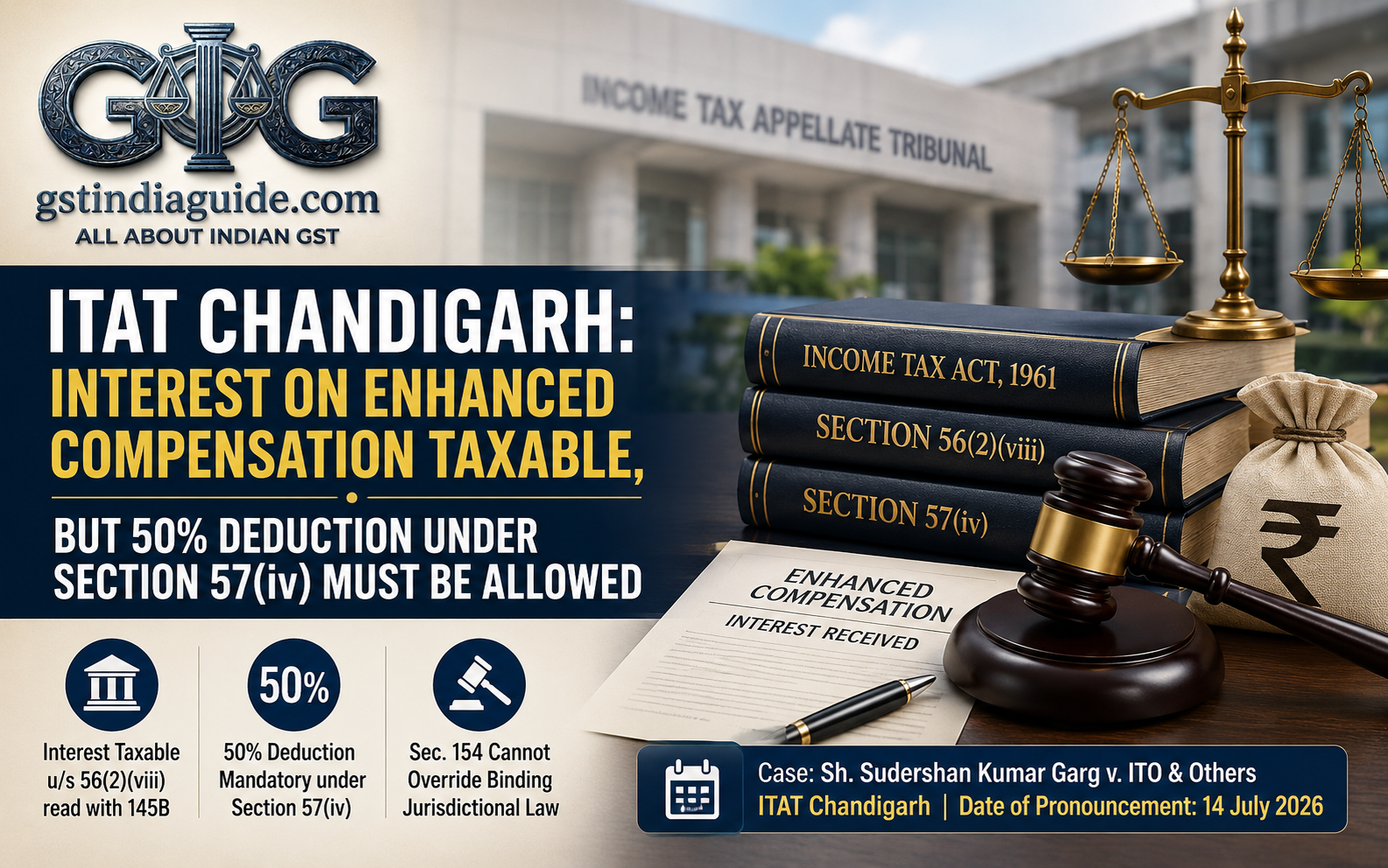
The Income Tax Appellate Tribunal, Chandigarh Bench “A”, in Sh. Sudershan Kumar Garg v. ITO, Ward, Sangrur & Others, has held that interest received on enhanced compensation is taxable as “Income from Other Sources” under Section 56(2)(viii) read with Section 145B of the Income-tax Act, 1961. However, the Tribunal clarified that the statutory deduction of 50% under Section 57(iv) must necessarily be granted while computing the taxable income. The common order was pronounced on 14 July 2026 in a group of seven appeals.
The Tribunal disposed of seven appeals through a common consolidated order since the grounds and legal issues involved were substantially identical.
Background of the Dispute
In the lead factual discussion relating to Pala Ram, the assessee, an agriculturist, had received enhanced compensation along with interest following compulsory acquisition of agricultural land. The assessee claimed that interest awarded under Section 28 of the Land Acquisition Act formed part of the enhanced compensation itself and, consequently, was also exempt under Section 10(37) of the Income-tax Act.
The CPC, Bengaluru, however, passed a rectification order under Section 154 and brought the interest on enhanced compensation to tax under Section 56(2)(viii) read with Section 145B(1). In the case discussed in detail, interest of Rs. 1,16,81,419 was added, resulting in total income being determined at Rs. 1,25,96,860 as against returned income of Rs. 9,15,440. The CIT(A) upheld the adjustment.
Interest on Enhanced Compensation Held Taxable
The Tribunal noted that, on the date of the impugned order, the issue stood governed by the judgment of the jurisdictional Punjab & Haryana High Court in Manjit Singh Narang, under which interest received on enhanced compensation was chargeable to tax under Section 56(2)(viii) read with Section 145B.
Since the decision of the jurisdictional High Court was binding on the authorities functioning within its territorial jurisdiction, the Assessing Officer could not grant relief contrary to that judgment in proceedings under Section 154.
The Tribunal further observed that a decision of a Coordinate Bench of the ITAT cannot override or dilute the binding effect of a judgment of the jurisdictional High Court. Accordingly, subsequent Tribunal decisions taking a different view could not furnish a valid basis for rectification under Section 154.
Section 154 Cannot Be Used Contrary to Binding Jurisdictional Law
Referring to the principle governing rectification proceedings, the Tribunal observed that jurisdiction under Section 154 is confined to rectification of a mistake apparent from the record. It cannot be exercised to review an issue or adopt a position contrary to law declared by the jurisdictional High Court.
Accordingly, the Tribunal found no error in the Assessing Officer and CIT(A) following the binding jurisdictional precedent while deciding the taxability of the interest.
50% Deduction under Section 57(iv) Is Mandatory
The Tribunal, however, found an important error in the computation of taxable income. It observed that where interest on enhanced compensation is taxed under Section 56(2)(viii), the statutory scheme automatically attracts Section 57(iv).
Section 57(iv) provides for deduction of an amount equal to 50% of such interest, with no further deduction being allowable. Therefore, the entire interest amount cannot be subjected to tax.
The Tribunal expressly held that only 50% of the interest received can ultimately be brought to tax. Where the Assessing Officer, CPC or CIT(A) had taxed the entire interest without granting the statutory deduction, such action could not be sustained.
Accordingly, while upholding the taxability of the interest under Section 56(2)(viii) read with Section 145B, the Tribunal directed the Assessing Officer to allow the 50% deduction under Section 57(iv) wherever it had not already been granted.
Decision of the ITAT
Subject to the limited modification regarding the statutory deduction under Section 57(iv), the Tribunal found no infirmity in the orders of the CIT(A). Since identical issues arose in all the connected appeals, the appeals of the respective assessees were dismissed, with the benefit of the statutory 50% deduction being preserved.
The ruling is significant for cases involving compulsory acquisition compensation because it distinguishes between the taxability of interest on enhanced compensation and the computation of the amount actually taxable. Even where such interest is taxable under Section 56(2)(viii), the prescribed deduction under Section 57(iv) cannot be denied.
[…] Click to view […]