Background of the Order
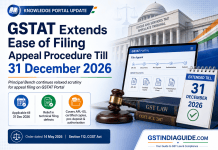
The Principal Bench of the Goods and Services Tax Appellate Tribunal, New Delhi, has issued Order No. 156/2026 dated 10 July 2026, introducing an additional mechanism for preserving the limitation period for appeals required to be filed before the GST Appellate Tribunal under section 112 of the Central Goods and Services Tax Act, 2017.
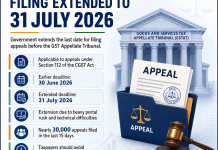
The order records that the GSTAT e-filing portal has been functional since 24 September 2025 and that the notified due date for filing appeals under section 112(1) and departmental applications under section 112(3) had been extended up to 31 July 2026. To address difficulties faced by appellants in completing electronic filing, the President of GSTAT has exercised powers under rule 123 of the Goods and Services Tax Appellate Tribunal (Procedure) Rules, 2025 and introduced a token-generation facility.
Nature of the Token Facility
An appellant who is unable to complete the appeal filing process may, on or before 31 July 2026, submit the minimum prescribed particulars through the designated facility on the GSTAT portal and obtain an electronically generated Token ID.
The token records the appellant’s intention to institute an appeal within the prescribed period. Where a valid token is generated on or before 31 July 2026, it will be treated as sufficient compliance for determining whether the appeal was initiated within the due date, provided the complete appeal is subsequently filed within the permitted period of sixty days from the date of generation of the token.
The facility, therefore, does not dispense with the requirement of filing the appeal. It merely preserves the appellant’s position regarding limitation for a restricted period and subject to strict compliance with the conditions stipulated in the order.
Procedure for Generation of Token
The appellant is required to access the prescribed token-generation form made available through the GSTAT e-filing portal. All mandatory fields must be correctly completed.
Where the first appellate order proposed to be challenged is available on the GST portal, the corresponding sixteen-digit ARN or CRN must be entered. Where the order is not available electronically, the appellant may provide the order number, reference number or file number together with the relevant tax period.
On successful submission, the system will generate a Token ID containing the date and time of generation. The facility is available to taxpayers and tax authorities holding a GSTIN, Temporary ID, UIN or TDS registration number.
A separate token is mandatory for each appeal. One token cannot be used for two or more appellate orders, even where the appeals relate to the same taxpayer or arise from a common investigation.
For example, where ABC Traders Private Limited proposes to challenge two separate appellate orders—one concerning the financial year 2018-19 and another concerning 2019-20—it must generate two distinct tokens on or before 31 July 2026. Generation of a single token will not preserve limitation for both appeals.
Sixty-Day Period for Completion of Appeal
The complete appeal must be filed within sixty days from the date on which the token is generated. The sixty-day period is token-specific and does not uniformly expire on a common date.
Accordingly, if a token is generated on 20 July 2026, the sixty-day period would be calculated from that date. Similarly, a token generated on 31 July 2026 would carry its own sixty-day completion period commencing from 31 July 2026.
The order expressly states that filing completed within sixty days of token generation alone will be regarded as having been validly filed within the original due date. After expiry of sixty days, the token will lapse and no appeal can be filed by relying upon that token.
The appellant should therefore not treat token generation as a substitute for preparation of the memorandum of appeal, statement of facts, grounds of appeal, supporting documents, authorisation and proof of the statutory pre-deposit.
Relationship with Section 112 of the CGST Act
Section 112(1) provides the statutory right of appeal to the Appellate Tribunal against an order passed by the Appellate Authority or Revisional Authority. The appeal ordinarily has to be filed within the period prescribed under that provision. Section 112(3) similarly enables the Commissioner to direct the filing of an application before the Tribunal against an order considered legally or factually improper.
The token mechanism does not amend section 112 or create a fresh substantive period of limitation. Its purpose is procedural: it records the initiation of appellate filing within the notified due date where the complete electronic filing cannot be accomplished because of portal-related or other filing difficulties.
The legal effect of the order is therefore conditional. The benefit arises only where:
| Requirement | Compliance expected |
|---|---|
| Date of token generation | On or before 31 July 2026 |
| Number of tokens | One separate token for each appeal |
| Information furnished | Complete and accurate particulars |
| Completion of appeal | Within sixty days from token generation |
| Preservation of record | Token ID, date, time and acknowledgement should be retained |
| Statutory requirements | Appeal, documents, prescribed fee and pre-deposit must ultimately be completed |
Pre-Deposit Requirement Remains Unaffected
The token mechanism concerns the time of filing and does not waive or modify the mandatory pre-deposit prescribed under section 112(8).
An appeal before the Tribunal cannot be treated as duly instituted merely because a token has been obtained. The appellant must still discharge the admitted amount of tax, interest, fine, fee and penalty and make the additional statutory pre-deposit applicable under section 112(8).
Where the impugned order demands only penalty without involving a demand of tax, the amended proviso to section 112(8) requires payment of ten per cent of the penalty, in addition to the amount payable under the proviso to section 107(6), subject to the applicable legal provisions. The token order does not grant any relaxation from this requirement.
Consequence for Delay Fee and Portal Difficulties
The advisory states that appellants who generate a valid token within the prescribed date will be treated as an exception where the appeal could not be completed within time because of technical issues or otherwise connected with the portal. Such appellants would not be required to pay the delay fee, subject to the applicable provisions and verification.
This protection should be understood cautiously. It is not an unconditional waiver of every consequence of delayed filing. The appellant must establish that:
- the token was validly generated within time;
- the particulars entered were accurate;
- the complete appeal was filed within sixty days; and
- the filing satisfied the statutory and procedural requirements.
The expression “subject to applicable provisions and verification” reserves the authority of the Tribunal to scrutinise the validity of the token and the eventual appeal.
Importance of Accurate Particulars
The advisory specifically warns that tokens generated with incomplete or inaccurate particulars may be treated as void. This condition is material because the token is intended to identify a particular appeal arising from a particular order.
An incorrect order number, tax period, registration number or appellate reference may prevent proper correlation between the token and the eventual appeal. A token generated merely as a precaution, without identifying the correct order proposed to be challenged, may therefore fail to preserve limitation.
Authorised representatives should verify the following before submission:
- correct GSTIN, Temporary ID, UIN or TDS registration number;
- exact appellate order number and date;
- ARN or CRN, wherever available;
- relevant tax period;
- identity of the appellant;
- separate token for each appeal; and
- downloadable acknowledgement showing the date and time of generation.
Practical Effect of the Order
The order creates a limited procedural safeguard for appellants who may otherwise lose their statutory remedy because of difficulties in completing electronic filing by 31 July 2026. It reflects the principle that access to appellate remedies should not be defeated merely because the electronic system does not permit completion of filing within the prescribed period.
At the same time, the relief is narrowly structured. The token preserves the filing date only provisionally. The appellant must complete the entire appeal within sixty days, failing which the token automatically lapses.
Accordingly, taxpayers should not postpone appeal preparation until after token generation. The statement of facts, grounds of appeal, compilation of documents, certified or authenticated copy of the impugned order, authority letter and computation of pre-deposit should be prepared simultaneously so that the appeal is filed well before expiry of the token period.
GST Commentary
The order represents an administrative accommodation within the statutory appellate framework rather than an extension of limitation in the conventional sense. It separates the act of recording the intention to appeal from the completion of the formal filing process. Such separation is justified in a technology-dependent appellate system where access to the statutory remedy is mediated entirely through an electronic portal.
The token must nevertheless remain linked to a specific appeal. It cannot become a general reservation of the right to file appeals at a later stage. This explains the requirement of a separate token for each appeal, accurate identification of the impugned order and automatic lapse after sixty days.
From a litigation perspective, preservation of the token acknowledgement will be essential. It should be retained along with screenshots of portal errors, correspondence with the helpdesk, complaint references and proof of attempts made to file the appeal. These records may become relevant if the validity or timeliness of the eventual appeal is questioned.
The mechanism should therefore be regarded as a protective procedural measure, but not as a substitute for compliance with section 112, the applicable GSTAT Procedure Rules, payment of the prescribed pre-deposit and completion of the appeal within the sixty-day period.