
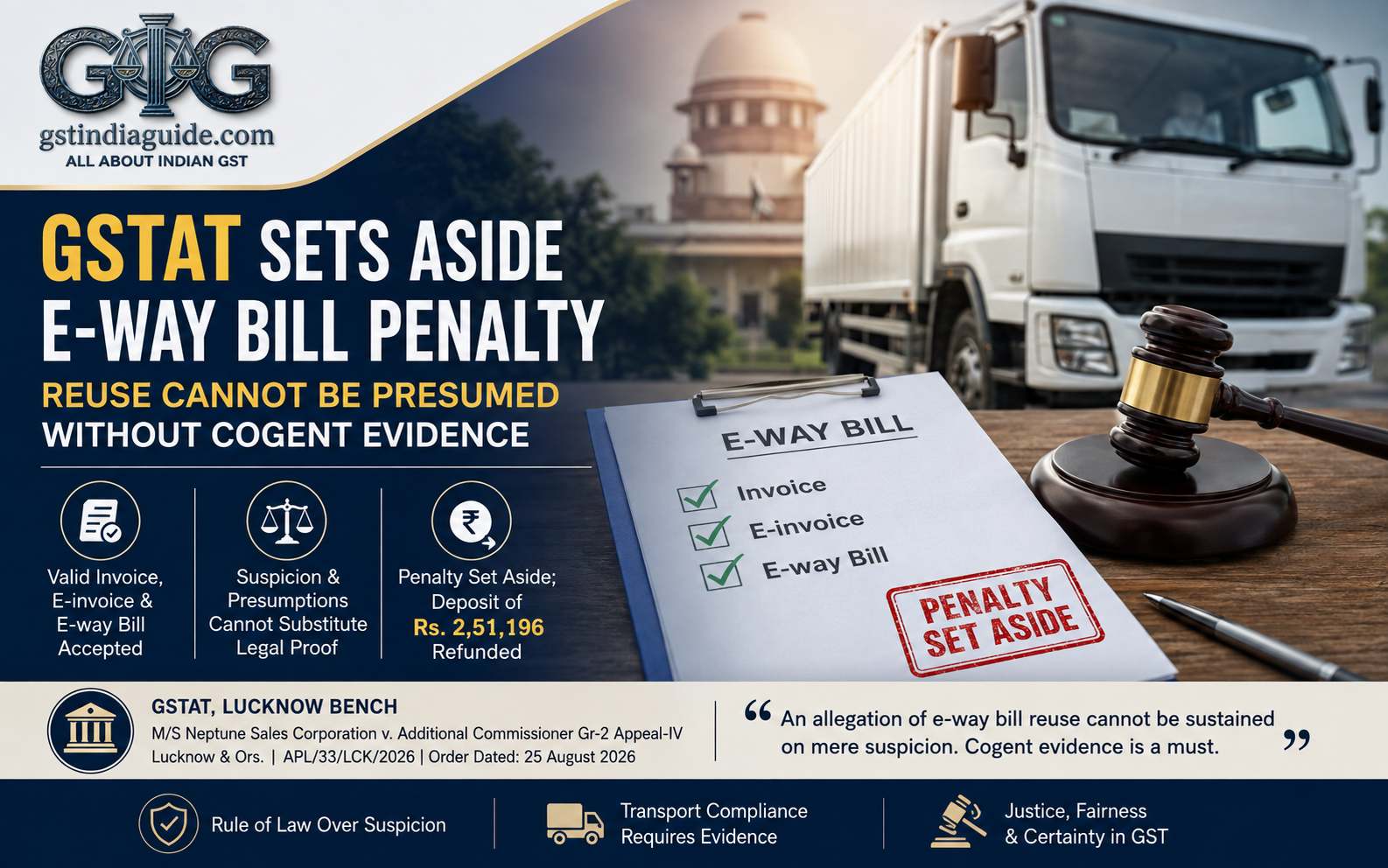
The GST Appellate Tribunal (GSTAT), Court No. I, in M/s Neptune Sales Corporation v. Additional Commissioner Gr-2 Appeal-IV Lucknow, Addl. Commr., Lucknow & Ors., has set aside detention and penalty proceedings initiated under Section 129 of the CGST/UPGST Act where the allegation of reuse of an e-way bill was founded essentially on inference and presumption rather than independent evidence.
The appeal, APL/33/LCK/2026, was decided by Hon’ble Santosh Kumar Srivastava, Member (Judicial) and Hon’ble Arvind Kumar, Member (Technical) on 25 August 2026. The dispute concerned a penalty of Rs. 2,51,196 imposed in relation to goods being transported under an invoice, e-invoice and a valid e-way bill.
Background of the Dispute
M/s Neptune Sales Corporation, a registered proprietorship engaged in manufacturing, was transporting goods from its business premises at Arazi No. 1071, Mubarakpur, Akabarpur, Kanpur Dehat to the declared destination. The goods were accompanied by the relevant invoice, e-invoice and e-way bill.
The vehicle was intercepted on 14 January 2024. The department relied upon an earlier verification of the e-way bill at Banthara Bazaar, Kanpur Road at about 4:15 A.M. and the subsequent location of the vehicle at Haj House, Lucknow at about 12:45 P.M. From these circumstances, the authorities presumed that the goods were being transported again using documents that had already been used for an earlier movement.
The principal question before the Tribunal was whether the goods were being transported for the first time or were being transported for a second time using the same e-way bill.
GSTAT: Suspicion Cannot Substitute Legal Proof
The Tribunal observed that the material on record did not establish any discrepancy in the description, quantity, value or ownership of the goods. The goods were also accompanied by the relevant tax documents, including the invoice, e-invoice and e-way bill.
Significantly, the Tribunal found that the conclusion regarding re-transportation was based principally on an inference drawn from the earlier verification or location of the e-way bill. There was no independent and cogent evidence demonstrating that the same goods had already completed an earlier journey or had previously been delivered.
The GSTAT emphasised that an allegation of reuse of an e-way bill cannot be sustained merely on presumptions and assumptions. The department was required to establish through reliable evidence that the goods were actually being transported in contravention of the GST law or that an e-way bill had in fact been reused.
The Tribunal also relied upon judicial precedents recognising that strong suspicion, strange coincidences or grave doubt cannot take the place of legal proof, and that detention of goods cannot be justified merely on presumptions where their movement is otherwise supported by valid GST documents.
Intention to Evade Tax Cannot Be Automatically Presumed
The Tribunal rejected the reasoning of the first appellate authority that intention to evade tax stood automatically proved from the circumstances. It held that such an intention could not simply be presumed.
The GSTAT further noted that the department had failed to place any cogent material, such as evidence establishing the alleged earlier journey of the very same goods, to prove reuse of the e-way bill.
Accordingly, the Tribunal held that the department had failed to establish that the goods were being transported in violation of the GST Act or Rules or that the e-way bill had actually been reused.
Order of the GSTAT
The GSTAT allowed the appeal filed by M/s Neptune Sales Corporation. It set aside the appellate order dated 30 October 2024 passed by the Additional Commissioner Grade-II (Appeal-IV), Lucknow.
The original order dated 19 January 2024, passed under Section 129 of the CGST/UPGST Act, was also set aside.
The Tribunal further directed that the amount of Rs. 2,51,196 deposited by the appellant pursuant to the detention and penalty proceedings be refunded in accordance with law.
Key Takeaway
The decision reinforces an important principle governing GST detention proceedings: an allegation that an e-way bill has been reused must be supported by cogent evidence. Mere vehicle-location data, suspicion or an inference regarding an earlier movement cannot by itself establish re-transportation of the same goods or an intention to evade tax. Where the goods are supported by valid tax documents and no independent evidence establishes a contravention, penalty proceedings under Section 129 cannot be sustained merely on presumptions.