
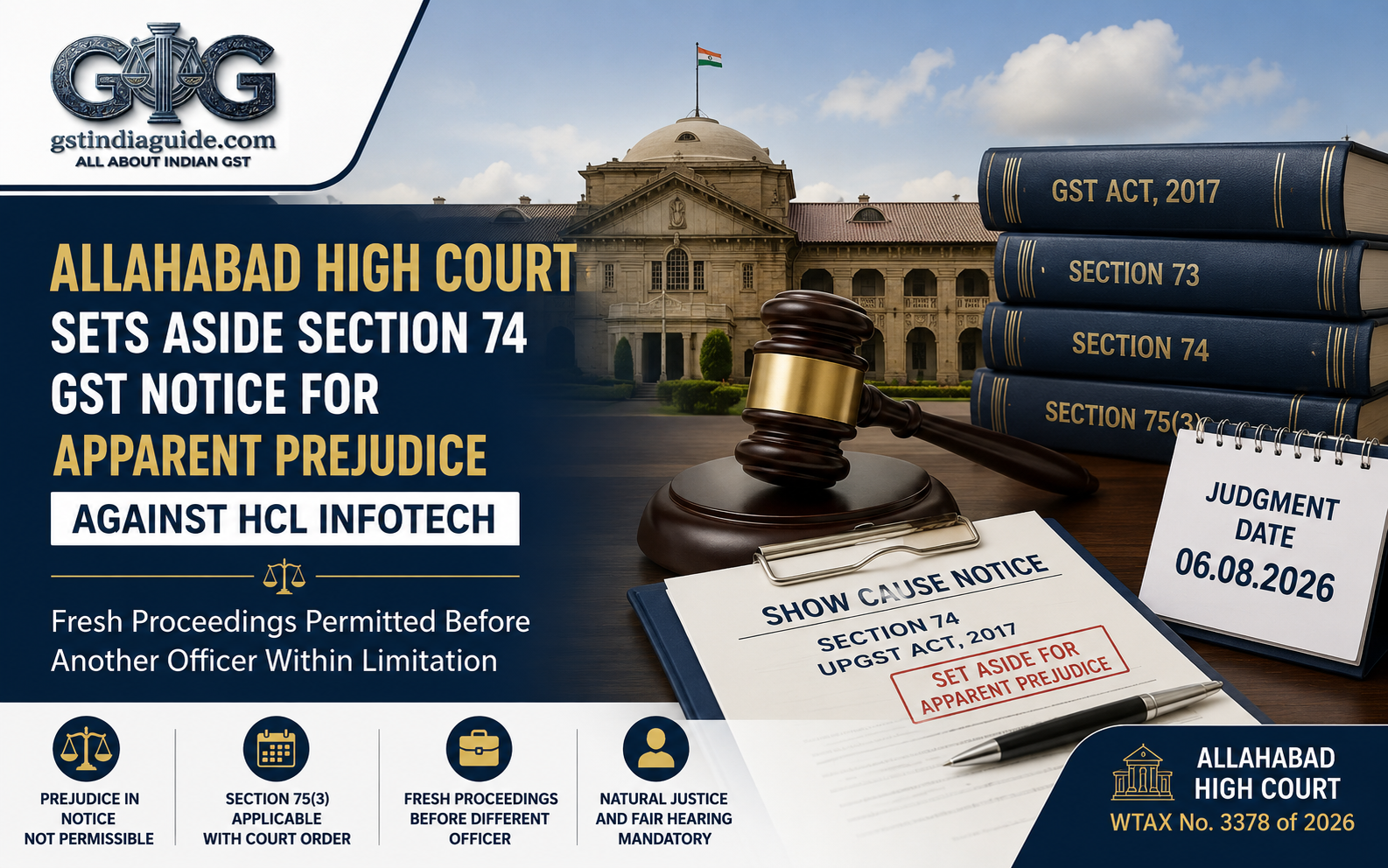
The Allahabad High Court, in Hcl Infotech Ltd. v. State of Uttar Pradesh and 2 Others, Writ Tax No. 3378 of 2026, examined the validity of a fresh show cause notice issued under Section 74 of the UPGST Act, 2017 for Financial Year 2017-18. The Court considered questions relating to limitation, the effect of its earlier order permitting fresh proceedings, the distinction between Sections 73 and 74, and whether remarks contained in the fresh notice disclosed prejudice on the part of the adjudicating authority. The judgment was delivered on 6 August 2026.
Background of the Dispute
The proceedings originated with a show cause notice dated 30 September 2023 under Section 73(1), covering issues including input tax credit relating to imports, TRAN-1 credit, zero-rated supplies, unreconciled ITC and reversal of common credit under Rules 42 and 43. That notice was subsequently dropped on 30 December 2023.
Thereafter, another notice dated 3 August 2024 was issued on the issues under Section 74. HCL Infotech challenged that notice before the High Court. In the earlier proceedings, the Court held that invocation of Section 74 requires the notice itself to disclose the foundational ingredients of fraud, wilful misstatement or suppression of facts to evade tax. Since those ingredients were absent, the notice was quashed. However, the Court expressly left it open to the Department to initiate fresh proceedings under Section 74 if those jurisdictional ingredients actually existed.
Fresh Section 74 Notice and Limitation
A fresh show cause notice was subsequently issued on 22 July 2026. HCL Infotech contended that the statutory period for issuing the notice had already expired and that Section 75(3) could not be relied upon to extend limitation for issuance of a fresh show cause notice.
The High Court rejected that contention in the peculiar factual context of the case. It noted that its earlier order dated 27 September 2024 had attained finality and had specifically permitted the Revenue to initiate fresh proceedings under Section 74, subject to the existence of the necessary jurisdictional facts.
Referring to Section 75(3), which provides a two-year period for issuing an order pursuant to a direction of an appellate authority, tribunal or court, the Court held that its earlier positive direction had to be given meaningful effect. Accordingly, compliance undertaken within two years from communication of the earlier High Court order could not be treated as barred merely by adopting a strict reading confined to the word “order” in Section 75(3).
The judgment therefore clarifies that where a prior writ order expressly grants liberty to commence fresh Section 74 proceedings, and that order has attained finality, the taxpayer cannot subsequently seek to nullify that liberty by advancing a limitation interpretation inconsistent with the operative judicial direction.
Sections 73 and 74 Operate in Different Fields
The Court also referred to its earlier findings that Sections 73 and 74 of the GST law operate in different factual fields. Section 73 deals with cases other than those involving fraud, wilful misstatement or suppression of facts, whereas Section 74 is attracted where those serious ingredients are present.
The earlier dropping of Section 73 proceedings, therefore, did not by itself prevent the Department from invoking Section 74 where the statutory jurisdictional conditions for Section 74 were independently found to exist. However, those ingredients must be specifically reflected in the show cause notice.
Prejudicial Remarks in Show Cause Notice
The decisive issue in the present writ petition arose from remarks contained in paragraph 3(ग) of the impugned notice. The adjudicating authority had accused HCL Infotech, among other things, of misleading the High Court and acting maliciously while pursuing its earlier writ remedy.
The High Court held that these observations were “clearly out of line” and were neither necessary nor desirable in the context of the adjudication. More importantly, the Court found that their inclusion demonstrated an element of prejudice on the part of the adjudicating authority. The concern became more serious because the alleged prejudice appeared to stem from the fact that the taxpayer had earlier approached the High Court and obtained relief.
Consequently, although the Court did not accept the taxpayer’s broader challenge to the Department’s ability to issue a fresh Section 74 notice, it set aside the impugned notice solely because of the apparent prejudice reflected in it.
Matter Remitted to a Different Officer
The Court directed the Additional Commissioner (Grade 1), State Tax, Gautam Budh Nagar to assign the matter to an officer other than the officer who had issued the impugned notice. The newly assigned officer was required to consider the matter neutrally and independently.
A fresh notice under Section 74, if jurisdictional facts existed, was permitted to be issued within two weeks. HCL Infotech was to receive four weeks to file its response. The Court also provided directions regarding supply of relied-upon and other requested documents, grant of adequate advance notice for personal hearing, and passing of a reasoned and speaking order.
Considering the approaching limitation period, the High Court further directed that the proceedings be concluded expeditiously, preferably without unnecessary adjournments, and by 31 December 2026.
Key Legal Takeaway
The judgment highlights two important principles in GST adjudication. First, where a High Court has expressly permitted fresh Section 74 proceedings and that order has attained finality, the Revenue may act upon that judicial liberty subject to the existence of the jurisdictional ingredients required by Section 74. Secondly, even where proceedings are otherwise legally permissible, the adjudicating authority must act with demonstrable neutrality. A show cause notice containing remarks revealing preconceived hostility or prejudice against a taxpayer can itself undermine the fairness of the adjudication and justify judicial interference.
The decision is particularly relevant to GST proceedings involving Sections 73, 74 and 75(3), limitation following remand or judicial directions, jurisdictional requirements relating to fraud or suppression, and the fundamental requirement of an unbiased adjudicating authority.