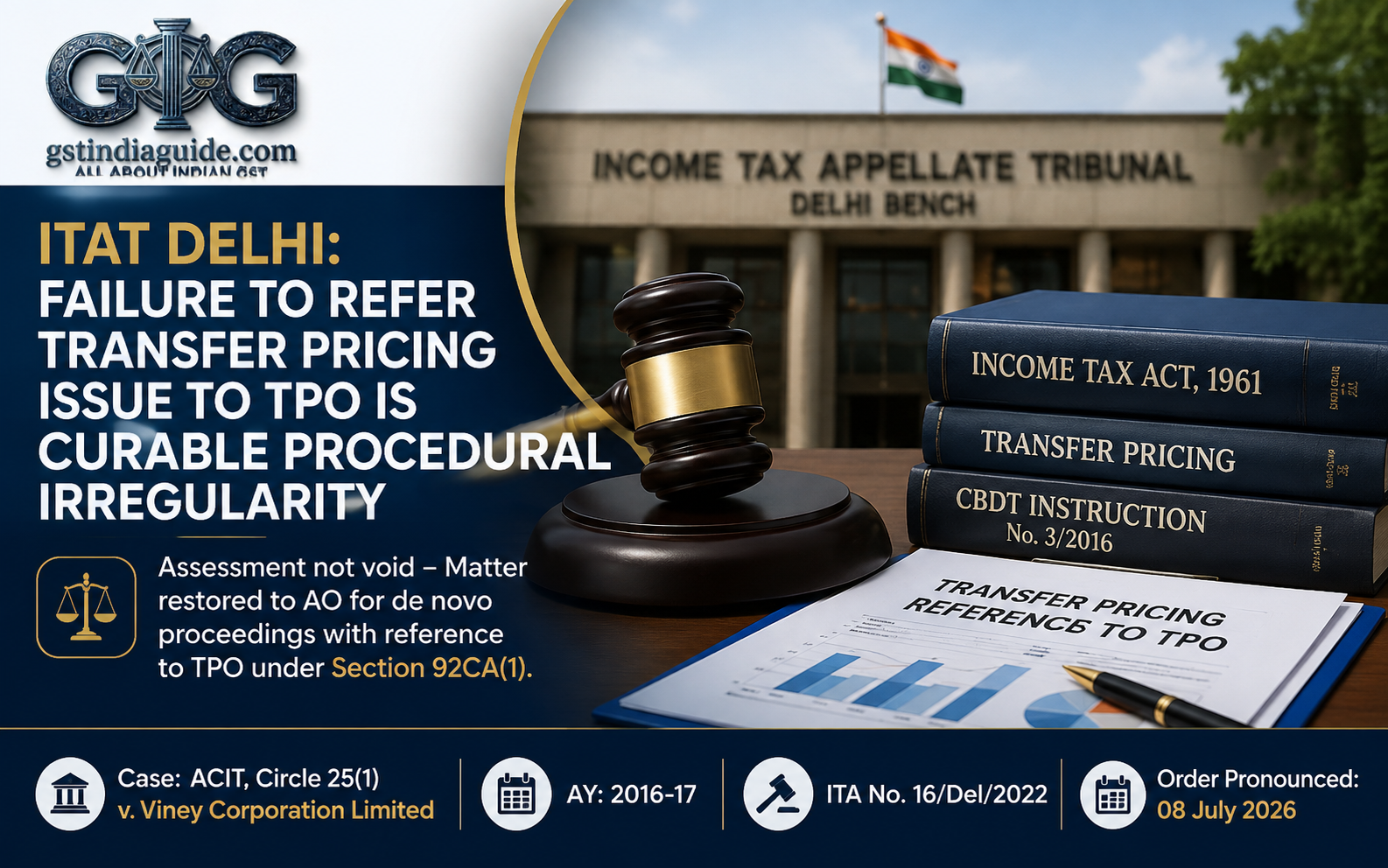
Viney Corporation Limited, engaged in the manufacture of auto components, filed its return of income for Assessment Year 2016-17 declaring income of ₹25.10 crore. The case was selected for complete scrutiny and an assessment under Section 143(3) of the Income-tax Act, 1961 was completed on 31 December 2018.
During the relevant year, the assessee reported specified domestic transactions aggregating ₹41.52 crore. Instead of referring those transactions to the Transfer Pricing Officer for determination of the arm’s length price, the Assessing Officer relied on the transfer-pricing adjustment made for the immediately preceding assessment year and applied the same proportion of 3.6%, resulting in a transfer-pricing adjustment of ₹1.49 crore.
The Assessing Officer did not make a reference to the TPO under Section 92CA(1) and also did not issue a draft assessment order under Section 144C before completing the assessment.
Proceedings Before the CIT(A)
The assessee challenged the validity of the assessment on the ground that the Assessing Officer could not himself determine the arm’s length price when no reference had been made to the TPO.
The CIT(A), relying upon CBDT Instruction No. 3/2016 dated 10 March 2016 and judicial precedents including Control Risk India Private Limited v. DCIT, held that the Assessing Officer was not permitted to undertake the transfer-pricing determination himself where the matter had not been referred to the TPO.
The CIT(A) further observed that the Assessing Officer had completed the assessment without issuing the draft assessment order contemplated under Section 144C(1). Consequently, the assessment order was held invalid and was quashed.
The Revenue carried the matter in appeal before the ITAT.
Issue Before the ITAT
The principal issue before the Tribunal was whether the Assessing Officer’s failure to refer the specified domestic transactions to the TPO before making the transfer-pricing adjustment rendered the assessment order void and invalid, or whether such failure constituted a procedural irregularity capable of being cured by restoring the matter for fresh assessment.
ITAT’s Findings
The ITAT observed that the Assessing Officer had made a transfer-pricing adjustment by adopting the adjustment determined by the TPO for the immediately preceding assessment year and applying it proportionately to the specified domestic transactions of ₹41.52 crore reported in Assessment Year 2016-17.
The Tribunal held that the Assessing Officer ought to have referred the matter to the TPO for computation of the arm’s length price instead of determining the ALP and making the transfer-pricing adjustment himself.
The Tribunal examined clauses 3.3 and 3.7 of CBDT Instruction No. 3/2016. Clause 3.7 specifically provides that even though an Assessing Officer has powers under Section 92C, determination of the arm’s length price should not be undertaken by the Assessing Officer in a case where no reference is made to the TPO.
However, after reading the relevant provisions and CBDT instructions together, the ITAT held that the Assessing Officer’s failure did not amount to an incurable illegality. Rather, it amounted to a procedural irregularity.
Procedural Irregularity Does Not Require Assessment to Be Quashed
The Tribunal placed reliance on the Supreme Court decision in PCIT v. S.G. Asia Holdings (India) Private Limited, where the matter had been restored to the Assessing Officer so that an appropriate reference could be made to the TPO in terms of Section 92CA(1).
Following the Supreme Court’s ruling, the ITAT concluded that the appropriate course was not to annul the entire assessment but to restore the proceedings to the Assessing Officer so that the transfer-pricing procedure could be undertaken in accordance with law.
The Tribunal accordingly set aside both the CIT(A)’s appellate order dated 10 August 2020 and the assessment order dated 31 December 2018 and restored the matter to the Assessing Officer for de novo assessment.
Effect of Dismissal of SLP in Control Risk India
The assessee relied upon the Delhi High Court judgment in Control Risk India Private Limited, pointing out that the Revenue’s Special Leave Petition against that decision had been dismissed by the Supreme Court.
The ITAT, however, observed that the SLP had been dismissed in limine without deciding the issue on merits. Referring to the Supreme Court decision in Kunhayammed v. State of Kerala, the Tribunal held that the Delhi High Court judgment had therefore not merged with the Supreme Court’s order dismissing the SLP.
Accordingly, the Tribunal treated the Supreme Court ruling in S.G. Asia Holdings (India) Private Limited as the binding precedent governing the controversy.
Other Additions Also Restored for Fresh Consideration
Apart from the transfer-pricing issue, the Revenue had challenged the CIT(A)’s deletion of several other additions, including:
- ₹2.94 crore relating to deduction under Section 35(2AB) for R&D expenditure;
- ₹20.18 crore relating to sundry creditors under Section 41;
- ₹10.31 lakh disallowance under Section 14A read with Rule 8D; and
- ₹5.22 crore relating to deductions claimed under Sections 80IB and 80IC.
Since the assessment itself was restored for de novo consideration, the Tribunal did not adjudicate these issues on merits at that stage. These grounds were also restored to the Assessing Officer for fresh adjudication in accordance with law after giving the assessee proper and adequate opportunity of hearing.
The assessee was permitted to produce the necessary evidence, documents and contentions before the Assessing Officer and TPO during the fresh proceedings.
Verdict
The ITAT partly allowed the Revenue’s appeal for statistical purposes.
It held that although the Assessing Officer should have referred the specified domestic transactions to the TPO before determining the arm’s length price, failure to do so constituted a procedural irregularity rather than an incurable illegality.
The order of the CIT(A) quashing the assessment and the original assessment order were therefore both set aside. The matter was restored to the Assessing Officer for a de novo assessment, including an appropriate reference to the TPO in accordance with Section 92CA(1).
Ratio
Where the Assessing Officer determines the arm’s length price of specified domestic transactions without making the appropriate reference to the Transfer Pricing Officer, the defect may constitute a procedural irregularity capable of being cured through remand rather than an illegality that necessarily renders the entire assessment void. Following the binding ruling of the Supreme Court in S.G. Asia Holdings (India) Private Limited, the proper course is to restore the matter so that the statutory transfer-pricing procedure can be followed.
Key Takeaway
The decision draws an important distinction between a defect that invalidates an assessment altogether and a procedural lapse that can be rectified through fresh proceedings. Where the Assessing Officer undertakes transfer-pricing determination without the requisite TPO reference, the assessment need not automatically be annulled; the proceedings may instead be restored for compliance with Section 92CA and completion of the assessment in accordance with law.