
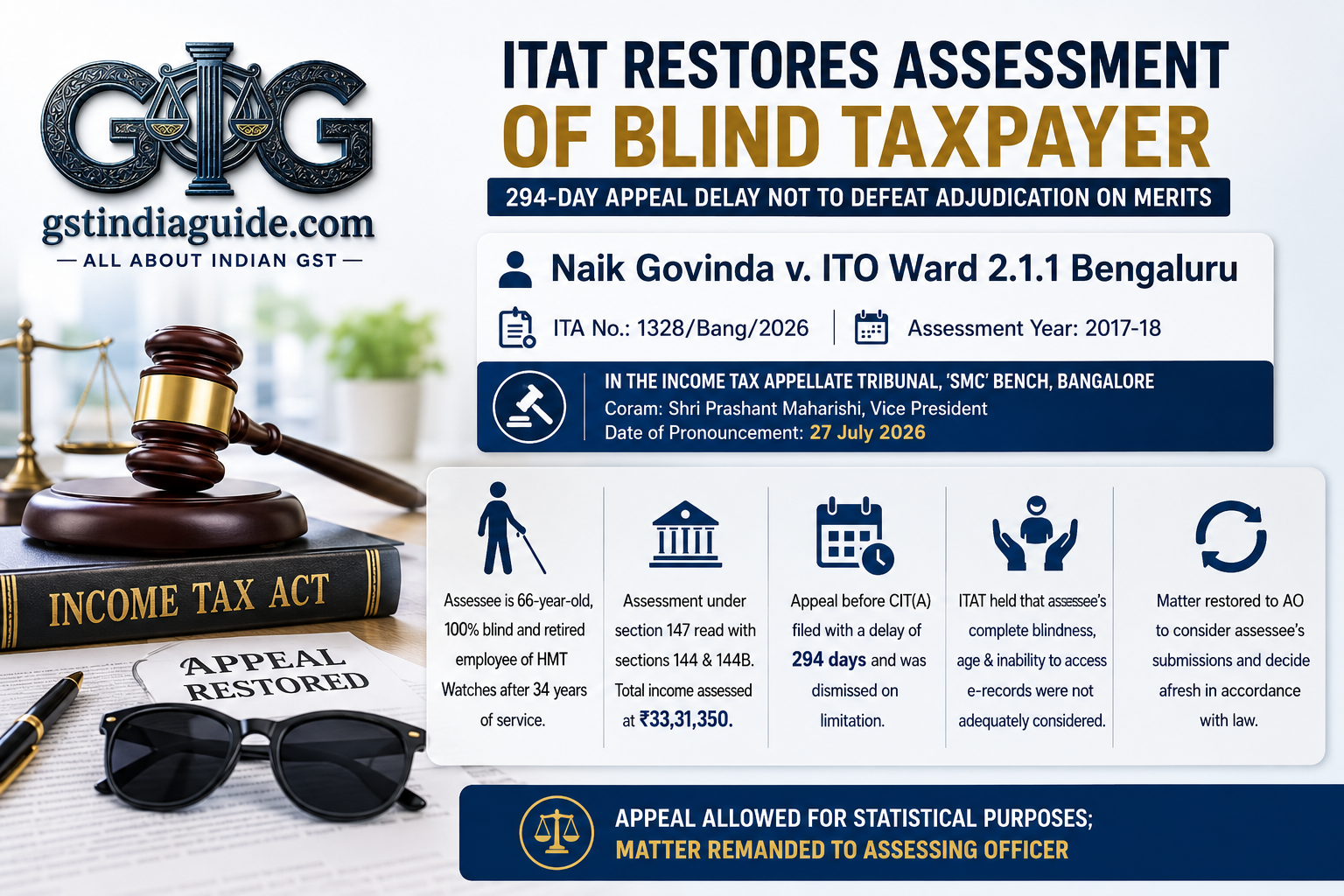
Naik Govinda v. ITO Ward 2.1.1 Bengaluru
Case No.: ITA No. 1328/Bang/2026
Assessment Year: 2017-18
Tribunal: Income Tax Appellate Tribunal, ‘SMC’ Bench, Bangalore
Coram: Shri Prashant Maharishi, Vice President
Date of Hearing: 26 May 2026
Date of Pronouncement: 27 July 2026
Background of the Case
The assessee, Naik Govinda, was a retired employee of HMT Watches Ltd., where he had served for 34 years before opting for voluntary retirement on 30 January 2016. He suffered from complete blindness resulting in 100% permanent disability.
For Assessment Year 2017-18, the assessee did not file a return under Section 139 because he was under a bona fide belief that his income was below the basic exemption limit. The Income Tax Department subsequently received information regarding cash deposits of ₹27,06,760 with State Bank of Mysore, a fixed deposit of ₹46,45,000 with UCO Bank and interest income earned from banks.
Reassessment and Additions
Reassessment proceedings were initiated and notices were issued to the assessee. As no response was received, the Assessing Officer proceeded to complete the assessment under Section 144.
The Assessing Officer treated credits, including cash, aggregating to ₹27,06,760 in the assessee’s State Bank of India account as income under Section 69A and applied the higher rate prescribed under Section 115BBE.
The Assessing Officer also noticed cash deposits of ₹39,54,394 in a cooperative bank account and treated 8% thereof, amounting to ₹3,16,351, as business income. Further additions were made towards bank interest and income-tax refund. The assessment order dated 10 March 2025 under Section 147 read with Sections 144 and 144B determined the total income at ₹33,31,350.
Appeal Dismissed Due to 294-Day Delay
The assessee challenged the assessment before the CIT(A). The assessment order had been received on 10 March 2025, whereas the appeal was filed on 27 January 2026, resulting in a delay of 294 days.
In seeking condonation, the assessee explained that he was a retired salaried employee, was completely blind, was of advanced age and faced serious health constraints. Because of these circumstances, he could not independently access electronic communications or monitor faceless proceedings on the Income Tax portal.
The CIT(A), however, declined to accept the explanation and dismissed the appeal on limitation.
ITAT Considers the Taxpayer’s Special Circumstances
The Tribunal took note of the fact that the assessee was 66 years old, had served HMT Watches for 34 years and suffered from complete blindness resulting in 100% permanent disability.
The Tribunal also considered the assessee’s explanation concerning the source and movement of funds. During the relevant financial year, fixed deposits aggregating to ₹46,45,000 had been made out of accumulated salary savings and retirement benefits received from HMT Watches Ltd., which were directly credited to his bank account.
According to the facts recorded by the Tribunal, cash had also been withdrawn in connection with the proposed marriage of the assessee’s daughter for purchasing gold, clothing and other marriage-related items. The marriage was cancelled during the same financial year due to unavoidable circumstances, following which the withdrawn cash was redeposited. The marriage was subsequently solemnized on 4 June 2017.
Disability and Inability to Access Electronic Records
A significant aspect considered by the ITAT was the assessee’s inability to independently deal with electronic records and faceless income-tax proceedings because of his complete blindness.
The Tribunal found that the CIT(A)’s order did not adequately take into account the assessee’s physical disability and the consequential inability to access records. It also held that the judicial precedents relied upon by the CIT(A) were distinguishable on the facts of the case.
Matter Restored to the Assessing Officer
Considering the assessee’s age, complete blindness, physical circumstances and the factual explanation concerning the transactions, the ITAT held that the assessment made under Section 144 deserved reconsideration.
The Tribunal therefore restored the entire matter to the Assessing Officer and directed the assessee to furnish the necessary details. The Assessing Officer was directed to consider those submissions in light of the facts and circumstances of the assessee and decide the matter afresh in accordance with law.
Accordingly, the assessee’s appeal was allowed for statistical purposes.
Key Takeaway
The decision demonstrates that while dealing with procedural defaults and delay, the particular circumstances affecting a taxpayer’s ability to participate in faceless and electronic proceedings require proper consideration. In this case, the assessee’s complete blindness, age and inability to access electronic records persuaded the ITAT to restore the best-judgment assessment for fresh consideration rather than allow the matter to conclude solely on procedural grounds.