
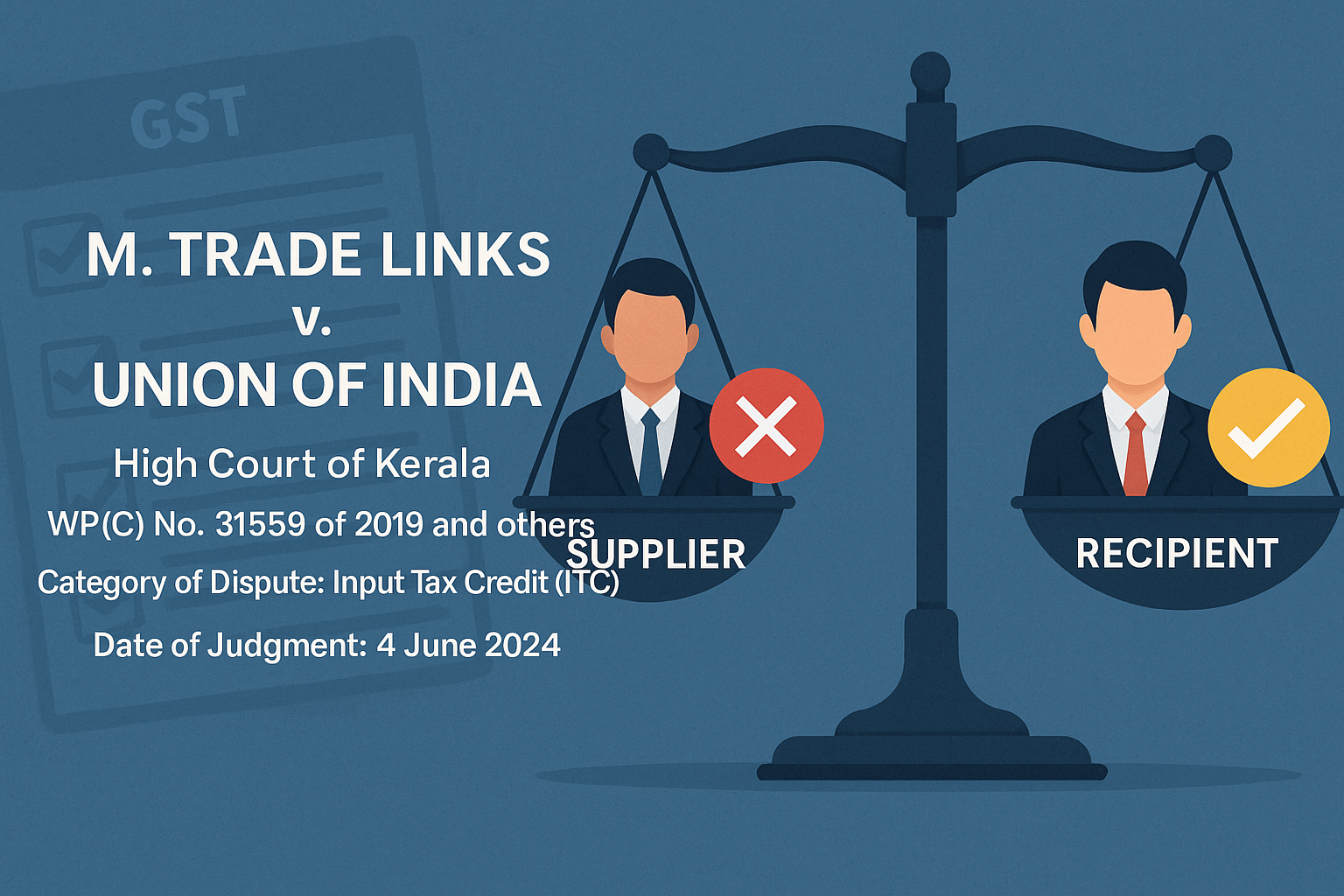
Case Title: M. Trade Links v. Union of India
Court: High Court of Kerala
Petition Nos.: WP(C) Nos. 31559 of 2019 and others
Date of Judgment: 4 June 2024
Relevant Sections: Section 16(2)(c), Section 16(4), CGST Act, 2017 and corresponding SGST provisions
Category of Dispute: Input Tax Credit (ITC)
Takeaway: “When Supplier Defaults, Can Recipient Be Penalized?”
Facts of the Case [Paras 1–40]
- The petitioners challenged the constitutional validity of Sections 16(2)(c) and 16(4) of the CGST/SGST Acts, alleging they violate Articles 14, 19(1)(g), and 300A of the Constitution. [Paras 1–2]
- Petitioners were bona fide purchasers possessing valid tax invoices, proof of payment to suppliers (including GST), and had received goods/services, but were denied ITC due to non-reflection in GSTR-2A or default by suppliers. [Paras 18–20]
- Petitioners argued that law does not compel impossibilities (lex non cogit ad impossibilia), and recipients should not suffer for the supplier’s defaults. [Paras 22–23]
- The provisions were claimed to arbitrarily equate honest taxpayers with fraudulent ones, violating constitutional rights. [Paras 24–26]
- It was submitted that procedural defaults, especially in initial GST years, should not lead to denial of substantial rights such as ITC. [Paras 30–35]
Questions in Consideration [Para 60]
- What are the grounds on which a taxing statute can be held unconstitutional?
- What is the nature of the claim to Input Tax Credit under the GST framework?
- Do Sections 16(2)(c) and 16(4) infringe constitutional provisions?
Observation of the Court [Paras 61–100]
- The Court reaffirmed that ITC is not a fundamental or vested right, but a concession/statutory entitlement subject to conditions. [Para 71]
- ITC is contingent upon tax actually being paid to the government. Without payment by the supplier, credit cannot be passed to the recipient. [Para 81]
- Section 16(2)(c), though strict, was held necessary to maintain the tax chain integrity, particularly in inter-state supplies, where tax collection needs to be reconciled across states. [Paras 82–84]
- Section 16(4)’s time limit is procedural and not arbitrary. Retrospective application of the extended due date (30th November instead of 20th October) from FY 2017–18 to FY 2022–23 was allowed considering initial transitional difficulties. [Paras 100–101]
- Circulars No. 183/15/2022 and 193/05/2023 allow ITC claims in bona fide scenarios. Petitioners were permitted to approach authorities within 30 days to avail these benefits. [Paras 99–101]
Judgment of the Court [Para 101]
- The constitutional validity of Sections 16(2)(c) and 16(4) of the CGST Act is upheld.
- Petitioners who missed claiming ITC due to technical or procedural reasons may still apply for relief under Circulars 183/15/2022 and 193/05/2023 within 30 days.
- The extended deadline of 30th November for September returns is to be applied retrospectively from 1-7-2017.
Between Fine Lines
- ITC is not an unconditional right but a statutory benefit governed by strict conditions.
- The recipient’s claim to ITC fails if the supplier defaults in remitting GST, even if payment is made.
- Procedural compliance (like timely filing of GSTR-3B) is crucial; however, initial year hardships were recognized.
- Circulars offer a window to claim ITC for genuine cases even if technical defaults occurred.
- Section 16(4)’s deadline was retrospectively relaxed from 20th October to 30th November in relevant years.
Summary of Referred Cases
| Case Name | Citation | Summary | Verdict/Usage |
| Godrej & Boyce Mfg. Co. Ltd. v. CST | [1992] 3 SCC 624 | ITC is a concession; legislature can set limitations | Cited to validate conditions under Section 16 |
| VKC Footsteps (India) Pvt. Ltd. v. UOI | [2022] 2 SCC 603 | Refund entitlement subject to statutory limitations | Used to support that ITC is not a fundamental right |
| ALD Automotive v. CTO | [2019] 13 SCC 225 | Extended period for ITC is additional benefit, not a right | Reiterated ITC must follow statutory timelines |
| Jayam & Co. v. Asst. Commissioner | [2016] 15 SCC 125 | Input credit is a concession and not an absolute right | Supported the conditional nature of ITC |
| Union of India v. Bharti Airtel Ltd. | [2022] 89 GST 1 | ITC must be self-assessed based on primary records | Affirmed ITC must be claimed via self-assessment |
| Willowood Chemicals v. UOI | [2018] 98 taxmann.com 100 | Conditions on ITC necessary for budgetary and fiscal discipline | Cited to justify time limits for ITC claims |
| Astha Enterprises v. State of Bihar | [2023] 148 taxmann.com 352 | Payment by supplier is mandatory for ITC | Confirmed Section 16(2)(c) constitutionality |
| Thirumalakonda Plywoods v. ACST | [2023] 152 taxmann.com 640 | Section 16(2) and 16(4) are restrictions, not mutually exclusive | Upheld both provisions’ constitutional validity |
| Gobinda Construction v. UOI | [2023] 154 taxmann.com 311 | ITC entitlement arises only upon satisfaction of statutory conditions | Cited to reject challenge to Section 16(4) |
| Mahalaxmi Cotton Ginning & Pressing | [2012 SCC OnLine Bom 733] | No set-off if tax not actually paid to treasury | Confirmed principle behind Section 16(2)(c) |
| Nahasshukoor v. ACST | [2023] 157 taxmann.com 648 | Restriction in Section 16(2)(c) applies universally | Validated non-discriminatory nature of provision |