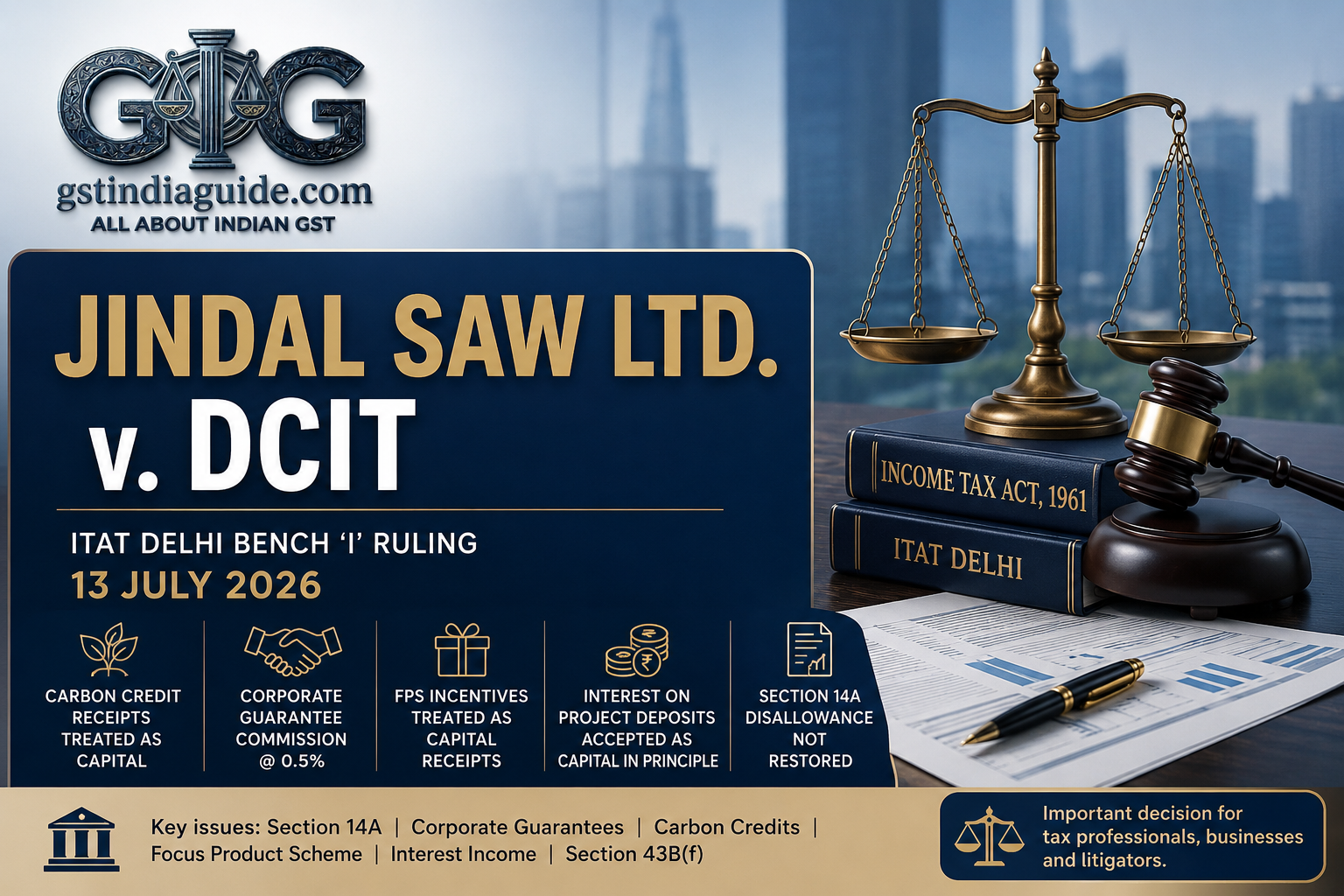
The Income Tax Appellate Tribunal, Delhi Bench “I”, in Jindal Saw Ltd. (formerly known as Saw Pipes Ltd.) v. Deputy Commissioner of Income Tax, examined cross-appeals concerning Assessment Years 2012–13 and 2013–14. The common order was pronounced on 13 July 2026 by Shri Satbeer Singh Godara, Judicial Member, and Shri Manish Agarwal, Accountant Member. The disputes involved disallowance under Section 14A, transfer-pricing adjustment on corporate guarantees, leave-encashment liability, taxation of carbon-credit receipts, incentives received under the Focus Product Scheme and interest earned on deposits connected with a mining project.
Background of the Dispute
The Revenue filed appeals seeking restoration of the Assessing Officer’s disallowance under Section 14A read with Rule 8D and the transfer-pricing adjustment made by applying a corporate-guarantee commission rate of 1.30 per cent. The assessee, through its cross-appeals, challenged the disallowance of the provision for leave encashment, the treatment of carbon-credit receipts as revenue income, the taxation of government grants received under the Focus Product Scheme and the treatment of interest earned on deposits as income from other sources.
Section 14A Disallowance Not Restored
For Assessment Year 2012–13, the assessee had earned exempt income of ₹16,685, whereas no exempt income was earned during Assessment Year 2013–14. The assessee had already made suo motu disallowances of ₹7,10,318 and ₹7,18,726, respectively.
The Tribunal observed that the voluntary disallowance exceeded the exempt income earned by the assessee. It therefore found no basis to restore the further disallowance made by the Assessing Officer under Section 14A read with Rule 8D. The Revenue’s ground on this issue was rejected.
Corporate-Guarantee Commission Restricted to 0.5 Per Cent
The Transfer Pricing Officer had determined the arm’s-length commission on corporate guarantees provided to overseas associated enterprises at 1.30 per cent. The Commissioner of Income Tax (Appeals), relying upon the decision in CIT v. Everest Kanto Cylinder Ltd., restricted the adjustment to 0.5 per cent.
The Tribunal upheld the decision of the appellate authority and held that the corporate-guarantee commission should be computed at 0.5 per cent. The Revenue’s appeals challenging this rate were consequently dismissed.
Leave-Encashment Provision Allowable Only on Payment
The assessee claimed deduction for the provision made towards accrued leave-encashment liability. The Tribunal rejected the claim by relying upon the Supreme Court’s decision in Union of India v. Exide Industries Ltd., which upheld the constitutional validity of Section 43B(f).
The Tribunal also referred to earlier orders passed in the assessee’s own case and held that the leave-encashment liability could be allowed only in the year of actual payment.
Carbon-Credit Receipts Held to Be Capital in Nature
An important issue before the Tribunal was whether receipts generated from the sale or transfer of carbon credits constituted taxable revenue income. The assessee also sought exclusion of such receipts while computing book profit under Section 115JB.
The Tribunal relied upon CIT v. My Home Power Ltd. and noted that Section 115BBG, which specifically provides for taxation of income from the transfer of carbon credits, was introduced prospectively with effect from 1 April 2017. Since the relevant assessment years were 2012–13 and 2013–14, the Tribunal held that the carbon-credit receipts were capital receipts and were not taxable.
It further directed that these receipts should be excluded from the computation of book profit under Section 115JB.
Focus Product Scheme Incentives Treated as Capital Receipts
The assessee raised an additional ground claiming that government grants received under the Focus Product Scheme formed part of its capital receipts and should also be excluded from the computation under Section 115JB.
The Tribunal referred to its earlier order in the assessee’s own case and examined the objective of the Focus Product Scheme under the Foreign Trade Policy. It observed that the scheme was intended to promote exports, expand employment opportunities and support industrial growth, particularly in rural and semi-urban areas.
Applying the purpose test, the Tribunal accepted the assessee’s claim and directed the Assessing Officer to treat the grants received under the Focus Product Scheme as capital receipts. The amounts were also directed to be excluded from the computation of book profit under Section 115JB.
Interest on Project-Linked Deposit Accepted as Capital in Principle
The assessee had earned interest of ₹50.63 lakh on deposits made in connection with a mining project. According to the assessee, the deposits represented security or “keenness money” required to be maintained with the Government of Rajasthan as a precondition for undertaking mining operations.
The lower authorities had treated the interest as income from other sources. The Tribunal distinguished the case from situations in which surplus business funds are independently invested to earn interest. It observed that the deposit was claimed to have been made as a compulsory surety for commencement of the mining project.
Relying upon the Supreme Court’s decision in CIT v. Bokaro Steel Ltd., the Tribunal accepted the assessee’s claim in principle. However, since the Revenue contended that the relevant supporting documents had not been produced, the Assessing Officer was directed to complete the consequential computation after verifying the documentary evidence.
Final Outcome
The Revenue’s appeals in ITA Nos. 2383 and 2384/Del/2018 were dismissed. The assessee’s appeals in ITA Nos. 2747 and 2748/Del/2018 were partly allowed. The assessee’s separate appeal in ITA No. 463/Del/2019, involving a duplicate claim concerning the same interest income, was dismissed.
The ruling is significant for its treatment of pre-2017 carbon-credit receipts and Focus Product Scheme incentives as capital receipts, its confirmation of a 0.5 per cent arm’s-length corporate-guarantee commission and its distinction between interest earned from surplus funds and interest arising from deposits intrinsically connected with the establishment of a project.
Why Read This Judgment?
The decision is relevant for advocates, Chartered Accountants, tax consultants, corporate tax teams, exporters and businesses dealing with transfer pricing, carbon credits, government incentives and project-related interest income. It explains the application of the purpose test to government subsidies, the tax treatment of carbon-credit receipts before the introduction of Section 115BBG and the importance of establishing a direct connection between deposits and project implementation.