
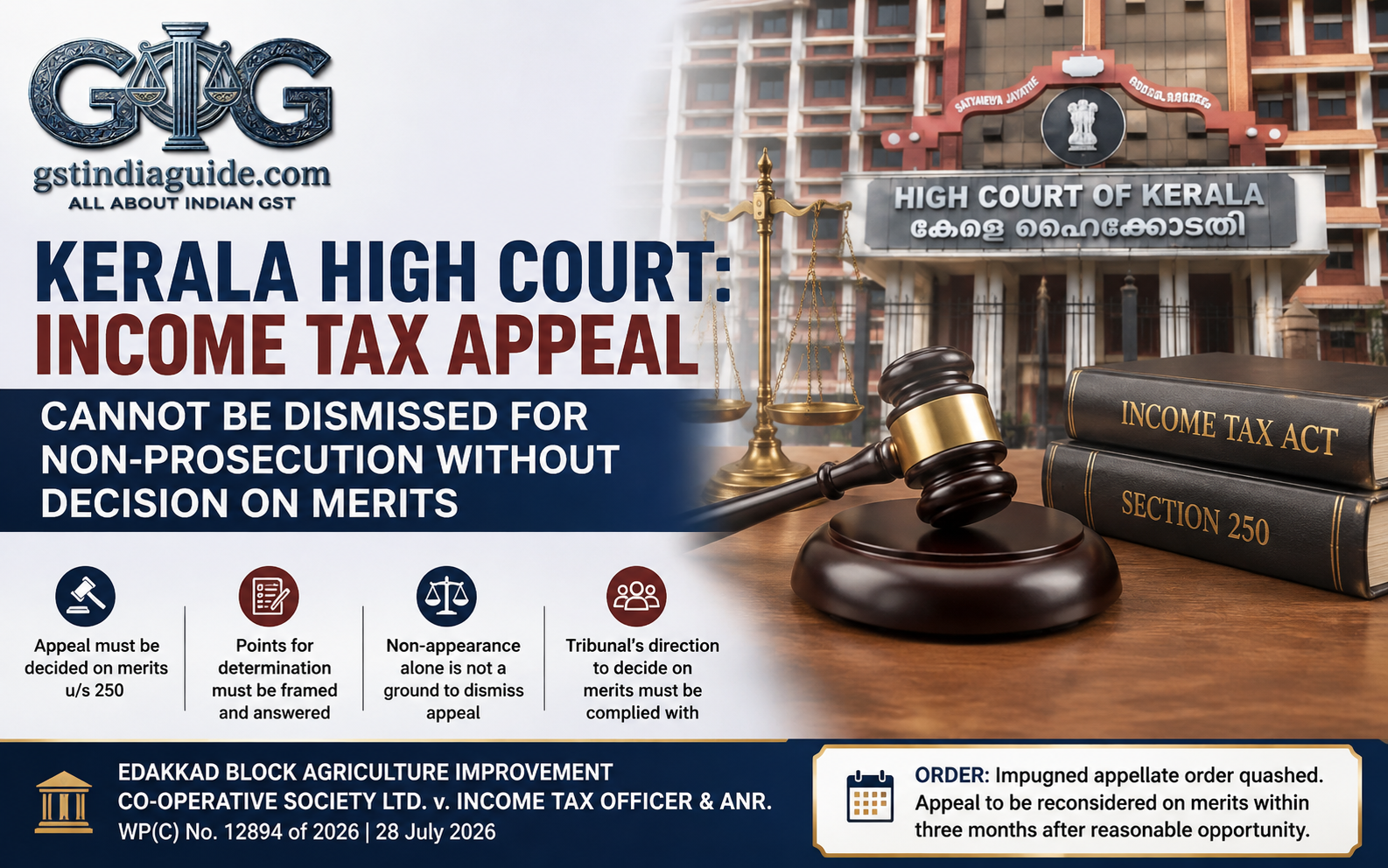
The Kerala High Court has held that a first appellate authority under the Income Tax Act, 1961 cannot dismiss an appeal merely because the assessee failed to appear for hearing or failed to file written submissions. The appellate authority is statutorily required under Section 250 of the Income Tax Act to determine the points arising in the appeal and decide them on merits by recording reasons.
The ruling was delivered in Edakkad Block Agriculture Improvement Co-operative Society Ltd. v. Income Tax Officer & Anr., WP(C) No. 12894 of 2026, decided by the Kerala High Court on 28 July 2026. The judgment was delivered by Justice Ziyad Rahman A.A. and bears the neutral citation 2026:KER:57371.
Background of the Case
The petitioner, Edakkad Block Agriculture Improvement Co-operative Society Ltd., is a co-operative society and an assessee under the Income Tax Act. The dispute arose from an assessment concerning Assessment Year 2017-18.
The assessee’s first appeal against the assessment order had initially been dismissed by the appellate authority on 11 June 2024 because the petitioner did not appear when the matter was taken up for hearing. The assessee thereafter approached the Income Tax Appellate Tribunal.
The Tribunal held that the first appellate authority could not dismiss an appeal merely for non-prosecution and was required to dispose of it on merits even when proceeding ex parte. The earlier appellate order was accordingly set aside and the matter was remanded for a fresh decision on merits after providing a reasonable opportunity of hearing.
Despite this direction, the first appellate authority again dismissed the appeal without examining the merits of the grounds raised by the assessee. The petitioner therefore approached the Kerala High Court.
Section 250 Requires a Reasoned Decision on Merits
The High Court examined the statutory obligation imposed upon the appellate authority under Section 250 of the Income Tax Act.
The Court observed that Section 250 requires the appellate authority to frame the points for determination and decide those points with specific reasons supporting its conclusions. Consequently, the statutory provision does not permit the first appellate authority to dismiss an appeal solely because the appellant failed to appear or did not submit written arguments.
The Court found that the impugned appellate order contained no discussion on the merits of the case. This omission was particularly significant because the Income Tax Appellate Tribunal had already specifically directed the appellate authority to reconsider and decide the appeal on merits.
Repeated Non-Appearance Does Not Remove Statutory Duty
The Income Tax Department argued that several opportunities had been granted to the petitioner and that the assessee had repeatedly failed to appear before the appellate authority.
The petitioner explained that the non-appearance occurred because of the medical condition of the Chartered Accountant engaged to represent it.
The High Court, however, held that the crucial question was not merely whether sufficient opportunities had been granted. The relevant issue was whether the appellate order complied with the statutory requirements prescribed under Section 250. Since the order did not formulate or decide the points arising in appeal on merits, the statutory requirements were not fulfilled.
Kerala High Court Relies on Earlier Judicial Principles
The Court referred to Anandan N. v. Commissioner of Income-tax (Appeals), [2025] 175 taxmann.com 408 (Ker.), where it had been held that an appellate order which does not formulate points for determination and decide those points on merits is legally unsustainable.
The judgment also records that the Income Tax Appellate Tribunal had relied upon the Bombay High Court’s decision in PCIT v. Premkumar Arjundas Luthra, [279 CTR 614], while earlier setting aside the dismissal of the assessee’s appeal for non-prosecution.
High Court Quashes Appellate Order
The Kerala High Court concluded that the appellate authority could not have disposed of the appeal without considering its merits, particularly after the Tribunal had expressly directed it to undertake a fresh merits-based adjudication.
Accordingly, the Court quashed the impugned appellate order and directed the Commissioner of Income Tax (Appeals), National Faceless Appeal Centre, to reconsider the appeal after providing the petitioner with a reasonable opportunity of hearing.
The reconsideration was directed to be completed within three months from the date of receipt of a copy of the judgment.
Key Takeaway
The judgment reinforces that an Income Tax first appeal is not liable to be rejected merely for non-appearance or failure to file written submissions. Even where an assessee does not participate in the proceedings, the appellate authority must comply with Section 250 by identifying the points for determination, examining the appeal on merits and recording reasons for its conclusions. An appellate order that merely dismisses an appeal for non-prosecution without addressing the merits is legally unsustainable.