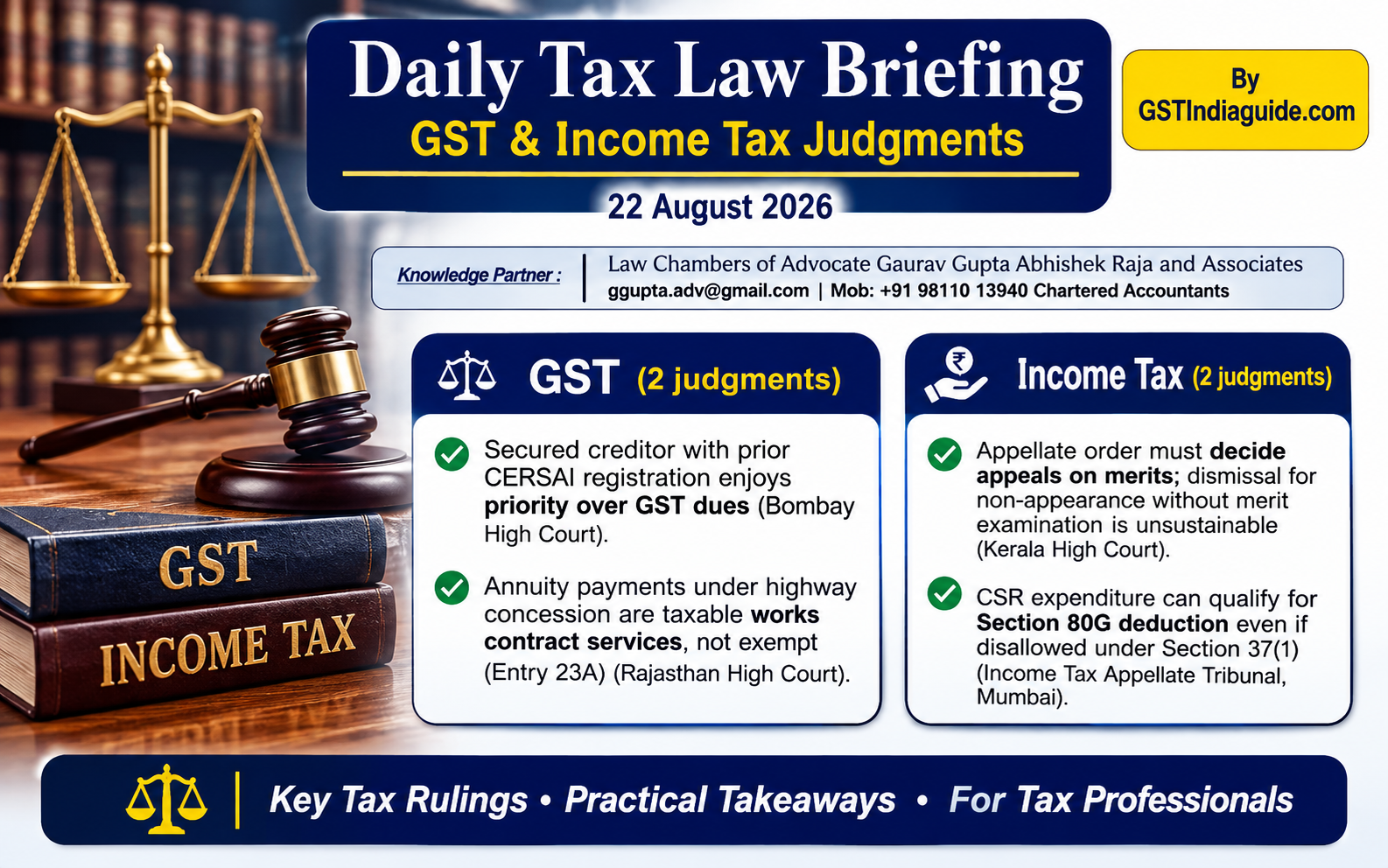
Daily Tax Law Briefing – GST & Income Tax | 22 August 2026
Goods & Services Tax (GST) (2 judgments)
| TITLE | BRIEF FACTS | RATIO |
| Bharat Co Operative Bank Mumbai Ltd v. Deputy Commissioner Of State Tax Mulund
Writ Petition (L) No. 172 of 2026, with Writ Petition (L) No. 446 of 2026
Bombay High Court
|
Bharat Co Operative Bank Mumbai Ltd challenged demand notices, a prohibitory order and communications issued by State tax authorities asserting priority over secured properties. The Bank’s security interests had been registered with CERSAI in 2015, 2016 and 2018, prior to the impugned tax actions. W.P.(L) 172/2026 concerned GST dues, while W.P.(L) 446/2026 concerned MVAT dues. The Bank relied upon the Full Bench decision in Jalgaon Janta Sahakari Bank Ltd. v. Joint Commissioner of Sales Tax. | The Court held that a secured creditor having prior CERSAI registration enjoys priority under Section 26E of the SARFAESI Act over all other dues, including revenue, taxes, cesses and rates payable to the Central or State Government or local authorities. It rejected the State’s contention that the Full Bench ruling was inapplicable to GST dues merely because GST involves central legislation. Since the Bank’s CERSAI registrations preceded the tax authorities’ claims, its secured dues had priority. The Court also advised departments to issue an SOP to prevent such demands where prior CERSAI security exists. Both Writ Petitions Allowed. |
| M/s Nagaur Mukundgarh Highways Pvt. Ltd. v. Central Board Of Indirect Taxes And Customs & Ors.
D.B. Civil Writ Petition No. 10055/2024, connected with D.B. Civil Writ Petition Nos. 10057/2024, 10058/2024, 10062/2024 and 10067/2024
Rajasthan High Court
|
The petitioner, a highway concessionaire, challenged CBIC Circular No. 150/06/2021-GST dated 17.06.2021, show cause notice dated 09.12.2022 and recovery order dated 07.07.2023 concerning GST on annuity payments received under its concession agreement with NHAI. It relied upon Entry 23A of Notification No. 12/2017-Central Tax (Rate) and an advance ruling dated 12.02.2019 which had held the relevant service exempt. The concession agreement provided for 50% project cost during construction and the balance through biannual annuity payments. | The Court held that the concession agreement essentially involved construction, design and maintenance of roads and constituted taxable works contract services, rather than merely providing access to a road or bridge. Entry 23A of Notification No. 12/2017-Central Tax (Rate), relating to Heading 9967, therefore did not exempt the annuity payments arising from construction services. Circular No. 150/06/2021-GST was held to be a valid clarification within CBIC’s authority under Section 168. The earlier advance ruling did not alter taxability determined from the statutory exemption and true nature of services. Writ Petitions Dismissed. |
Income Tax (2 judgments)
| TITLE | BRIEF FACTS | RATIO |
| Edakkad Block Agriculture Improvement Co-operative Society Ltd v. Income Tax Officer & Anr.
WP(C) No. 12894 of 2026
Kerala High Court
|
The petitioner Co-operative Society challenged the appellate order concerning its assessment for AY 2017-18. Its earlier appeal had been dismissed for non-prosecution, but the ITAT set aside that order and directed de novo disposal on merits after reasonable opportunity. On remand, the appellate authority again dismissed the appeal without examining its merits because the petitioner failed to appear and file written submissions. The petitioner contended that such disposal violated the statutory requirements of Section 250 of the Income Tax Act. | The Court held that Section 250 requires the first appellate authority to frame points for determination, decide those points and state reasons for its conclusions. An income-tax appeal cannot be dismissed solely because the appellant failed to appear or submit written submissions; even an ex parte disposal must be on merits. Since the impugned order contained no discussion on merits and also disregarded the ITAT’s specific direction to decide the appeal on merits, it was legally unsustainable. The order was quashed and reconsideration directed within three months after reasonable opportunity of hearing. Matter Remanded. |
| Yoboho New Media Private Limited v. Principal Commissioner of Income Tax, Circle 8(3)(1)
ITA No. 4320/MUM/2025
Income Tax Appellate Tribunal, Mumbai
|
The assessee incurred ₹37,79,570 towards Corporate Social Responsibility expenditure, which was disallowed while computing business income but deduction of ₹26,09,290 was claimed under Section 80G. The assessment was completed under Section 143(3) read with Section 144B. The PCIT considered the Section 80G deduction inadmissible because CSR expenditure was mandatory and held the assessment order erroneous and prejudicial to Revenue under Section 263. The assessee challenged the revisional order before the Tribunal. | The Tribunal held that although CSR expenditure is excluded from deduction under Section 37(1) by Explanation 2, Section 80G contains no corresponding prohibition except for specific statutory exclusions. Where a donation otherwise satisfies Section 80G, deduction cannot be denied merely because it also constitutes CSR expenditure. The Assessing Officer’s acceptance of the claim represented a legally sustainable view and Section 263 could not be invoked merely to substitute the PCIT’s preferred interpretation. The Section 263 order was set aside and the assessment order restored. Appeal Allowed. |