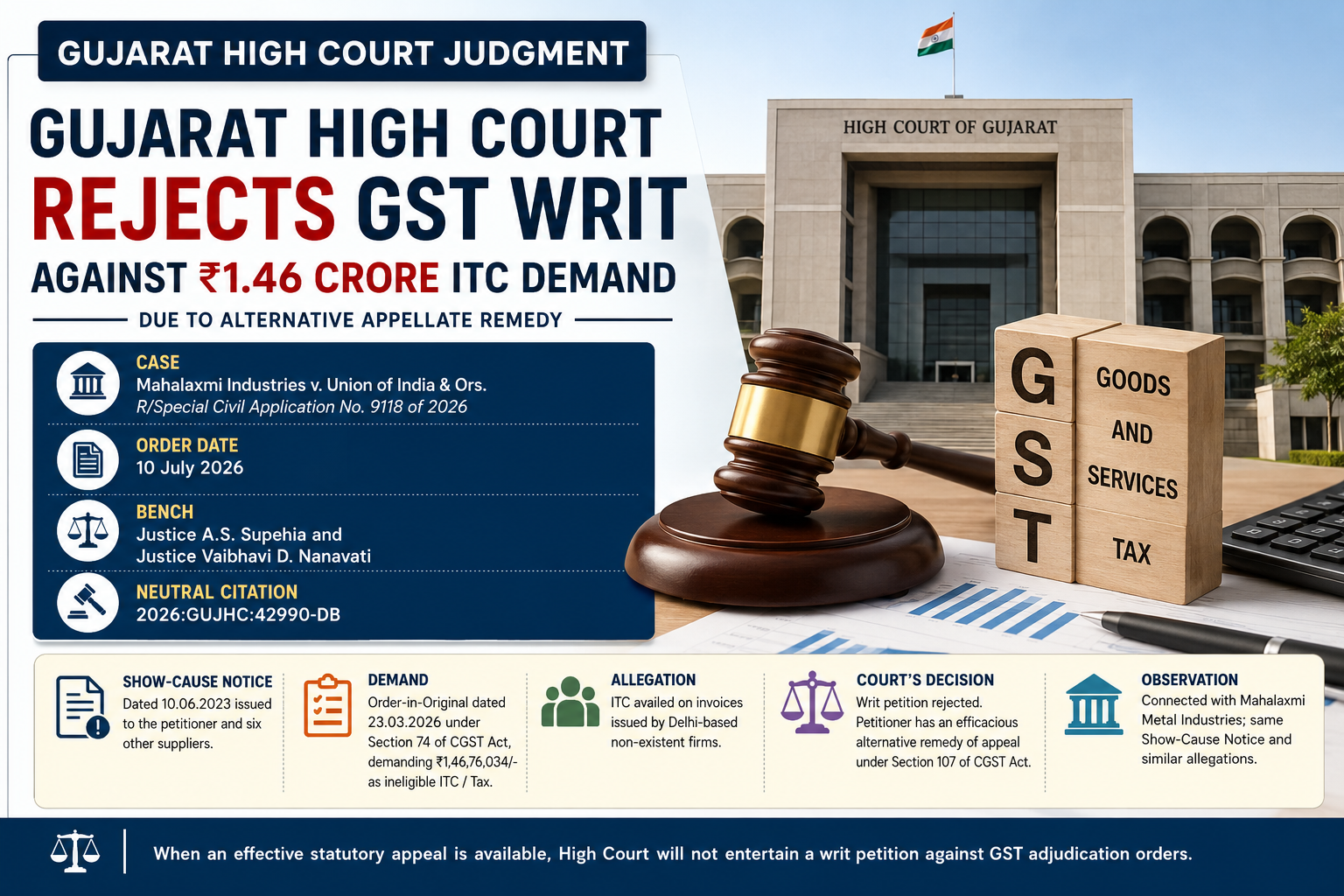
The Gujarat High Court, in Mahalaxmi Industries v. Union of India & Others, declined to entertain a writ petition challenging an Order-in-Original passed under Section 74 of the Central Goods and Services Tax Act, 2017. The Court held that the petitioner had an efficacious statutory remedy of appeal under Section 107 of the CGST Act and, therefore, the dispute should be pursued before the competent Appellate Authority.
The order was passed by a Division Bench comprising Justice A.S. Supehia and Justice Vaibhavi D. Nanavati in R/Special Civil Application No. 9118 of 2026 on 10 July 2026. The judgment bears the neutral citation 2026:GUJHC:42990-DB.
Background of the Dispute
Mahalaxmi Industries challenged an Order-in-Original dated 23 March 2026 passed by the Assistant Commissioner of Central GST, Division-V, Odhav, Ahmedabad South. The adjudication order, issued under Section 74 of the CGST Act, confirmed the recovery of allegedly ineligible input tax credit and tax amounting to ₹1,46,76,034.
The proceedings originated from a common show-cause notice dated 10 June 2023 issued to the petitioner and six other suppliers. The notice proposed proceedings under Sections 74 and 122 of the CGST Act in relation to the alleged availment of input tax credit on invoices issued by Delhi-based firms stated to be non-existent.
Earlier Connected Writ Petition
The Court noted that another entity, Mahalaxmi Metal Industries, had earlier filed Special Civil Application No. 6227 of 2026 against an adjudication order arising from the same show-cause notice. That petition had been withdrawn with liberty to pursue the statutory appellate remedy.
According to the Court, Mahalaxmi Metal Industries and the present petitioner were operating from nearby premises and were allegedly managed by closely related persons. The adjudication proceedings against both entities arose from the same show-cause notice and involved substantially similar allegations concerning input tax credit claimed on invoices issued by non-existing firms.
The Bench also examined the record of the earlier writ petition after a statement was made that the common show-cause notice had neither been referred to nor challenged in that proceeding. On verification, the Court found that the same notice had been placed on record in the earlier petition. It consequently recorded that the statement made before it had misled the Court.
Alternative Remedy Under Section 107
The principal reason for rejecting the petition was the availability of an efficacious statutory appeal under Section 107 of the CGST Act. The petitioner could challenge the findings recorded in the Order-in-Original before the Additional or Joint Commissioner of Appeals.
The Court observed that the factual findings and alleged modus operandi recorded against Mahalaxmi Industries were materially similar to those involved in the connected proceeding filed by Mahalaxmi Metal Industries. Since the earlier petitioner had withdrawn its writ petition to pursue an appeal, the Court found no justification for adopting a different approach in the present case.
Accordingly, the High Court refused to examine the merits of the demand in its writ jurisdiction and rejected the petition.
Legal Principle Emerging from the Decision
The ruling reiterates that a writ petition ordinarily should not be entertained against an adjudication order when the CGST Act provides an effective statutory appellate remedy. Disputed factual issues concerning the genuineness of transactions, eligibility of input tax credit, the existence of suppliers and the evidentiary basis of a Section 74 demand are generally matters to be considered by the Appellate Authority.
The decision also highlights the importance of complete and accurate disclosure before a constitutional court, particularly where connected proceedings involving related entities arise from the same show-cause notice.
Conclusion
The Gujarat High Court rejected the writ petition filed by Mahalaxmi Industries without examining the merits of the alleged wrongful availment of input tax credit. The petitioner was left to challenge the Order-in-Original through the statutory appeal available under Section 107 of the CGST Act.
The ruling is relevant for GST litigants seeking to directly challenge adjudication orders before High Courts, especially where an appellate remedy remains available and the dispute involves contested factual findings.