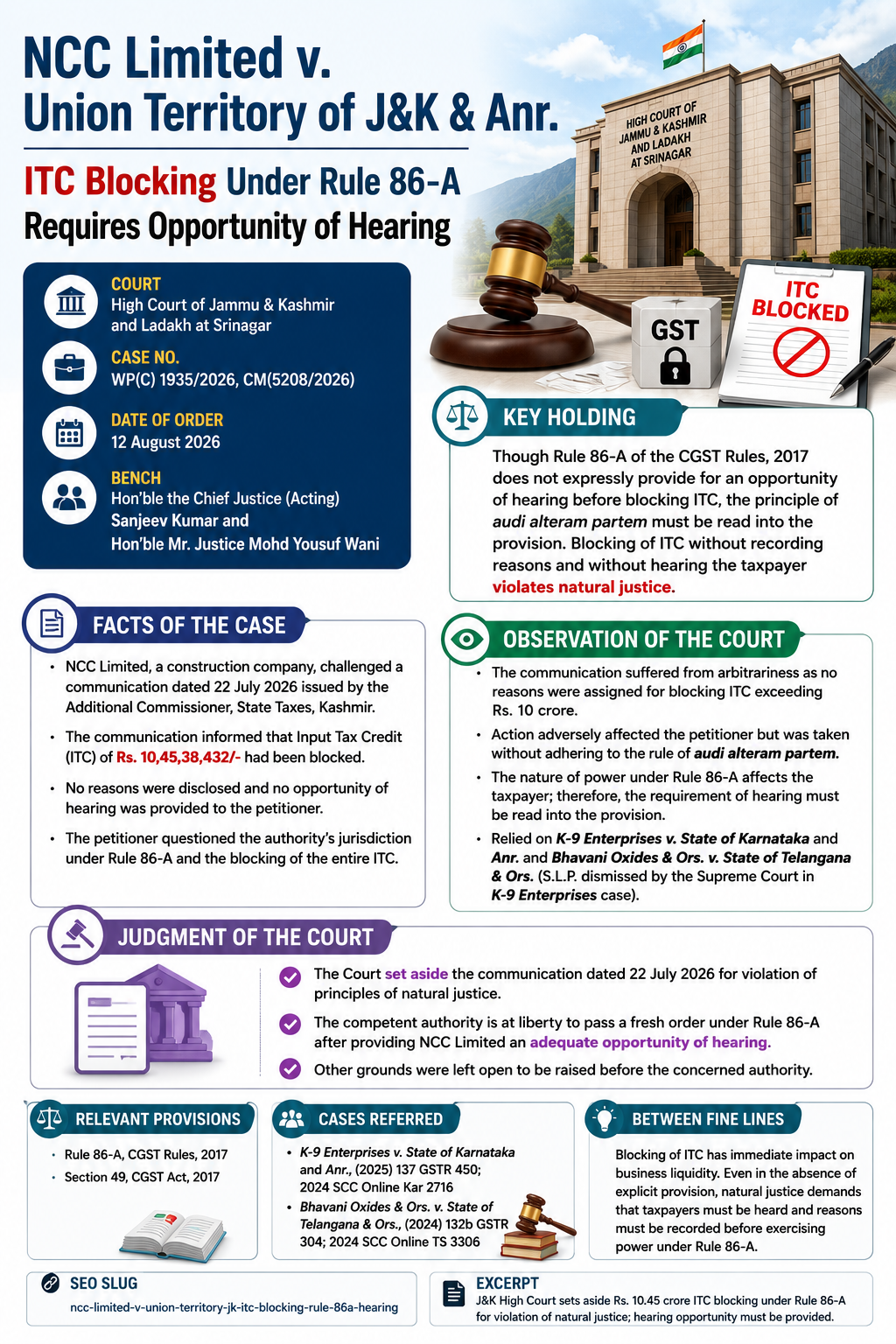
Court: High Court of Jammu & Kashmir and Ladakh at Srinagar
Case No.: WP(C) 1935/2026, CM(5208/2026)
Date of Order: 12 August 2026
Bench: Hon’ble the Chief Justice (Acting) Sanjeev Kumar and Hon’ble Mr. Justice Mohd Yousuf Wani
Category: GST – Blocking of Input Tax Credit
Relevant Provisions: Rule 86-A of the Central Goods and Services Tax Rules, 2017; Section 49 of the Central Goods and Services Tax Act, 2017; Article 226 of the Constitution of India.
Facts of the Case
NCC Limited, a construction company, approached the High Court under Article 226 challenging a communication dated 22 July 2026 issued by the Additional Commissioner, State Taxes, Kashmir, informing it that Input Tax Credit amounting to Rs. 10,45,38,432/- had been blocked. The petitioner contended that the communication disclosed no reasons for blocking the ITC and had been issued without affording it an opportunity of hearing. It also questioned the authority’s jurisdiction under Rule 86-A and contended that the entire ITC could not have been blocked in the manner adopted.
Question in Consideration
Whether Input Tax Credit can be blocked under Rule 86-A of the CGST Rules, 2017 without recording reasons and without providing the taxpayer an opportunity of being heard.
Observation of the Court
The High Court observed that the impugned communication suffered from arbitrariness because the authority had not disclosed any reasons for blocking ITC exceeding Rs. 10 crore. The action materially affected the rights and interests of the petitioner but had been taken without adhering to the principle of audi alteram partem.
The Court specifically held that although Rule 86-A does not expressly provide for an opportunity of hearing before ITC is blocked, the nature of the power exercised under the provision adversely affects the taxpayer. Consequently, the requirement of audi alteram partem must be read into Rule 86-A.
The Court referred to the Division Bench decisions in K-9 Enterprises v. State of Karnataka and Anr. and Bhavani Oxides and Others v. State of Telangana and Ors., noting that the Karnataka High Court decision had also been upheld by the Supreme Court through dismissal of the Special Leave Petition.
Judgment of the Court
The High Court found merit in the petition and set aside the communication dated 22 July 2026 for violation of the principles of natural justice. The Court, however, clarified that the setting aside of the communication would not prevent the competent authority from passing an appropriate fresh order under Rule 86-A of the CGST Rules, 2017 after providing NCC Limited an adequate opportunity of hearing. Other issues raised by the petitioner were left open to be urged before the concerned authority.
Between Fine Lines
The ruling establishes that the absence of an express hearing requirement in Rule 86-A does not exclude the principles of natural justice. Since blocking of ITC has immediate adverse consequences for a taxpayer, an adequate opportunity of hearing must form part of the exercise of power under Rule 86-A. A reasonless communication blocking substantial ITC without such opportunity is vulnerable to being set aside as arbitrary and contrary to audi alteram partem.
Cases Referred
K-9 Enterprises v. State of Karnataka and Anr., (2025) 137 GSTR 450; 2024 SCC Online Kar 2716.
Bhavani Oxides and Others v. State of Telangana and Ors., (2024) 132b GSTR 304; 2024 SCC Online TS 3306.